


 Warhammer Logo PNG
The Warhammer logo is both martial and cosmic. The emblem transports the viewer into a fictional future world where wars rage. It tells a tale of extraordinary empires, technologies, and materials unknown to mankind.
Warhammer began in 1975 in a London flat, when Ian Livingstone, Steve Jackson, and John Peake founded Games Workshop to sell board games. Peake made handmade chess and backgammon sets, Livingstone handled marketing, and Jackson published Owl & Weasel. The business changed after Brian Blume of TSR gave them UK rights for Dungeons & Dragons.
White Dwarf followed in 1977, and the shop opened in Hammersmith in 1978. That year, Bryan Ansell and Games Workshop founded Citadel Miniatures to make 25 mm metal figures. Ansell believed miniatures needed rules and battles, so he brought in Rick Priestley and Richard Halliwell. The project, first called Rune Hammer, was renamed Warhammer to avoid confusion with Chaosium’s RuneQuest.
Warhammer Fantasy Battles appeared in 1983 with a first run of 3,000 copies. The rules were uneven, but the mix of tactics, collecting, modeling, and painting separated it from miniature makers such as Ral Partha. In 1985, Ansell moved Games Workshop to Nottingham and turned White Dwarf into a Warhammer magazine.
In 1987, Priestley created Warhammer 40,000: Rogue Trader, moving the fantasy mood into a science-fiction future. Tom Kirby led a management buyout in 1991, and Games Workshop joined the London Stock Exchange in 1994. Black Library began in 1997, Dawn of War reached PC players in 2004, The Horus Heresy novels started in 2006, Age of Sigmar replaced the fantasy world in 2015, and Amazon Studios joined a screen project with Henry Cavill in 2023.
Meaning and History
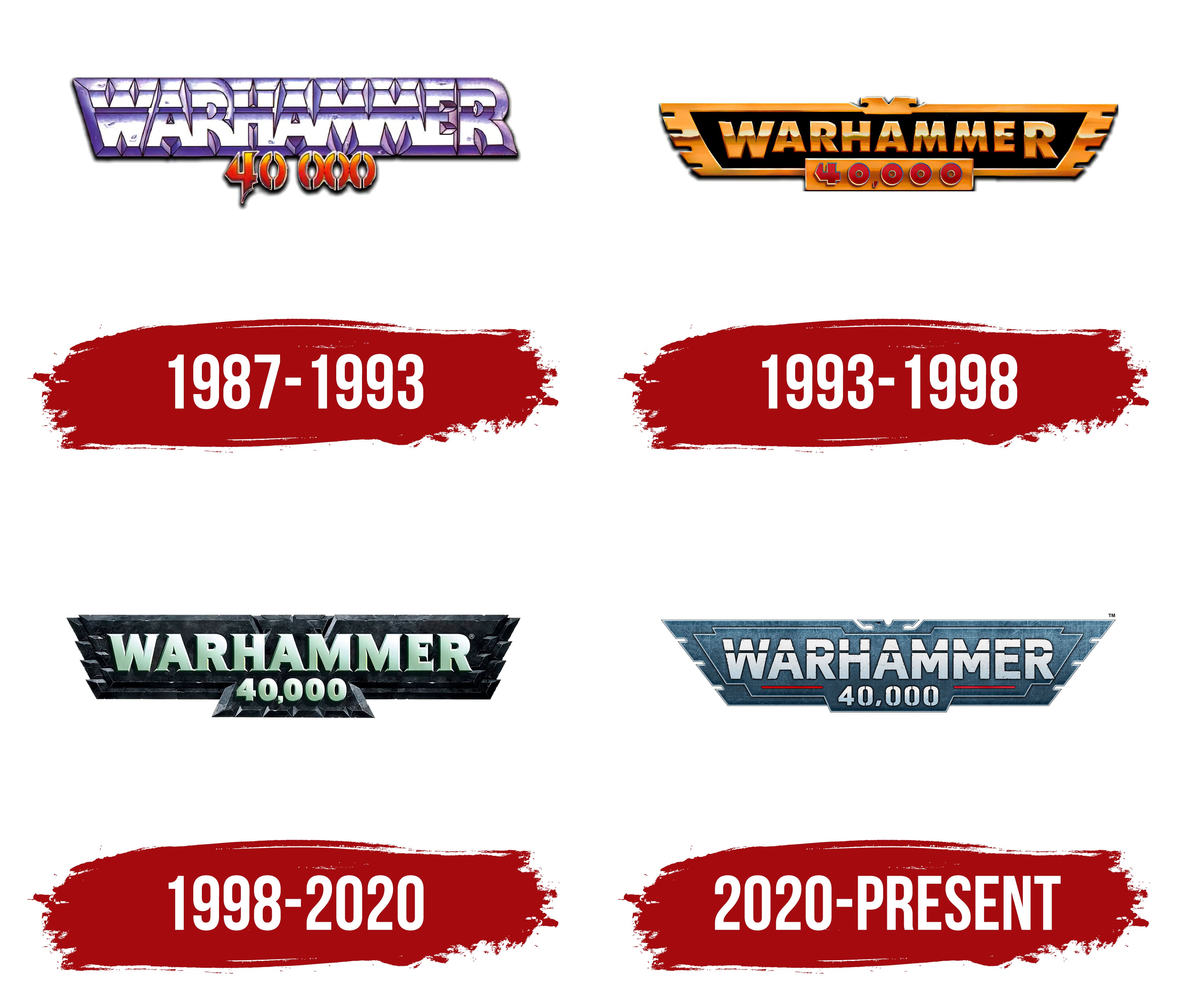
Despite the logo’s appearance in 1987, the game’s history started four years earlier. The first Warhammer was offered by Games Workshop in 1983. However, few remember the initial version nowadays. Fame came to the game precisely in 1987 when a spin-off appeared. It featured the same heroes but living in a different, entirely revamped world. The game’s rebranding was called Warhammer 40000. The version’s logo has changed four times, but always maintained the fantasy flair and bird shape.
What is Warhammer?
A unique board game where entire armies of miniature figures battle. Two players move their figures in turn, determining the outcome of each action by rolling dice or using tables.
1987 – 1993
The first logo is executed as a bas-relief of the name, with its letters bisected by a line into two parts. The symbols, flat at the bottom and protruding from the face, remind one of game pieces standing on flat pedestals on the table.
The game’s name indicates combat action. The addition of “hammer” is more indicative of a significant emphasis on weapons than on axes specifically. The game features infinite rifle variations, such as the lasgun, bolter, and melta, as well as psychological weapons and others. However, blade models are also present in the arsenals, for example, the chain weapon, in the form of a chainsaw cutter or orc hatchets and cleavers.
The word “Warhammer” is associated with ferocious close combat, which the logo conveys.
The line in the center of the letters is like a demarcation between two armies. Each incision in the symbols is made as part of a weapon, thereby enhancing the connection to military themes.
The number 40000, stated below the inscription, has a specific meaning. The game’s history begins on the threshold of the 41st millennium. Therefore, 40 thousand is the age of the Warhammer world with its races.
1993 – 1998
The second edition, with a more detailed set of rules, came out in 1993. The game came in a box with figurines. The symbol of the second generation is the Imperial Eagle. It points to the Imperium – a vast empire uniting the planets of millions of galaxies. It predominates in the Warhammer Universe. Its subjects are human subspecies that have evolved over the past millennia: Ogryns, beastmen, and squats.
The empire is ruled by the emperor, who is worshipped. A bird is depicted on the leader’s armor. The eagle on the logo points to the empire and the emperor, whose life has been artificially sustained for more than 1000 years. The imperial eagle also implies that, in the game, different empires and races battle one another: Tau, Orks, Eldar, Chaos, Necrons, and Tyranids.
The black color inside the bird conveys the idea of space, the galaxy. It points to dark times and constant battling. The orange edging in the shape of an eagle indicates a closed universe, a special world where events take place. The color of the inscription and the outlines hint at the fires of battle.
1998 – 2020
The third edition improved the rules for large battles and detailed the codex system. The version’s emblem seems carved out of stone. The eagle has a double row of feathers, which signifies the battles of two armies. The lower section, where the number 40000 is located, is designed in the shape of a bird’s tail.
The dark color shows the addition of the Dark Eldar army figures to the collection. The coloring matches their black-green clothing.
2020 – today
In 2020, the ninth edition appeared with four new sets. The eagle figure in the updated logo resembles the blade of a double-edged axe, evoking associations with metal, weapons, and war. The red stripe underlining the word Warhammer hints at bloody battles. The logo restores the feature that splits the letters into two parts, returning the sign to its theme of confrontation between the Imperium and other races.
Font and Colors
The blue-green color of the logo resonates with the digital world. It is used for controlling spaceships and weapons. It hints at extraterrestrial materials unknown to modern humanity. Blue-green also speaks of unusual forms of life. Some races, especially those introduced in the game alongside the latest logo, have bodies transformed with metal (Necrons) or are dressed in suits made of super-materials (Chaos Space Marines).
The inscription’s font is strict and bulky, suggesting armor, equipment, and heavy weaponry. If we discount the dividing stripe, the letters resemble the bold symbols of the Verdana font.