


 Wawa Logo PNG
The Wawa logo promises reliable assistance on the road. Visiting Wawa shops and gas stations brings travelers joy, replenishes their energy, and helps them continue their journey with ease. The emblem wishes, “Good luck!”
Wawa is a U.S. retail chain of convenience stores and gas stations that serves the East Coast. In 2008, it was recognized as the largest retail system within walking distance of home. Its basic food assortment includes salads, dairy products, snacks, beverages, ready meals (lunch and dinner), deli meats, French fries, and several types of coffee. It also offers car refills. The company was founded in 1890 and repurposed in 1964. The headquarters are located in Chester Heights, Pennsylvania.
The Wood family originally owned this firm. In its early years, it operated in the steel industry (from 1803 to 1890). After moving from New Jersey to Delaware County, Pennsylvania, the family switched to milk production, establishing both a farm and a factory. George Wood started the business. A born marketer, he promoted the business by offering hygienic, safe, specially treated milk. He gained a foothold in the dairy products market through home delivery.
Later, the entrepreneur refocused the business and opened his stores, gradually forming small outlets in places far from supermarkets. In 1964, Grahame Wood expanded the family business significantly. In 1977, partners joined the chain’s management, and they distributed profits pro rata. In 1996, the mini-mart chain combined food outlets with gasoline dispensers. In 2010, it began selling diesel fuel.
Meaning and History
The company’s name comes from the city where the first dairy and its headquarters were located: Wawa, Pennsylvania. And it, in turn, is named after the Canada goose, the Ojibwe. Wawa appears in Longfellow’s The Song of Hiawatha (part two, The Four Winds). So the image of a goose flying high became the corporate emblem, symbolizing the area where the company originated.
What is Wawa?
Wawa is an American company that owns a chain of convenience stores and gas stations. It started in 1964 when Grahame Wood opened his first grocery store. By 1972, the number of outlets had grown to 100. They did not look like traditional supermarkets because the owners initially focused on the catering industry.
1890 – 1964
According to official data, Wawa was founded in 1964. But few people know that its history dates back about 200 years. Once upon a time (from 1803 to 1890), it was an iron foundry. Then its owner, entrepreneur George Wood, bought the farm and started delivering milk to homes, naming the new business the same as the previous one: Wawa.
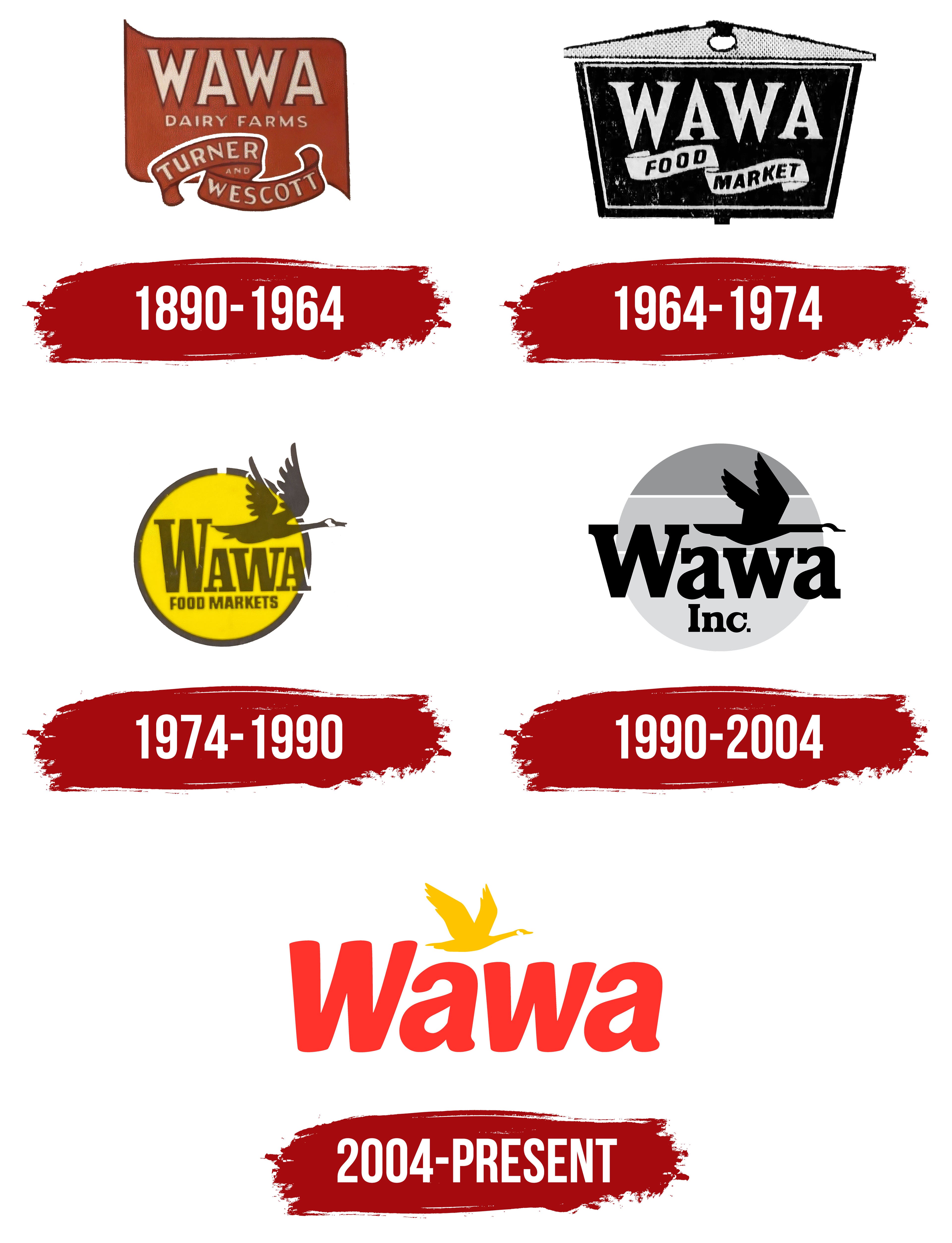
Around that time, a logo featuring an asymmetrically shaped brown polygon appeared. The brand name is written inside it, in a capital font with sharp serifs. The second line contains the phrase “DAIRY FARMS,” centered. And at the bottom, on a curved ribbon, is the phrase “TURNER AND WESCOTT.” All letters are beige, and only the word “WAWA” has thin, dark brown outlines.
1964 – 1974
When people stopped using home-delivery milk services, Wawa’s owners opened their first grocery store. The brand’s strong reputation made it expected to be popular.
The logo of that period looks like an advertising plate, consisting of two elements: a large black trapezoid and a small spotted triangle with a round hole. The geometric composition includes the light gray word “WAWA” in triangular serifs and the black phrase “FOOD MARKET.” The latter is written in bold sans-serif inside a curved gray ribbon.
1974 – 1990
The logo shows the legendary goose associated with the city where Wawa Dairy first appeared. The goose is depicted in flight. Its neck, torso, and tail form a single line, suggesting determination and persistence. The bird’s wings are up as it flaps, and its head is outside the circle in the background. The goose is positioned above the three letters, “awa.” The top of the first “W” is flush with the bird’s body. Below, in small serif type, it says “Food Markets.” The emblem’s color scheme is yellow.
1990 – 2004
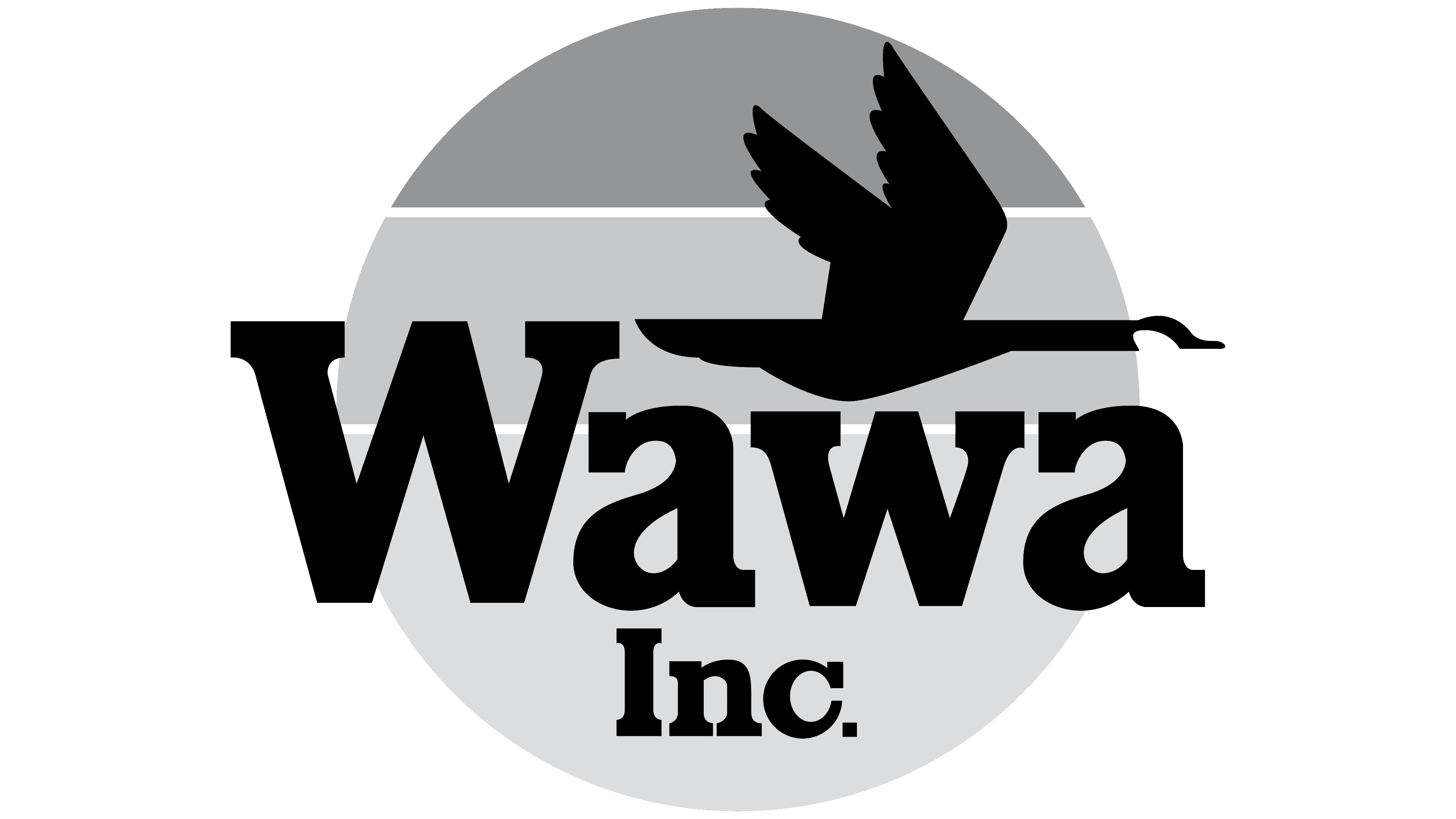
At the end of the 20th century, a new version of the goose logo appeared. The original, created by a student at Villanova University and a part-time employee at Wawa, proved so successful that designers made only a few changes. In particular, they corrected the shape of the flying bird: they added graceful curves to the wings, connected the feathers, and reduced the body. Because the tail, body, and neck are aligned in a straight line, the goose looks more confident and purposeful.
The artists kept the bird image because it is directly related to the brand name. Few people know that the word “Wawa” comes from the Lenni-Lenape language of the people living in the Delaware Valley. It literally translates as “Canadian Goose.” By the way, store chain officials often compare themselves to a flock of geese settling in new territory. Here, the analogy is drawn to opening new outlets in different cities.
The bird’s background is not the golden sun, as in the original, but a gray sky in three shades, from darkest at the top to lightest at the bottom. Under the black silhouette of a goose is the same black two-level inscription. The first line contains the word “Wawa,” and the second line contains “Inc.” with a dot at the end. The designers used a bold font with massive rectangular serifs.
2004 – today
As the range of goods and services expanded, the retail chain updated its logo. It is more colorful than the previous one: it has no grey monotony. The letters are now bright red; the goose is yellow. The designers also slightly changed its position in the picture, placing it diagonally, as if it were soaring. They also changed the font: classic serif letters were replaced by modern symbols with smooth sans serif lines.
Font and Colors
The Wawa chain of stores and service stations uses the same logo. It is presented in two forms: early and current. The revisions mostly concerned the logo’s mood, but not its key elements, including the eponymous goose and the brand’s name. The big bird was depicted seated and multicolored, with luxuriant plumage, in the earliest emblems.

Early logos (late 19th and early 20th centuries) used two types of lettering: printed and handwritten italic. In the current interpretation, the emblem inscription uses a font reminiscent of Gotham Bold. The individual version refers to the drawn letters. The brand’s signature palette comprises three shades: red, yellow, and blacky.