


 Accenture Logo PNG
The Dublin-based consulting firm’s Accenture logo is a succinct visual mark. The identity symbolizes accessibility, openness, the resolve to break away from stereotypes, and the pursuit of new horizons.
Accenture’s roots go back to 1953, when Arthur Andersen created an administrative consulting unit focused on implementing computing in business. In 1954, the team installed a UNIVAC I system for General Electric in Louisville, one of the earliest commercial uses of computers. This work shaped technology consulting as a standalone business.
Through the 1960s and 1970s, the unit expanded as corporate IT adoption grew. By the 1980s, consulting generated a large share of Arthur Andersen’s revenue, leading to conflicts between auditors and consultants over control and strategy.
In 1989, the division became Andersen Consulting within Andersen Worldwide and operated with growing independence. Disputes with Arthur Andersen escalated into a lengthy arbitration. In 2000, the ruling required a payment of about $1 billion to fully separate.
The split forced a rebrand. After an internal naming process, the company adopted the name Accenture from “Accent” and “future”, effective January 1, 2001. That same year, it launched an IPO on the New York Stock Exchange.
In 2002, Arthur Andersen collapsed after the Enron scandal, while Accenture remained unaffected because it had separated earlier. In 2009, Accenture moved its legal base from Bermuda to Ireland.
In later years, Accenture expanded through acquisitions, focusing on digital services, cloud, cybersecurity, and AI. Its main competitors include McKinsey & Company and Deloitte, both of which focus on implementation, systems integration, and outsourcing.
Meaning and History
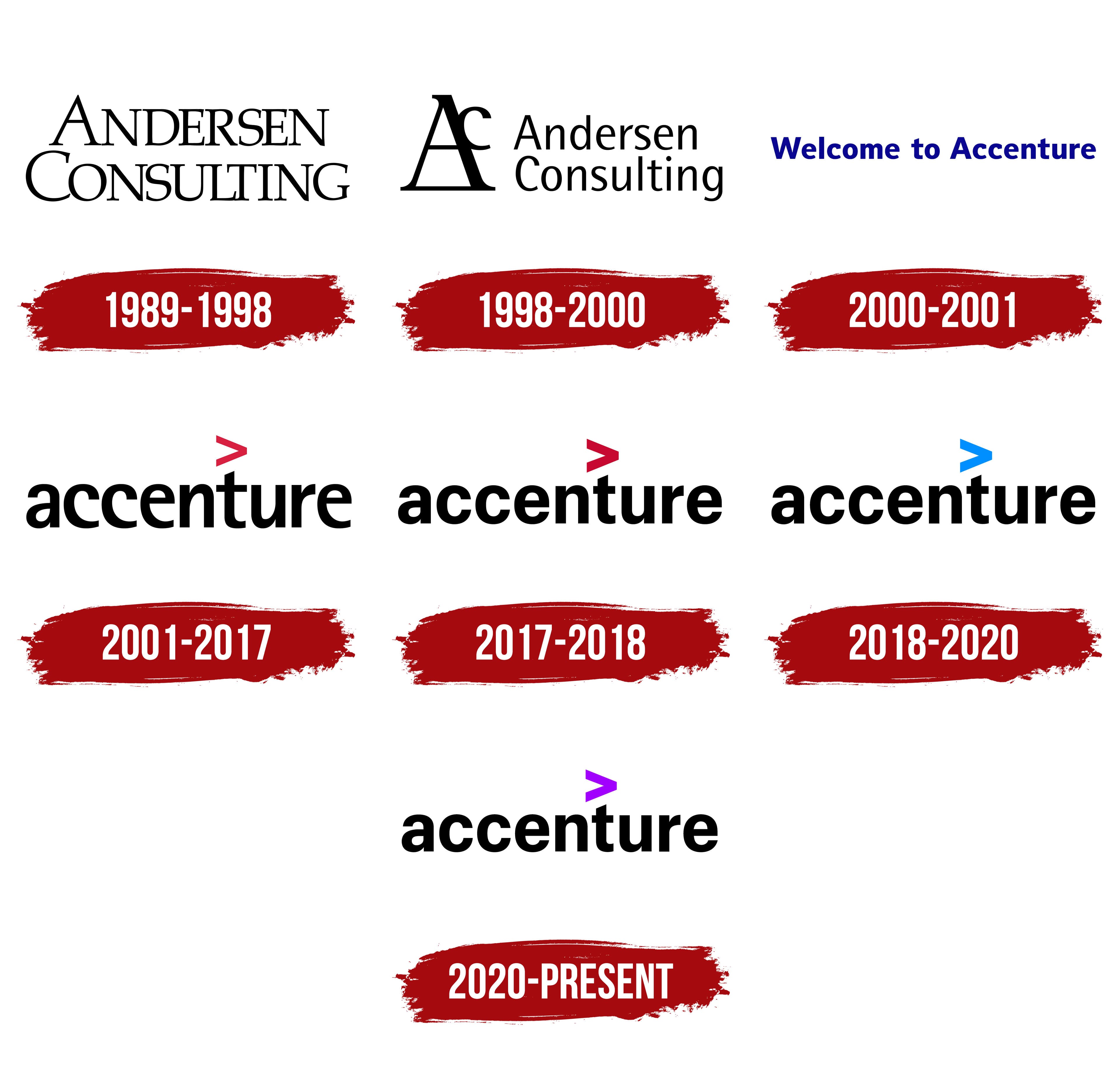
For nearly three months, the administration considered a name for the company until business consultant Kim Petersen suggested Accenture. Management says it conveys a determination to break away from stereotypes and pursue new horizons, reflecting the consulting service it guarantees. The group officially approved the name in 2001, and it immediately became the company’s emblem. It symbolizes the intention to help clients improve their future.
What is Accenture?
Accenture is a consulting company that optimizes and plans organizations and provides human resources consulting services. It is registered in Bermuda, but its office is located in New York.
1989 – 1998
Before it became Accenture, the company was known as Andersen Consulting, a name that reflected its origins. It began as Arthur Andersen’s consulting division, which received a separate name in 1989. The surname maintained a connection to founder Arthur Andersen, while “Consulting” identified its line of business. Today, Accenture provides management and technology consulting, implements digital systems, and manages business processes.
The first Andersen Consulting logo centered on the company name. Black lettering appeared on two lines, with “ANDERSEN” above “CONSULTING.” Both words used Palatino, with fine serifs and contrasting stroke weights. All letters were capitals, though the initial “A” and “C” stood taller than the rest, marking the start of each word. The treatment recalled traditional book typography.
1998 – 2000
The 1998 Andersen Consulting logo update reflected the company’s desire to distance itself from Arthur Andersen. The two organizations were already disputing the terms of their relationship and how they divided their business activities. Amid those disagreements, the company commissioned Landor Associates to develop a new identity.
The agency combined a monogram with the full company name. A large “A” appeared on the left, with a small “c” overlapping its upper-right portion. The monogram could stand alone as a company emblem. To the right, Andersen Consulting still occupied two lines, but the lettering changed. A modified Rotis Sans Serif replaced Palatino, and mixed-case lettering replaced the all-caps treatment. The company retained the Andersen Consulting name while updating its appearance during the dispute with Arthur Andersen.
2000 – 2001
The 2000 separation from Arthur Andersen required Andersen Consulting to change its name. Under the arbitration ruling issued in August, the company had to stop using its former name by the beginning of the following year. An employee competition called BrandStorming was held to find a replacement.
Kim Petersen, a consultant in the Oslo office, proposed Accenture. He combined parts of the phrase “accent on the future.” The new name shifted the emphasis from the consulting services identified by “Consulting” to the company’s future. On October 26, 2000, company leader Joe Forehand announced the Accenture name.
2001 – 2017

The Accenture name officially took effect on January 1, 2001, though preparations for the transition began in fall 2000. The phrase “Renamed. Redefined. Reborn. 01.01.01.” appeared alongside the former branding, giving audiences advance notice of the company’s new name and identity. The identity work began after the October name announcement. Landor Associates led the renaming program. Employees and branding specialists participated in the name search, and linguists reviewed it before the international launch.
Margaret Youngblood and Frank Mueller of Landor Associates designed the logo. They replaced the two-line Andersen Consulting name and monogram with a horizontal lowercase “accenture” wordmark and a red “>” symbol above the “t.” The black lettering used Rotis Sans Serif Extra Bold, with smooth stroke endings. Elongated proportions and tight letter spacing gave the name a compact appearance. The lower strokes of the “c” and “e” extended outward, while the letterforms remained open.
A small gap separated the red symbol from the name. Its two diagonal strokes met on the right, forming the mathematical greater-than sign. Positioned above the “t,” it resembled an accent mark. It connected the logo to “accent on the future,” expressing the name’s forward-looking idea.
2017 – 2018

Accenture’s 2017 logo update focused primarily on the letterforms. The company kept the name’s arrangement and the accent above it, limiting changes to their shapes. The lettering became fuller, rounder, and more conventional. The letters widened, while the openings in the “c” and “e” narrowed to small gaps.
The lowercase “a” retained its double-story construction. The red “>” symbol received thicker strokes. It remained above the “t,” with the top of the letter still guiding its placement.
2018 – 2020

Subsequent versions of the Accenture logo differed in the color of the “>” accent. During the redesign, its brown color was replaced with light blue. The blue accent sat above the “t,” standing out against the black name. Only the symbol’s color changed. The letterforms and arrangement remained the same.
Corporate materials in 2018 featured a version with a vivid purple accent above the black wordmark. It retained the lettering’s shape and the symbol’s position above it.
2020 – today
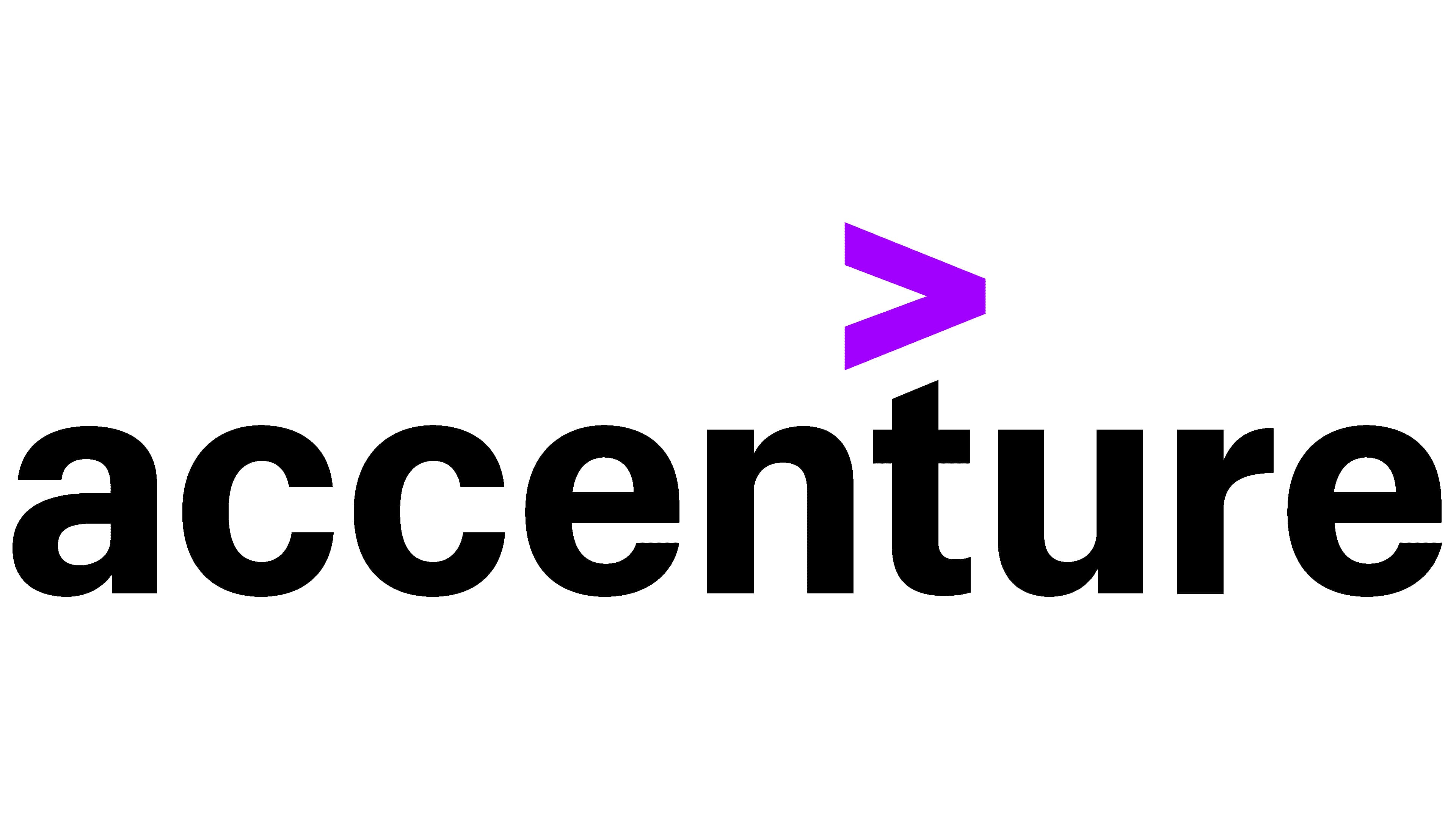
By 2020, Accenture had expanded the role of the “>” symbol, turning the logo’s accent into a recurring motif throughout its identity. It began appearing beyond its familiar position above the “t,” maintaining a connection to the company name and tying together materials within the new identity system.
Accenture introduced its updated brand platform on October 14, 2020. Developed in collaboration with Droga5, it responded to accelerating technological change and organizations’ growing need to transform their operations. The company promised to unlock the potential of technology and human ingenuity. The phrase “Let there be change” accompanied that promise, connecting the brand update to its work helping clients transform their businesses.
Font and Colors

The simple design clearly conveys the company’s direction and work style. For example, the lowercase letter “a” emphasizes accessibility and service. The ‘greater than’ sign indicates the forward movement vector. The strict letters indicate a pursuit of perfection.
The logo uses a standard sans-serif font. The color scheme is monochromatic, consisting of black (text) and red (accented mathematical symbol).
In the new logo, the font was not adjusted – it remained the same as in the 2017 version. The main focus was on the color of the mathematical sign. Thus, it changed from red to sky blue, then to light purple.
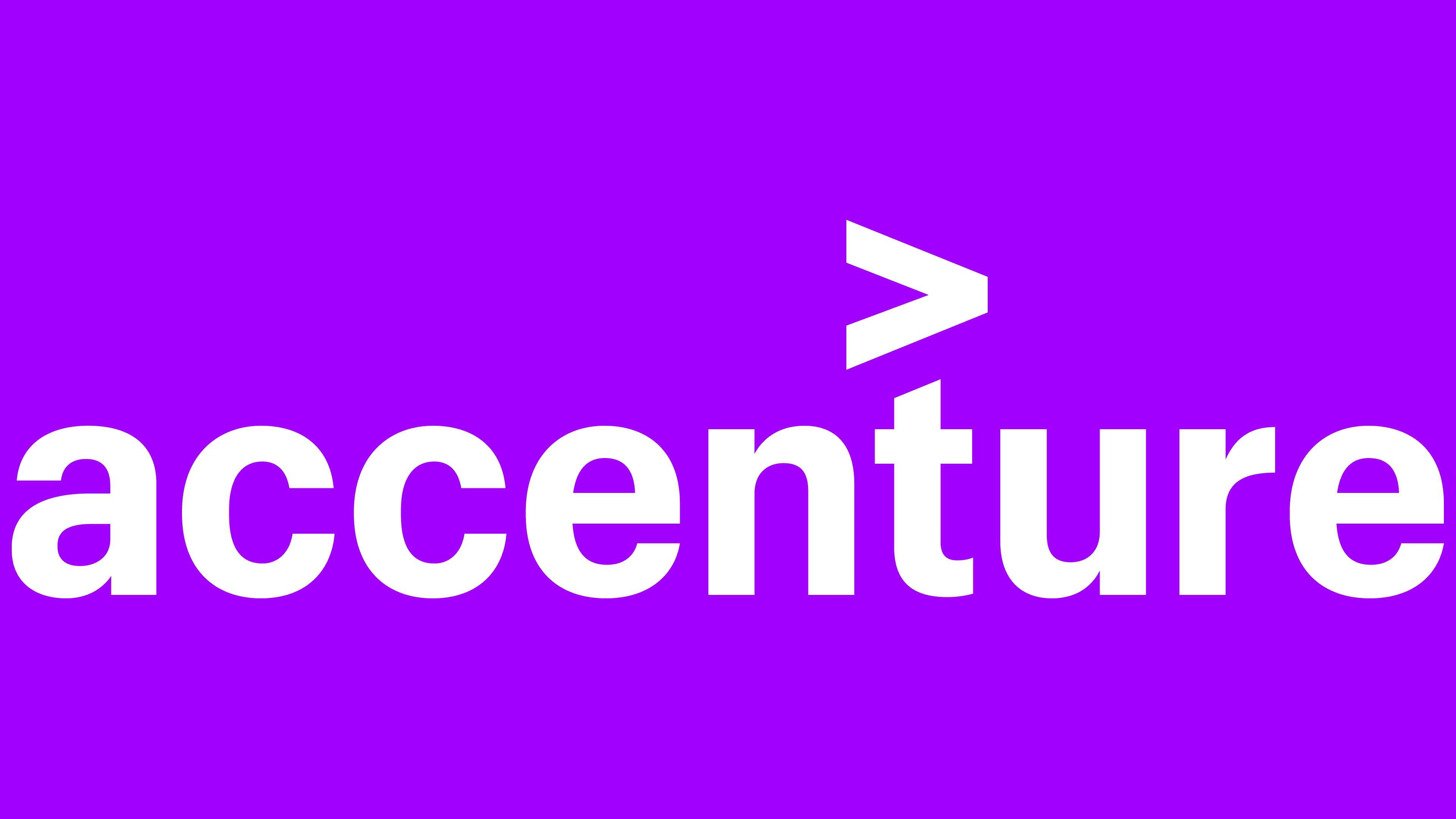
Accenture Logo Color Codes:
- purple: Hex #A100FF; RGB 161, 0, 255; CMYK 37, 100, 0, 0; Pantone 2592 C
- black: Hex #000000; RGB 0, 0, 0; CMYK 0, 0, 0, 100; Pantone Black 6 C

FAQ
What does the Accenture logo mean?
The Accenture logo signifies accessibility (the word begins with a lowercase letter), openness (sleek symbols with wide inner space), and continuous growth (the mathematical ‘greater than’ sign at the top). No other elements appear besides the name.
Is Accenture Strategy different from Accenture?
The Accenture company has several divisions, including Accenture Strategy and Accenture Technology. They differ in function: the former plans the strategy for management and business development, while the latter implements and uses it.
What is Accenture’s strategy?
It combines industry expertise, design, and analysis, guided by people. This helps clients act confidently and quickly.
What is Accenture’s company slogan?
Accenture’s motto is “Let there be change.” It adopted this in the second half of 2020 and added it to the website. Its logo also uses the slogan “High performance. Delivered.”