


 DHL Logo PNG
Movement, speed, accuracy, and efficiency, along with safety guarantees and high-quality service, reflect the uniqueness of DHL, the logistics company. The DHL logo is one of the most recognizable brands, and its modern look suggests the company is moving forward in all directions.
DHL began in 1969, when Berkeley law student Larry Hillblom noticed delays in cargo deliveries caused by paperwork. He proposed sending documents ahead by air. On September 25, 1969, Hillblom founded DHL with Adrian Dalsey and Robert Lynn, using part of a student loan. Early Seatrain Lines deliveries ran between San Francisco and Honolulu.
In the early 1970s, DHL focused on international routes and opened offices in Asia and Australia. By 1974, it entered Europe, followed by the Middle East in 1976, Latin America in 1977, and Africa in 1978. It also operated in Eastern Bloc countries, while US competitors stayed domestic.
DHL expanded in the United States only in 1983, in response to FedEx, which was founded in 1971 by Fred Smith. FedEx used a centralized air hub, while DHL relied on a distributed model. Competition pushed DHL to introduce tracking systems and automation. By 1988, it operated in 170 countries and employed over 16,000 people.
In 1998, Global Finance named DHL the most global company. That year, Deutsche Post began acquiring shares, gaining control by 2001 and full ownership by 2002. Headquarters moved from San Francisco to Bonn.
After integration, DHL gained access to the European postal infrastructure. In 2005, it acquired Exel, expanding into supply chain services. The group formed divisions such as DHL Express and DHL Supply Chain, maintaining the global network it has built since 1969.
Meaning and History
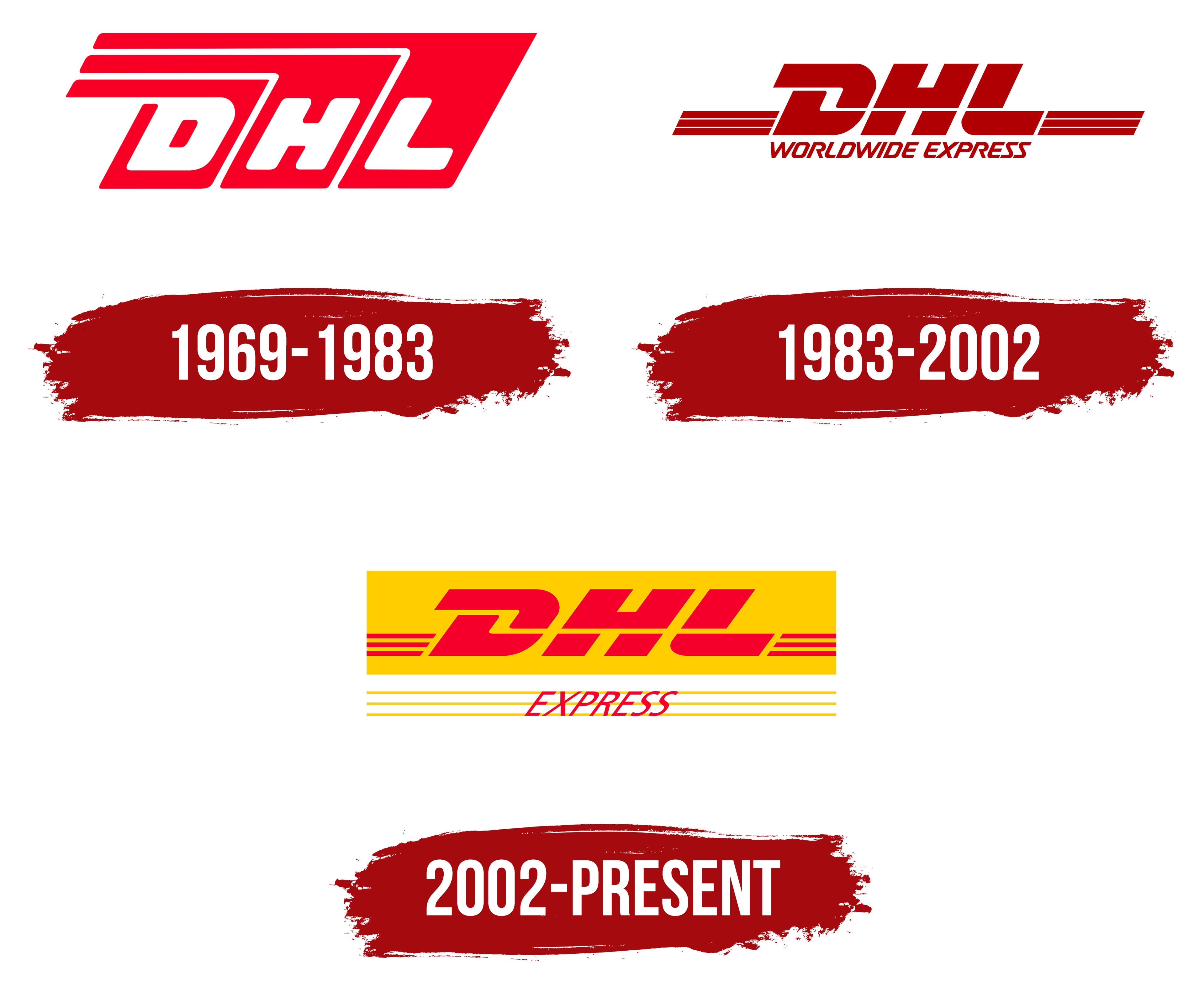
The DHL logo’s history traces a shift from white script on a red background to a more complex graphic composition. Although the brand name has retained its original style, individual elements and color choices have changed noticeably.
What is DHL?
DHL is a German logistics company originally from the USA. It was founded in 1969 in San Francisco to deliver parcels by courier and transport correspondence by express. Since then, the company has expanded its activities worldwide. The company’s headquarters are in Bonn, Germany.
1969 – 1983

In the original emblem, the company name is given special prominence: each letter is in its own polygon. The geometric shapes vary in height and are slightly tilted to the right. At the top, three wide lines add dynamics to the image.
1983 – 2002
In 1983, the company entered the US domestic market by launching a delivery service. This expansion coincided with a logo update. The designers transformed the font, adding a wide serif to the letter “D”. The term “WORLDWIDE EXPRESS” was placed under the DHL abbreviation to denote the company’s specialization. The large rectangles were removed, and the top stripes were duplicated and placed to the right and left of the inscription.
2002 – today
In 2002, Deutsche Post AG acquired the logistics company. As a division of DHL Express, it introduced a logo designed by the branding studio Nitsch Design. The designers kept most of the previous logo, made it red, and placed it inside a yellow rectangle. At the bottom, the red word “EXPRESS” appears in italics and is superimposed on three yellow lines.
Font and Colors
The company’s trademark carries its name. These are the first letters of the founders’ surnames: Adrian Dalsey, Larry Hillblom, and Robert Lynn. The inscription is paired with long horizontal stripes that convey speed. After all, DHL positions itself as an international delivery service and has specialized in express transportation since 1969.

The designers made the letters bold to emphasize them and italicized them to add dynamism to the emblem. They used a font developed specifically for DHL, based on the Minion and Frutiger font groups. It combines wide serifs (“D”), strong geometric symmetry (“H”), and rounded corners (“L”).
Two yellow lines cross the abbreviation. The substrate is also bright yellow (Pantone 116), as are the three stripes behind the word “EXPRESS.” All inscriptions are red (Pantone 200), which allows them to stand out against other elements. This color combination was not always used. From 1983 to 2002, the logo was burgundy, and the earliest version was red and white.