


 FedEx Logo PNG
The FedEx logo symbolizes movement and direction. It seems to show the moment between sending and receiving, when everything is already going the way it should. It has a sense of route and speed, and a feeling that everything moves in the right direction, as if the brand itself were connecting cities and people.
FedEx traces its origins to a 1965 Yale paper by Frederick W. Smith, which outlined a hub-and-spoke overnight delivery system. The concept proposed routing all shipments through a central hub rather than direct city-to-city routes.
After military service in Vietnam, Smith founded Federal Express in Memphis in 1971, choosing the city for its central location and reliable airport facilities. Operations began on April 17, 1973, with 14 Dassault Falcon 20 aircraft delivering 186 packages to 25 US cities. Losses reached nearly $30 million in the first two years, and at one point, Smith covered fuel costs after winning $27,000 in Las Vegas.
By 1976, the company became profitable. Deregulation in 1977 allowed a shift to Boeing 727 cargo jets, increasing scale. In 1978, Federal Express went public, and in 1979, it introduced COSMOS, a real-time package-tracking system, while UPS still relied on manual processes.
In 1981, it launched an overnight letter service, competing with the US Postal Service and DHL. The idea of guaranteed next-day delivery quickly spread across US business practices.
International expansion began in 1984 with Gelco but led to heavy losses in Europe. In 1989, the acquisition of Flying Tigers for $880 million enabled global routes and entry into Asia. In 1994, the company officially adopted the name FedEx.
In 1998, FedEx acquired Caliber System for $2.4 billion, and in 2000, it formed FedEx Ground. The same year, FDX Corporation was renamed FedEx Corporation. Later deals included Kinko’s in 2004 and TNT Express in 2016 for €4.4 billion.
Meaning and History
The company’s debut logo is widely regarded as one of the most commercially successful examples of negative-space use, where every detail, even the hidden ones, contributes to the idea. Experts have praised this subtle concept.
As a result, the emblem has received over 40 design awards and has been ranked among Rolling Stone magazine’s top 10. This is all thanks to the white arrow concealed within the logo. It runs along the border of the vertically arranged words “Federal” and “Express,” culminating in a point between the letters “E” and “X.” This symbolizes speed, movement, and forward momentum.
What is FedEx?
It is an American company specializing in postal and courier delivery across the country and worldwide. It also offers logistical services. Founded in 1971, the service was initially called Federal Express.
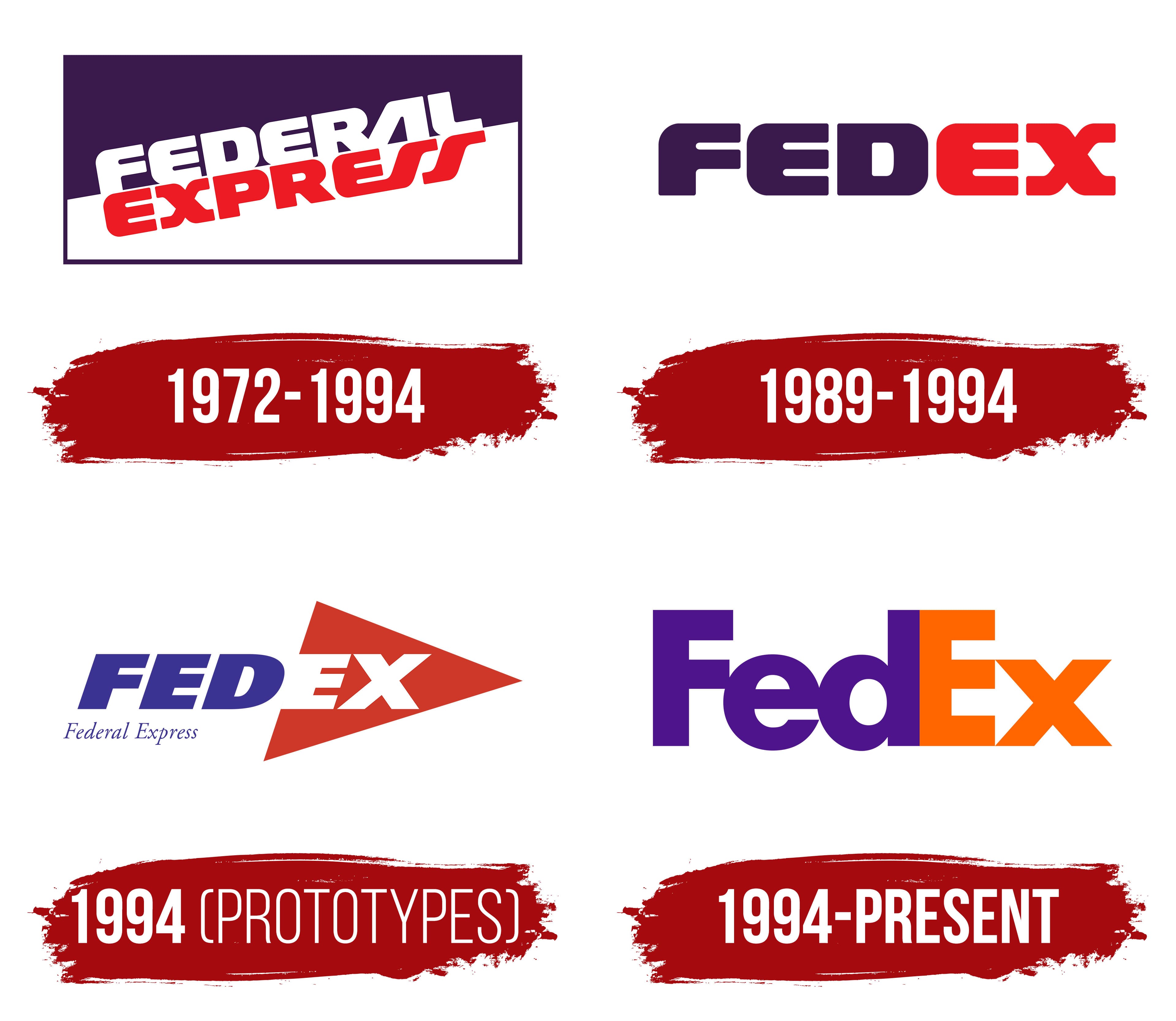
1972 – 1994

Federal Express began operations in 1973, but the logo was introduced earlier, on May 1, 1972. Richard C. Runyon Design developed it. The company received a name that sounded formal and businesslike.
The first emblem was built on simple geometry. The base was a rectangle divided diagonally into two parts: a purple upper section and a white lower section. A thin purple border runs along the edge, uniting the mark into a single block. Across it, placed diagonally, is the inscription FEDERAL EXPRESS. The word FEDERAL is white on a dark background, while EXPRESS is red and sits in the lower white section of the rectangle. The typeface is large and sans serif, closely resembling Microgramma Bold Extended or Eurostile.
The letters include unusual details. The SS is stretched horizontally, and the A has no crossbar.
The name Federal Express was used until 1994. The early logo became a symbol of a period when courier services were rapidly developing, and modern logistics were taking shape.
1989 – 1994

On April 1, 1989, Federal Express shortened its name to FedEx and introduced a new logo. The Express division retained the old logo. At the same time, a separate version with a more restrained appearance and the shorter name began appearing in documents and internal correspondence.
Lindon, Leader of Landor Associates, designed the new mark. It drew on experience from Northwest Orient Airlines’ identity. The main idea relied on negative space and a simple rendering of the name, divided by color. The FED portion is set in dark purple, while EX is colored red.
The FedEx wordmark uses large, uppercase letters in a grotesque typeface. The forms are dense and geometric, with slightly rounded corners, giving the logo a businesslike, calm appearance.
The updated version was used in documents and internal company materials. In advertising, the company still used the previous logo. It separated the brand’s external communication from administrative work.
1994 (prototypes)
In 1994, Federal Express introduced a new logo that never became its primary logo. The company did not publicly explain why it abandoned it. They presented it as an experimental prototype and a step toward a new visual direction. Lindon Gray, Leader of Landor Associates, developed it. The mark supported the new name, FedEx, and centered on a large wordmark.
The name was divided by color. The FED portion was rendered in a deep blue. EX appeared in white on a red-orange wedge that extended to the right, resembling a directional sign. The wedge begins at the letter E and widens toward the right edge.
In this trial version, negative space between the E and X appeared for the first time. The shape formed between the letters creates an arrow associated with speed.
FedEx is set in a geometric italic typeface close to Univers 85 Extra Black and a modified Futura Bold. Below, they added the name Federal Express. It was set in a serif italic typeface, such as Times Italic or Georgia, in blue, and placed under the FED portion.
1994 – today
After the prototype, FedEx introduced another logo version in June 1994. Lindon Gray, Leader of Landor Associates, also developed it. The mark is simple, without complex elements or color combinations.
The name appears as a single word: FedEx. The Fed portion is light lavender, while Ex is pastel orange. The letters d and E touch, which makes the word appear unified without a visual break.
The typeface is based on Futura Bold and adapted for the brand. The wordmark mixes lowercase and uppercase letters and lacks serifs. The forms are clean and geometric.
The key device is hidden between the E and x. The cutout in the E and the inner form of the X create a right-pointing arrow. The arrow isn’t drawn separately; it appears through the negative space between the two letters. As a symbol, it fits the theme of logistics, where delivery speed and direction are essential.
FedEx Corporation
2000 – 2006

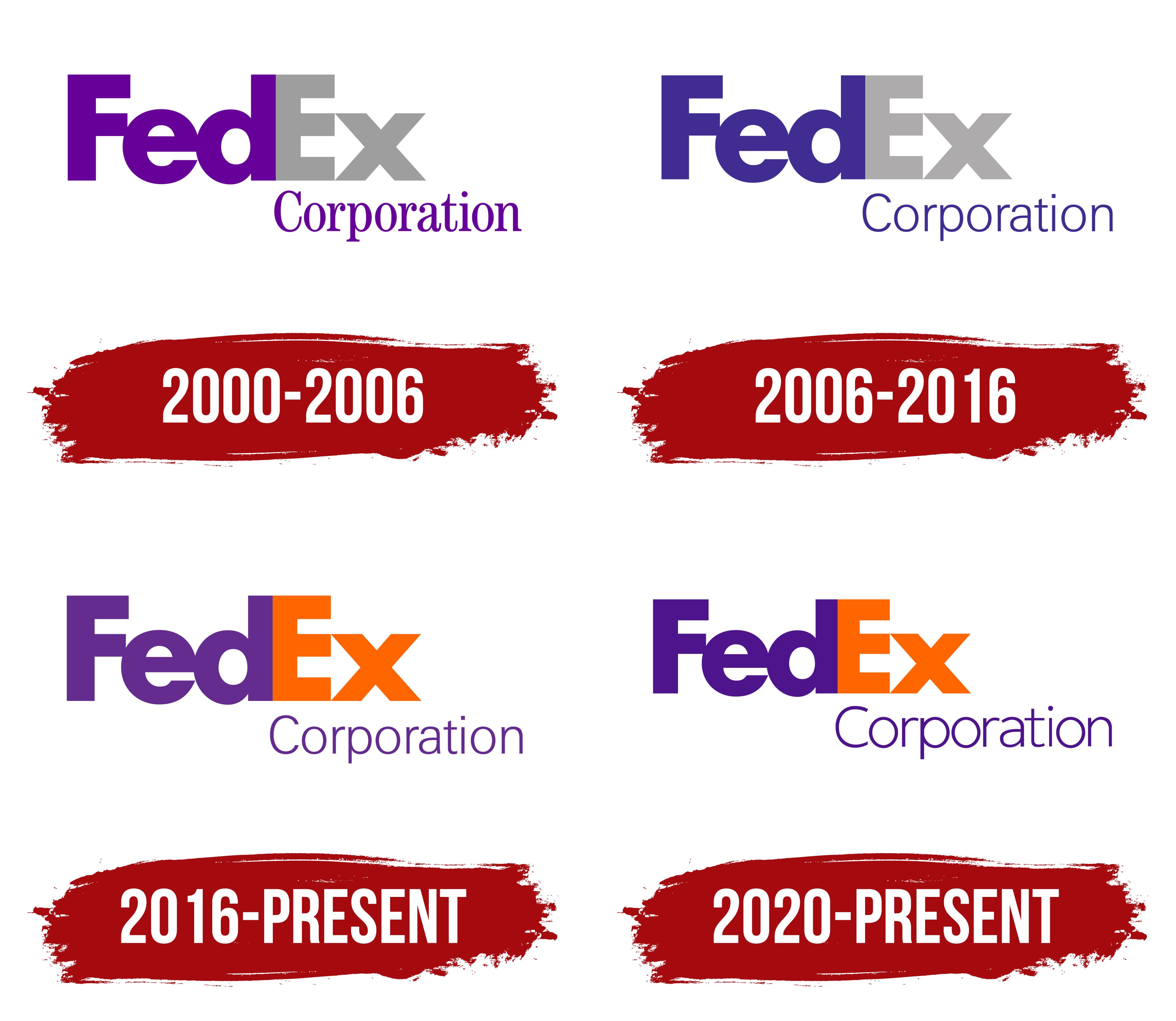
FedEx Corporation’s first corporate logo centered on a two-color wordmark. At the top is the word FedEx, written as a single unit in a large sans-serif typeface. Fed is colored in a rich purple, while Ex is rendered in light gray.
Within the internal space between the letters E and x, a white arrow pointing to the right is also present.
Below, the word Corporation is added. It is shifted to the right and set in a serif typeface with more elongated proportions to distinguish it from the top line. The color matches the purple tone of the Fed portion. In style, the typeface is close to a transitional serif, similar to Times New Roman.
2006 – 2016

In the updated FedEx logo, the overall structure was retained. The main changes concern the name’s color. The Fed portion became more saturated and more purple, with a slight shift toward blue. Ex remained light gray.
The word Corporation is placed below and shifted to the right. It differs from the previous version in its typeface. The font closely resembles modern versions of Garamond and Optima. The word “Corporation” matches the new purple shade.
2016 – today

In the next version of the corporate emblem, the colors were updated again, while the form remained unchanged. The Fed portion was made bright purple, and Ex was colored in a rich orange. The typeface and construction of the mark remained unchanged.
The arrow between E and x was retained. It still appears between the letters and conveys delivery, speed, and direction.
2020 – today

In 2020, the Fed portion of the name was made darker. The orange in Ex became slightly warmer and denser. The overall logo scheme did not change.
The word ‘Corporation’ was enlarged, and the letter spacing was reduced. The lower line repeats the purple shade of Fed. The arrow between E and x remains. It is still formed by the space between the letters and is associated with the themes of delivery, speed, and direction.
Font and Colors
CEO Fred Smith considered renaming the brand even when the company was called Federal Express. Three teams worked on the branding and offered over 200 variants. Some were depicted as arrows, but none were camouflaged. However, one day, the company head and brand manager noticed a hidden arrow when selecting the right logo.
The inscription is a unique combination of two fonts, Futura Bold and Univers 67, created by Lindon Leader. To present them effectively, the designer experimented extensively, measuring letter spacing, switching between uppercase and lowercase, and aligning symbols by height.
At one point, he noticed a faint arrow between the top and bottom words. After reviewing numerous working versions, the designer mixed two fonts: Univers 67 for “X” and Futura Bold for “E,” creating an entirely new font.
The logo’s color palette varies by application. However, it always comprises bright, appealing combinations that catch the eye and draw attention. For instance, the orange part of the logo represents FedEx Express, the green represents FedEx Ground, and the red represents FedEx Freight. There’s also a corporate version with a blue “Ex” and a commercial/trading version with a yellow end.