


 Uber Logo PNG
Uber was founded in San Francisco in 2009. It offers an online app for easy ordering. The brand presents a modern, succinct Uber logo that demonstrates friendliness and ease of use, reflecting the business’s direction.
Uber began in December 2008 in Paris, when Garrett Camp and Travis Kalanick struggled to find a taxi during LeWeb. Camp, who had sold StumbleUpon to Reddit for $75 million, proposed a simple idea: request a car through a phone app.
In 2009, UberCab was registered in San Francisco. The service targeted premium users with black cars and SMS booking. The first ride took place in May 2010. Early adopters came from the local tech community. In 2011, the company expanded across New York, Chicago, and Boston, and internationally to London and Paris. The company shortened its name to Uber after regulatory pressure.
In 2012, UberX introduced a new model that allowed private drivers to use their personal cars. Prices dropped sharply, opening access to a wider audience. The same year, Lyft entered the market, triggering strong competition in the US.
Between 2013 and 2016, Uber expanded globally, often clashing with regulators and taxi unions. Operations faced bans in France, Germany, and Spain. In China, Uber invested over $2 billion before selling its business to Didi Chuxing in 2016 in exchange for a stake.
In 2017, internal scandals led to Travis Kalanick’s resignation. Dara Khosrowshahi took over. In May 2019, Uber went public on the New York Stock Exchange, raising $8.1 billion, though shares fell on the first day. By 2023, the company reported its first annual operating profit.
Meaning and History
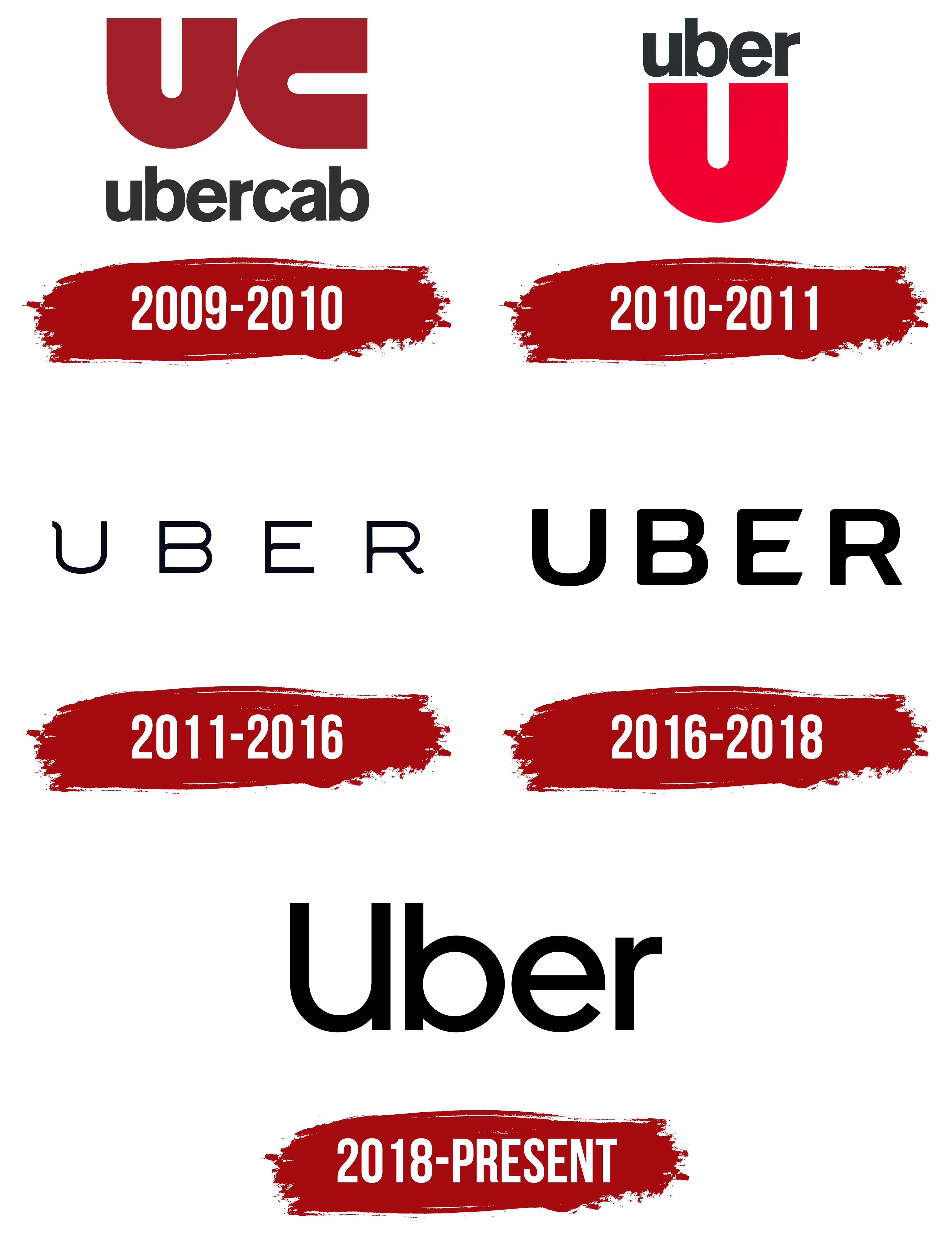
Despite its youth, Uber has undergone several transformations, resulting in a friendly, intuitive interface and logo that reflect its business direction. It shows the ability to track the ordered car with a driver on board. Before that, the logo was the composite word UberCab.
What is Uber?
Uber (or Uber Technologies) is an American company that provides taxi, courier, freight, food, and parcel delivery services. It is also a mobile app that lets users request these services. The platform was founded in 2009 by Garrett Camp and Travis Kalanick. The company’s headquarters is in San Francisco, California.
2009 – 2010

Earlier, the Uber brand was called UberCab, which was reflected in its original logo. The black inscription, in lowercase letters, sat at the bottom. Above it was a stylized “UC” monogram in burgundy color. The “U” and “C” had the same shape, differing only in orientation. All glyphs were bold and sans-serif except for the “a,” which had a small triangular protrusion at the bottom.
2010 – 2011

The debut version, comprising a capital letter (graphic part) and the company name (textual part), conveyed the service’s close connection to the road. To this end, designers created a semi-circle sign on a highway and placed the word “Uber” in lowercase above it. This signified the starting and ending points of a sequence.
Additionally, the designers played with the logo’s style by combining two uppercase letters into one. They specifically used the word UberCab, taking “U” and “C” from it. They left the first symbol as is and rotated the second 90 degrees. As a result, they created a new sign for the transport service.
2011 – 2016

During this period, an updated version based on a word form appeared. The company name was written in a thin, even sans-serif font in uppercase. The only difference from the classical appearance was a miniature curved protrusion at the top of the “U” and on the lower leg of the “R.” The word “Cab” completely disappeared from the name.
2016 – 2018

In 2016, the service owners revised the logo design and chose a smooth sans-serif font without protrusions. All letters were uppercase, with an emphasis on the slanted parts of “E.”
2018 – today

The current emblem features the word “Uber” in an elongated form. Now, all characters are lowercase, except the first. The bold font makes the black letters stand out against a white background.
Font and Colors

The most serious period in the emblem’s history was in 2011-2012, when a radical redesign was conducted. Although the new version did not resemble its predecessor, it retained the connection to the automotive and road theme. The visual center became the letter “U” with inwardly curved upper ends. The icon was placed in a rectangle.
The name also changed. The letter “U” looked unusual and differed from the one in the graphic symbol. Designers elongated and curved the left end. All other characters were made normal and smooth, with serifs removed. The dominant colors became silver-white and grayish-blue. A year later, the service owners also changed the design of the mobile application and desktop site.

The passenger symbol became round, and the driver’s became hexagonal. The icons are inside a square, which distinctly highlights them on the map. Color schemes and patterns vary by country. For example, the Chinese version predominantly features a red palette, the Indian version turquoise, and those using Uber in the USA see a dark turquoise logo.

The emblem’s font has changed over the years, shifting from wide, lowercase letters to narrow, uppercase letters. Unique elements included the letters “U,” “R” (in one version, they have curved ends), and “E,” which had slanted side cuts.
The Uber logo’s palette is highly diverse, with the design team presenting 65 color variants for local use. As a result, each country has its own recognizable style. Therefore, instead of the traditional corporate palette of black, white, and blue, there are now many other combinations. Standard icons use white and two shades of blue, or white with brown and orange.