


 ADT Logo PNG
“The client is completely safe. To do this, we use all possible technologies from video surveillance to access codes,” the ADT logo says. The emblem represents versatility, protection from all sides, and a safe field around the user.
ADT’s history began on April 5, 1874, when inventor Edward Callahan created a telegraph-based alert system. His call-box network connected dozens of homes and enabled centralized monitoring. On August 14, 1874, American District Telegraph was founded in Baltimore and offered messenger, guard, and fire response services.
In 1901, ADT became part of Western Union, which consolidated dozens of communication firms. In 1909, AT&T gained control, but antitrust action in 1914 forced it to divest. Between 1910 and 1930, ADT expanded into fire alarms and security systems, shifting from telegraph services to protection.
The company went public in the 1960s and listed on the NYSE in 1969. In 1987, Hawley Group Limited acquired ADT and renamed it ADT Security Systems, expanding through acquisitions, including the 1990 acquisition of Britannia Security Group. In March 1997, Tyco International acquired ADT for $5.6 billion and later combined it with Brink’s Home Security. ADT remained under Tyco for over a decade. On October 1, 2012, after Tyco split, ADT returned to the NYSE as an independent company.
In February 2016, Apollo Global Management completed a $6.9 billion leveraged buyout. It merged ADT with Protection 1, creating a network serving more than 6 million customers. In January 2018, ADT returned to public markets with a valuation of about $10.5 billion. In 2020, Google acquired a 6.6 percent stake for $450 million and partnered with ADT on smart home systems, integrating Nest devices.
Meaning and History
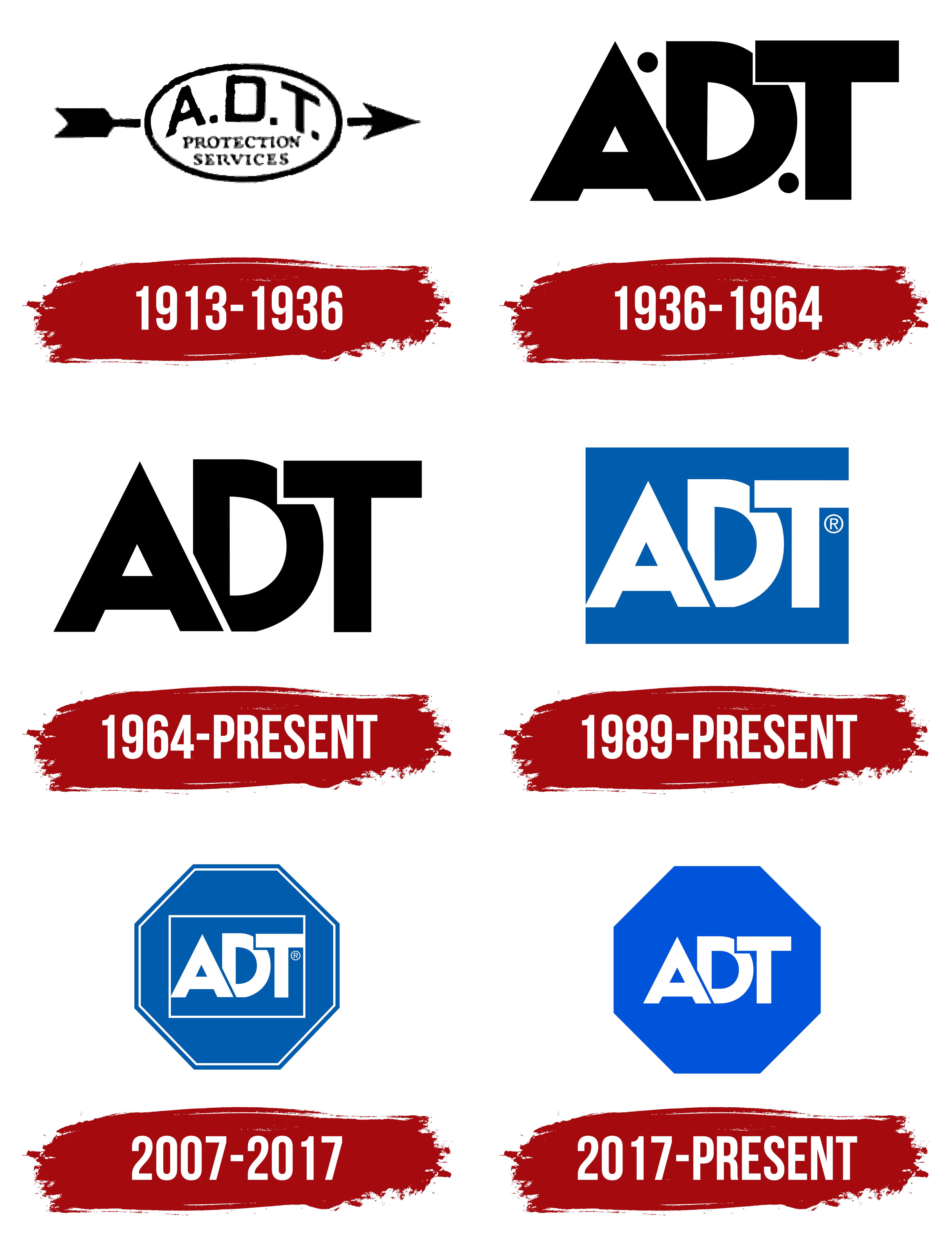
The ADT logo’s history dates back over a hundred years. Since then, it has come a long way – from an abbreviation in an oval pierced by an arrow to a modern, stylish monogram in a blue octagon. The current version looks like a road sign. This is not in vain, as it serves as a call to stop, pay attention, and follow the safety rules, which ADT helps you comply with.
What is ADT?
ADT is an American company that protects property in residential homes, warehouses, enterprises, offices, and other facilities. It develops access control systems, intercoms, fire alarm systems, video surveillance kits, and various security equipment. It has monitoring centers to track alarm signals throughout the United States. The abbreviation “ADT” stands for “American District Telegraph.”
1874 – 1913
During this stage of the company’s development, the brand’s logo and emblem had not yet been established.
1913 – 1936

This version featured a white oval with a black border pierced by a flying arrow. In the oval was written “A.D.T. PROTECTION SERVICES. The designers divided the words into three lines and centered them.
1936 – 1964

The logo’s designers combined “A,” “D,” and “T” so that “A” covered “D” from below and “T” from above. Small black circles appeared to the left and right of the central letter.
1964 – today

In the middle of the last century, the company began to use a simplified wordmark without a ring. In the new version, the inscription resembled a monogram because the “A” and “T” partially overlapped the “D.” All three letters were bold and black.
1989 – today
In 1989, designers created the acronym “white” and placed it inside a blue rectangle. This option is still relevant.
2007 – 2017

At the beginning of 2007, the corporation acquired a completely new logo. The letters “ADT” were inside a dark blue octagon. At the same time, they placed it in a rectangular white frame, and another white line ran along the octagon’s inner contour.
2017 – today
The latest redesign made the image simpler and more versatile. The designers opted for a lighter shade of blue and removed the subtle white borders.
ADT pulse logo
ADT Pulse is a smart home and security system developed by ADT Inc., a leading provider of security services in the United States. Introduced in 2010, the system lets users remotely control home security, lighting, thermostats, and other connected devices through a mobile app or web portal. With ADT Pulse, homeowners can monitor and manage their home automation and security features from anywhere, enhancing convenience and protection.
The ADT Pulse logo features a dominant blue color scheme. At its center is an octagon with white “ADT” lettering, emphasizing its connection to the parent company, ADT Inc. Below it, the word “Pulse” appears in a clean, elegant, thin typeface.
Font and Colors
The octagonal figure with the word “ADT” is the only corporate emblem. It has the simplest design, except that the letters are superimposed. This monogram dates back to the 1950s and was used differently: on a blank or a rectangle. Now, it has an octagonal background.
Non-standard placement of “A,” “D,” and “T” does not interfere with font identification. This may be a redesigned version of the standard sans-serif typeface. The letters are bold and proportional. Their lines are the same thickness.
The logo resembles a road sign because of its characteristic color combination: the octagon is tinted a bright, fresh blue (#005DA9). The abbreviation is completely white (#FFFFFF). The ADT Corporation’s owners also noticed this feature and began using the logo for advertising, placing it on single roadside poles.