 AKA Logo PNG
The AKA logo represents the noble cause for which Alpha Kappa Alpha Sorority, an intercollegiate sorority, was created. It focuses on the desire for independence, equality, and integrity as African American female students organize it. The simple images convey the desire for growth, and the chosen colors reflect black girls’ natural impulse to fully adapt to today’s society.
Alpha Kappa Alpha began at Howard University in Washington, D.C., at a time when fewer than a thousand African Americans were enrolled in U.S. colleges. In 1907, student Ethel Hedgman Lyle developed the idea of a sorority based on mutual support and public service for educated Black women.
On January 15, 1908, nine students held the first official meeting in Miner Hall. Among the founders was Lucy Slowe, valedictorian of the 1909 class and the first Black woman to win a national sports title in the United States. The new sorority adopted salmon pink and apple green, the ivy leaf emblem, and the motto “By Merit and Culture.”
In 1910, seven sophomores joined without initiation, expanding the founding group to sixteen. By 1912, internal conflict emerged over the name, colors, and symbols. Nellie Quander opposed the changes and led the legal incorporation effort. On January 29, 1913, Alpha Kappa Alpha became the first African American Greek-letter organization incorporated in the District of Columbia. The dissenting group later founded Delta Sigma Theta.
After incorporation, AKA expanded nationally. Its second chapter opened at the University of Chicago in 1913, the first Boule was held in 1918, and Ivy Leaf appeared in 1921. AKA helped form the National Pan-Hellenic Council in 1930. Later projects included the Mississippi Health Project in 1934, the American Council on Human Rights in 1947, funding for sickle cell research in 1958, Martin Luther King Jr.’s 1964 convention address, and the 1965 Job Corps center in Cleveland. By 2025, AKA had more than 365,000 members in over 1,000 chapters.
Meaning and History
The idea for Alpha Kappa Alpha originated with Ethel Hedgemon Lyle, a student at Howard University, and her instructor, Ethel T. Robinson. She told her about a college sorority affiliated with Brown University and shared her thoughts on sisterhood. In this way, women could enter societies that had previously excluded them because of their race. To make her idea a reality, Ethel began campaigning among female students in 1907, encouraging her friends to take decisive action and awakening their interest in the opportunities ahead.
As a result, she brought together a group of 16 people who laid the foundation for the AKA in 1908. Naturally, in addition to a name, the new structure needed a personalized emblem to reflect its goals, objectives, and concepts. Thus, a heraldic design symbol was created. Salmon pink and apple green were chosen as the official colors. The key symbol of the organization was the ivy leaf, representing strength, endurance, constancy, and friendship.
What is AKA?
An acronym for Alpha Kappa Alpha sorority, AKA aims to support African American women by empowering them, raising their status, and addressing social injustices. The organization was founded in 1908 at Howard University by Ethel Hedgemon Lyle and the group of students she led. The organization is a member of NPHC (National Pan-Hellenic Council). The center of government is located in Washington, DC.
1908 – today
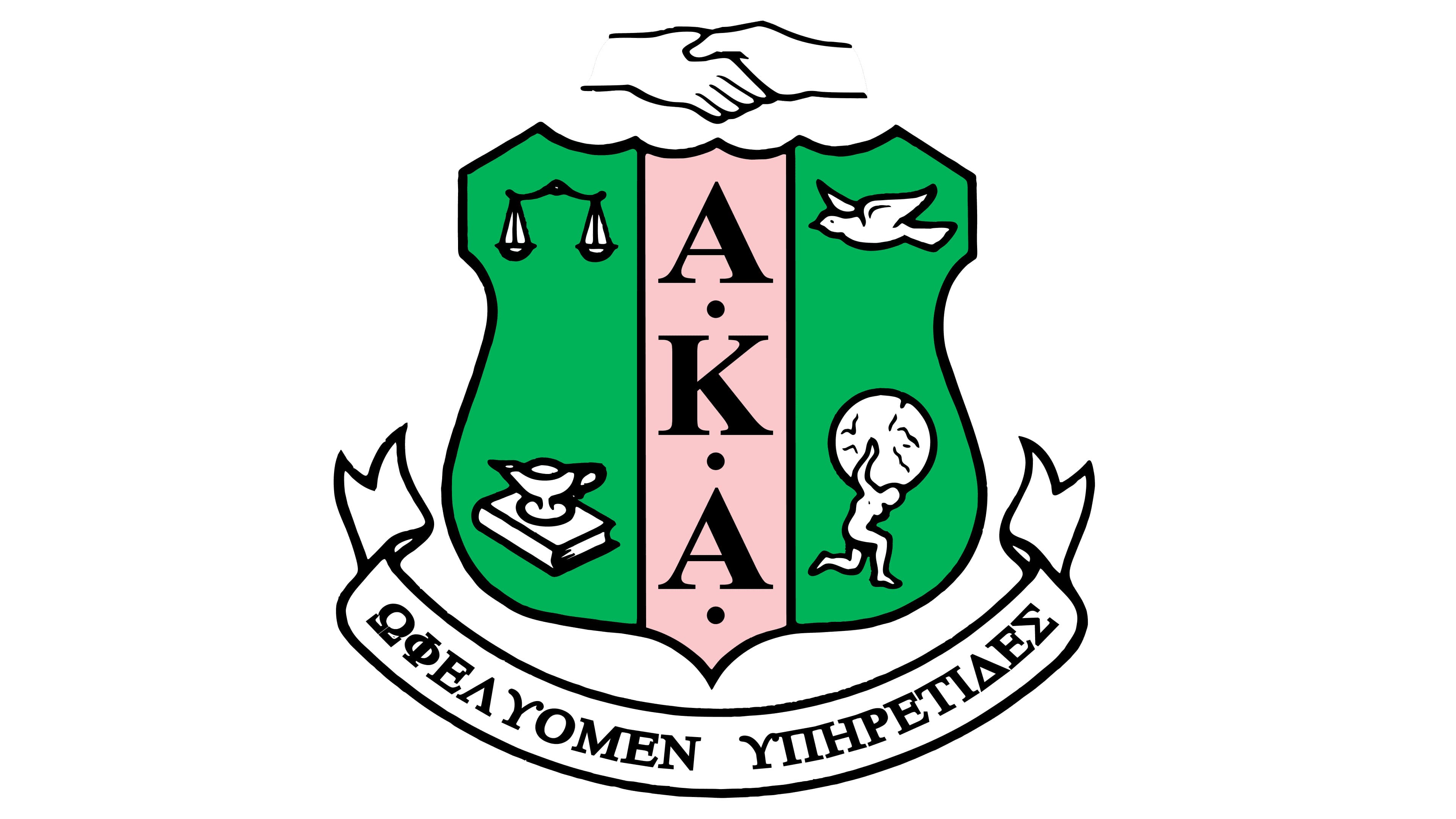
The AKA logo features several important symbols that play a crucial role in the sorority’s worldview. The first notable feature is heraldry: the emblem’s base is the coat of arms, with several points centered at the top and only one at the bottom. In the center is a pink stripe with a black inscription. The abbreviation is arranged vertically and is read from top to bottom. The letters are uppercase, Roman, and bold, but the thin lines nicely balance the thickness. To the right and left are green fields with iconic elements.
- A white dove symbolizes peace.
- With a globe on his shoulders, Atlas represents universal support, might, and boundless power.
- The scales symbolize the triumph of justice, law, and order.
- The book and the lamp serve as an allegory of light and knowledge.
All images are contoured, small, white, and drawn with thin strokes. Above the coat of arms are two hands clasped in a handshake. They also have an important semantic meaning, as Alpha Kappa Alpha strives for friendliness and harmony with the people around it. The organization is willing to lend a helping hand to every potential sorority member. At the bottom is a ribbon with an inscription in ancient Greek.
Font and Colors
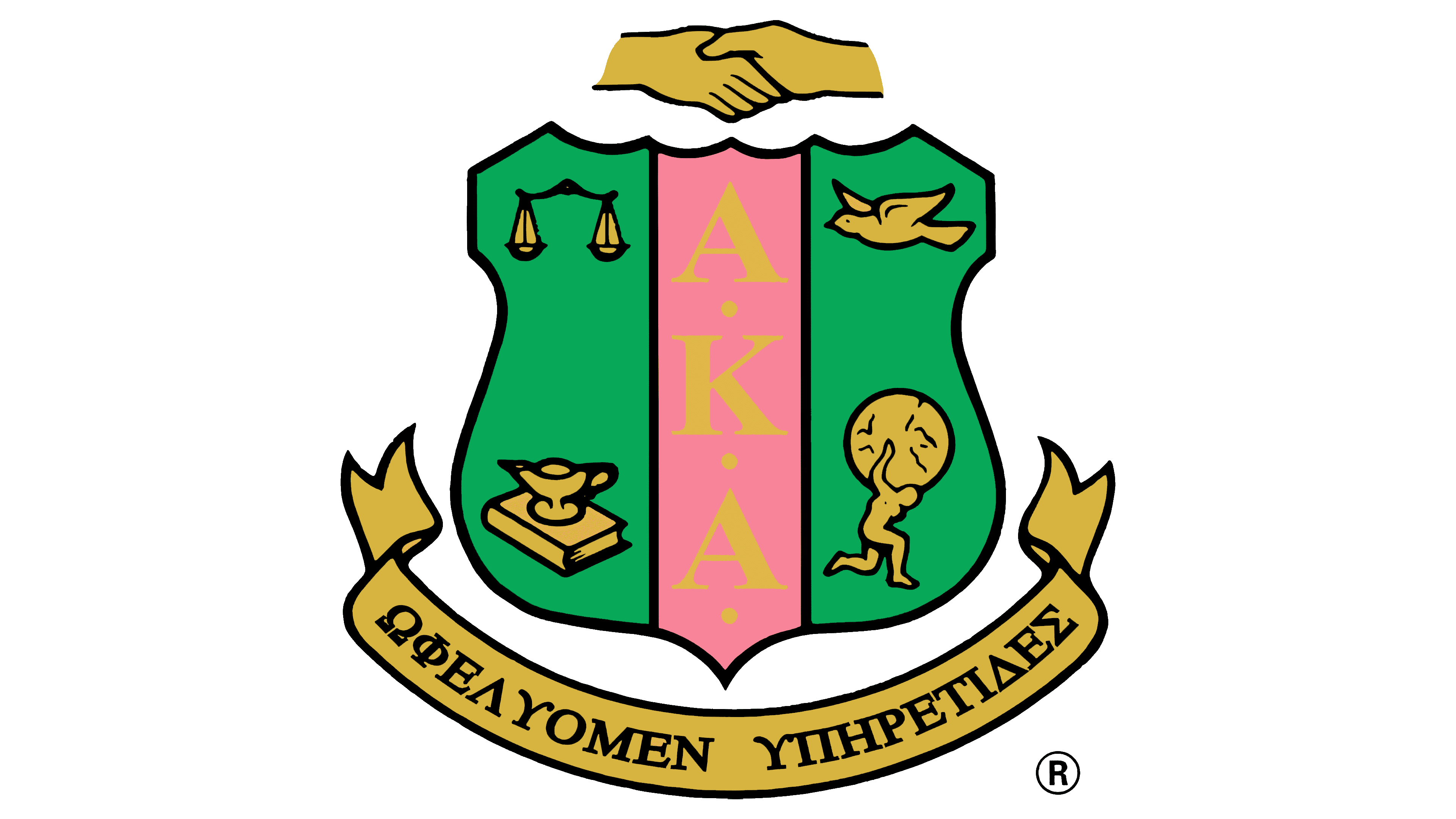
The abbreviation is typed in a classic serif font and separated by bold dots. The lettering in Ancient Greek is in uppercase font and also has serifs. The palette includes the signature pink and green colors, Salmon Pink and Apple Green. White and black colors, used for outlining, harmoniously complement the logo, making it formal and strict.