


 Alien Logo PNG
The Alien logo is fantastic and soaring. It talks about cosmic spaces, weightlessness, and ships carrying extraterrestrial life. The symbol is full of struggles for survival and desperate battles. It opens the curtain to an unknown world.
The Alien franchise began in the late 1970s at 20th Century Fox, after producers Gordon Carroll, David Giler, and Walter Hill acquired Dan O’Bannon’s screenplay. O’Bannon had spent years developing the story of a space freighter crew facing an unknown alien life form. Ridley Scott later directed the film, while Swiss artist H. R. Giger shaped the Xenomorph, the egg, the chestburster, and the alien ship through his biomechanical visual style.
Alien was released in May 1979 and became a major box-office success, earning about $184 million worldwide on a budget of roughly $11 million. Sigourney Weaver’s Ellen Ripley became the central figure of the series. The film mixed horror and science fiction in a tighter, darker way than Star Wars, which had taken the genre in a more adventure-driven direction two years earlier.
James Cameron directed Aliens in 1986, changing the format from claustrophobic horror to military action. The sequel earned about $183 million worldwide and won Oscars for visual effects and sound editing. Alien 3 followed in 1992 as David Fincher’s feature debut, though conflicts with the studio marked production. Alien: Resurrection, directed by Jean-Pierre Jeunet, closed Ripley’s main story in 1997.
Fox later joined the property with Predator in Alien vs. Predator in 2004, followed by a 2007 sequel. Ridley Scott returned with Prometheus in 2012, a prequel about the origins of the alien race, earning about $403 million worldwide. Alien: Covenant continued that line in 2017. In 2024, Fede Álvarez directed Alien: Romulus for Hulu, a separate story aimed at a new audience.
Meaning and History
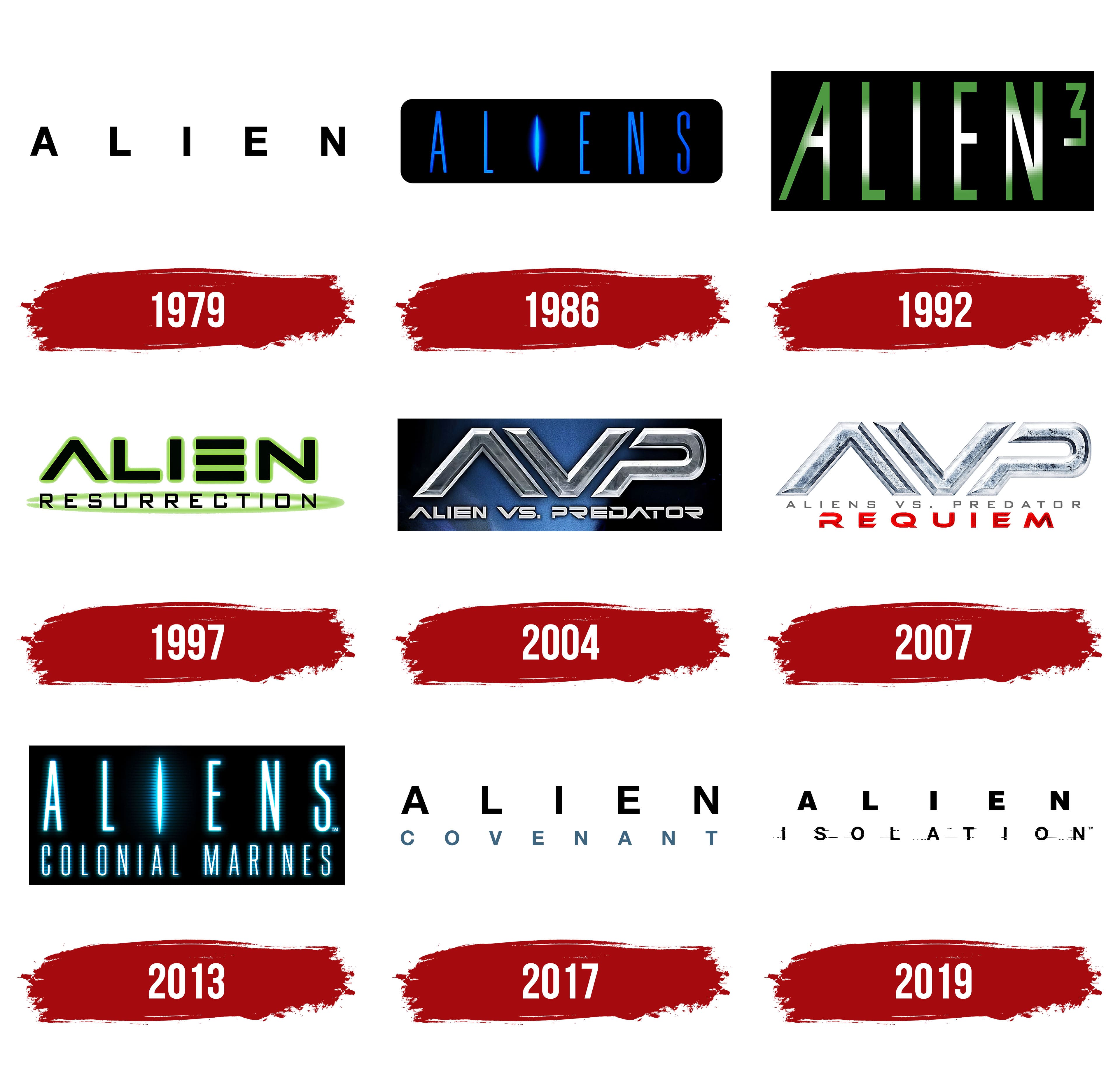
Audiences and critics received the picture so well that, in the following years, 20th Century Fox released three sequels, which also proved successful. As a result, additional crossovers, games, toys, and other proposals appeared. Each logo of the series relates to the next film adaptation. As part of the overall franchise, the emblems do not reflect evolution; they are dedicated to individual films. However, each has an element of mystery and mysticism.
What is Alien?
A series of films from 1979 to 2019 dedicated to the theme of extraterrestrial beings that use humans as hosts and incubators. There have been four main parts of the franchise. Then two crossovers unite Aliens and other popular aliens. Subsequently, the creators turned to the history of the Alien universe, creating three prequels. Work is currently underway to continue the main storyline.
1979

The logo of the original film adaptation. It consists of simple capital black letters written far apart. The space indicates cosmic space and weightlessness. The technique leaves a mystery between the symbols, expecting sudden events. The sign retains understatement.
Black letters resonate with the alien xenomorph’s color and the space beyond the spaceship’s windows. They are associated with horror and the night.
1986

The first Alien sequel appeared in 1986. It is associated with a deliberate mission for which the heroine Ripley goes to the planet in search of alien monsters.
The logo reflects a space theme, featuring a black rectangular base with rounded corners. The dark background also points to danger and the unknown. The team doesn’t know what awaits them upon landing. The inscription is done in blue neon letters. The central I is transformed into a narrow slit from which light is pouring. Stepping inside, travelers will see a new world.
The glow is reminiscent of the ship’s semi-darkness, lit by hidden LED lights.
1992

The third part, “Alien 3”, where the events unfold on a prison planet.
The logo’s square black background hints at an enclosed space. Ripley has to deal with an Alien that hid on her ship. The confined background with large letters inside reflects the idea of a cell.
Large green title letters appear as if illuminated by a flashlight, depicting a jailer approaching the cell and shining it in the prisoner’s face. The lines of symbols resemble the prison tunnels where the inmates lived in the movie.
1997

The fourth film was about the alien clones and Ripley. It was released in 1997 under the name “Alien: Resurrection.” The emblem of the version is the most unusual and has no repetitions. The word Alien is executed futuristically. E lacks the main glyph, and A is missing a crossbar. The technique indicates a loss of completeness. Characters are not real; they are cloned individuals.
Three identical stripes instead of E signify the process of chromosome change, creating externally similar creatures. The word “resurrection” is surrounded by an oval figure, a symbol of reproduction, a closed cycle.
Green shades draw a parallel with the previous part.
2004
Thanks to the franchise’s success, several films were released with related plots, uniting the stories of two alien monsters, each of which had been filmed in separate films earlier. The 2004 film was called “Alien vs. Predator.”
The series got its own logo, different from the previous ones. The emblem consists of three letters made from an unusual alloy. The first comes from the word Alien, but without a partition in the letter A. The second letter is part of VS. In Latin, the word “versus,” shortened to “VS,” means “against.” The last element, R, is Predator.
The spelling of each element is slightly simplified, indicating lower life forms, whose main themes are reproduction and survival, to which the battle between them is dedicated.
Below the abbreviation is the full name in lowercase.
The emblem chose a black background with a gradient and a glow coming from the planet. The space theme prevails, as the main participants are aliens. The action takes place on the ice of Antarctica, which presumably gives the logo’s background its glow.
2007
In 2007, the second part of the crossover “Aliens vs. Predator: Requiem” appeared. The main abbreviation and caption remained the same. Meanwhile, a more prominent red inscription, Requiem, has been added, and the background has been removed.
The white substrate speaks of events unfolding on Earth in broad daylight. The red color of the inscription indicates bloody battles and many injured people.
2013

The film “Prometheus” served as a unique prequel to the story, addressing the origins of the alien monsters encountered by Captain Ripley. The same year the prequel was released, Aliens: Colonial Marines, a video game set in the Aliens universe, was also released. The game received harsh criticism and is considered one of the worst in history.
Its logo resonates with the franchise’s second installment. The black background symbolizes space. The rectangular canvas displays letters that glow like a spaceship’s lights. The brightest, central letter I is designed as an entrance to subspace for jumps across vast distances. This element represents the entrance to another world unknown to man. All that remains is to draw back the curtain.
2017

The sequel to Prometheus, titled “Alien: Covenant,” closer to the previous installments, was known at the time of filming to have at least two more prequels planned. Therefore, the film was prepared as one of three parts.
The emblem’s design was based on the franchise’s first logo, with one small addition: the blue subscript “Covenant.” The first word, Aliens, indicated that it belonged to the same franchise, while the second linked the film to the logos of past installments.
2019
“Alien: Isolation” served as the final prequel installment, telling the story of the xenomorphs’ creator and leading into the franchise’s first film. The logo has a significant nod to this message. The emblem replicates the 1979 logo.
Large black letters with substantial spaces between them. The characters in Alien have become slightly thicker to reflect the long time between installments. Each element is a separate puzzle piece of the story, forming a unified picture. The inter-letter spaces symbolize the distances between planets. The difference between the series’s first and last logos is evident in the addition of the word “isolation” below the main title.
The story isn’t over; further Alien sequels are planned. In 2022, it was announced that work had begun on the film “Alien: Romulus.”
Font and Colors
The main logo shades are black, green, and blue. The colors reflect the film’s main themes and the locations where its stories unfold.
- Black – the color of space. It depicts the aliens’ appearance and conveys the horror, fear, and death they bring.
- Blue – the prototype of stars and their glow. This shade is used in conjunction with a neon light, adding to the overall picture. The blue palette evokes technology, suggesting future progress.
- Green – the color of life. It tells of Earth, the desire to survive, to protect the home from threat. It indicates the theme of reproduction.
The font of some of the emblem inscriptions is simple and even, indicating the monsters’ straightforward goals and collective organization. In some logos, futurism is evident, with characters taking on whimsical forms.