


 American Standard Logo
Modern life is impossible without this company’s products. The American Standard logo expresses this idea directly: it is confident, original, and stylish. At the same time, the emblem’s design is distinguished by sophistication. The sliding strokes and inseparable glyphs show the sanitary ware’s high aesthetics, attractiveness, and reliability.
American Standard’s roots go back to 1875, when James West Arrott and Francis Torrance brought cast-iron enameling technology from Europe to Pittsburgh. Under the name Standard Manufacturing Company, they began making enamel-coated bathtubs. In 1899, Standard Manufacturing merged with other plumbing producers to form Standard Sanitary Manufacturing Company, which became North America’s largest plumbing manufacturer by 1900.
A second branch began in 1892 with the American Radiator Company, created through a merger of heating equipment makers. Under Charles Woolley’s leadership, it became a major supplier of radiators and heating systems. In 1924, the company built the American Radiator Building in Manhattan, known for its black brick and gold roof.
In 1929, American Radiator merged with Standard Sanitary to form American Radiator & Standard Sanitary Corporation. The new company ended that year with $187 million in revenue and more than $20 million in net profit. During World War II, it shifted heavily to military production, making parts for the B-29 Superfortress, more than 2.5 million hand grenades, and 75 million cast-iron bomb noses.
In 1967, the company adopted the shorter name American Standard Corporation. After a leveraged buyout in 1988, it returned to the stock market in 1995. By 1998, revenue reached $6.7 billion, with 57,000 employees and businesses in plumbing, climate equipment, and vehicle braking systems. Its plumbing rivals included Kohler Company and Moen. In 2007, the group split into WABCO, American Standard Brands, and Trane. Ingersoll Rand acquired Trane in 2008, while American Standard Brands later combined with Crane Plumbing and Eljer.
Meaning and History
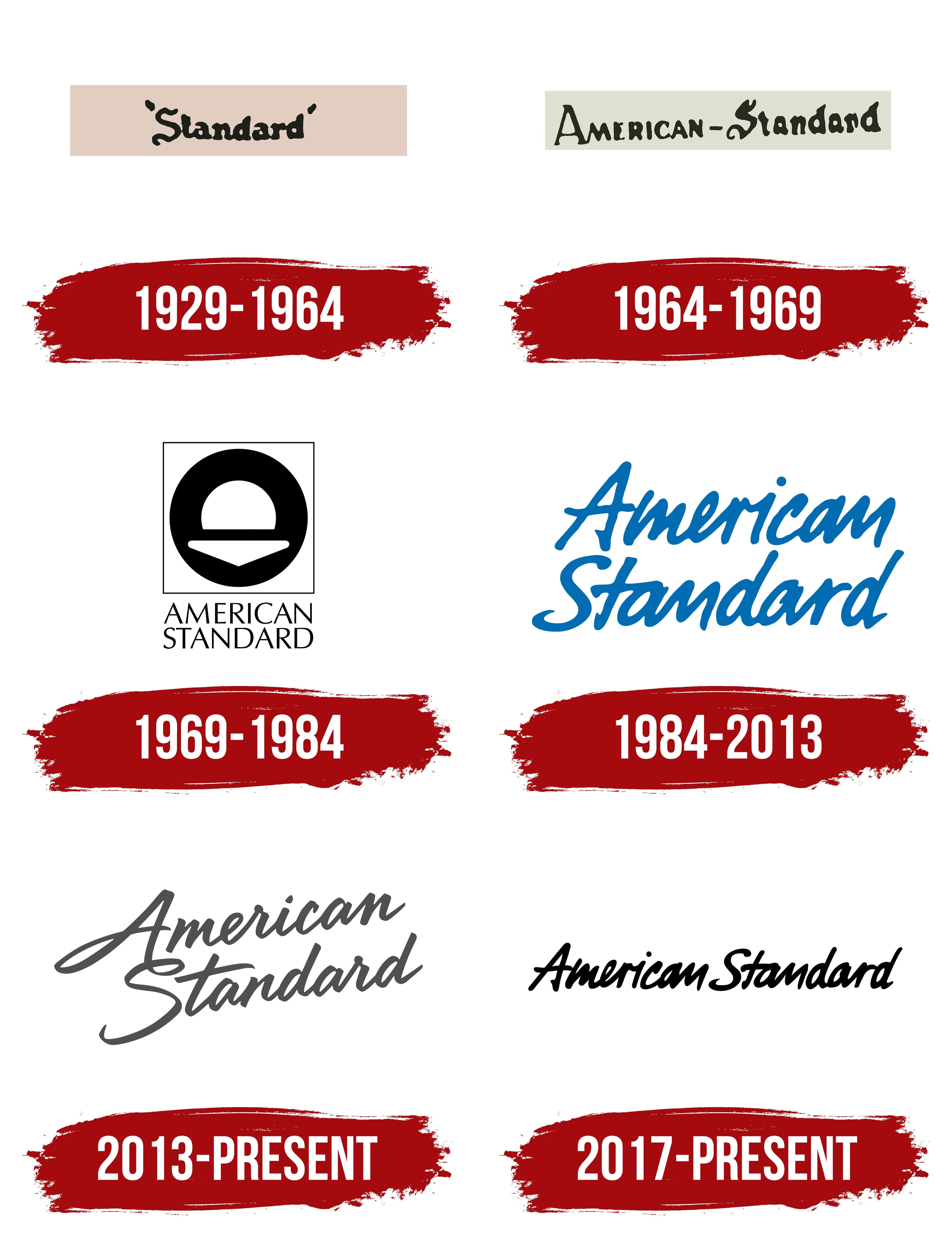
Throughout the company’s existence, six logo redesigns have been developed. Each redesign made minimal changes, maintaining brand recognition while meeting modern standards.
What is American Standard?
At a minimum, it is a world-renowned sanitary ware brand that offers products far beyond U.S. borders.
1929 – 1964
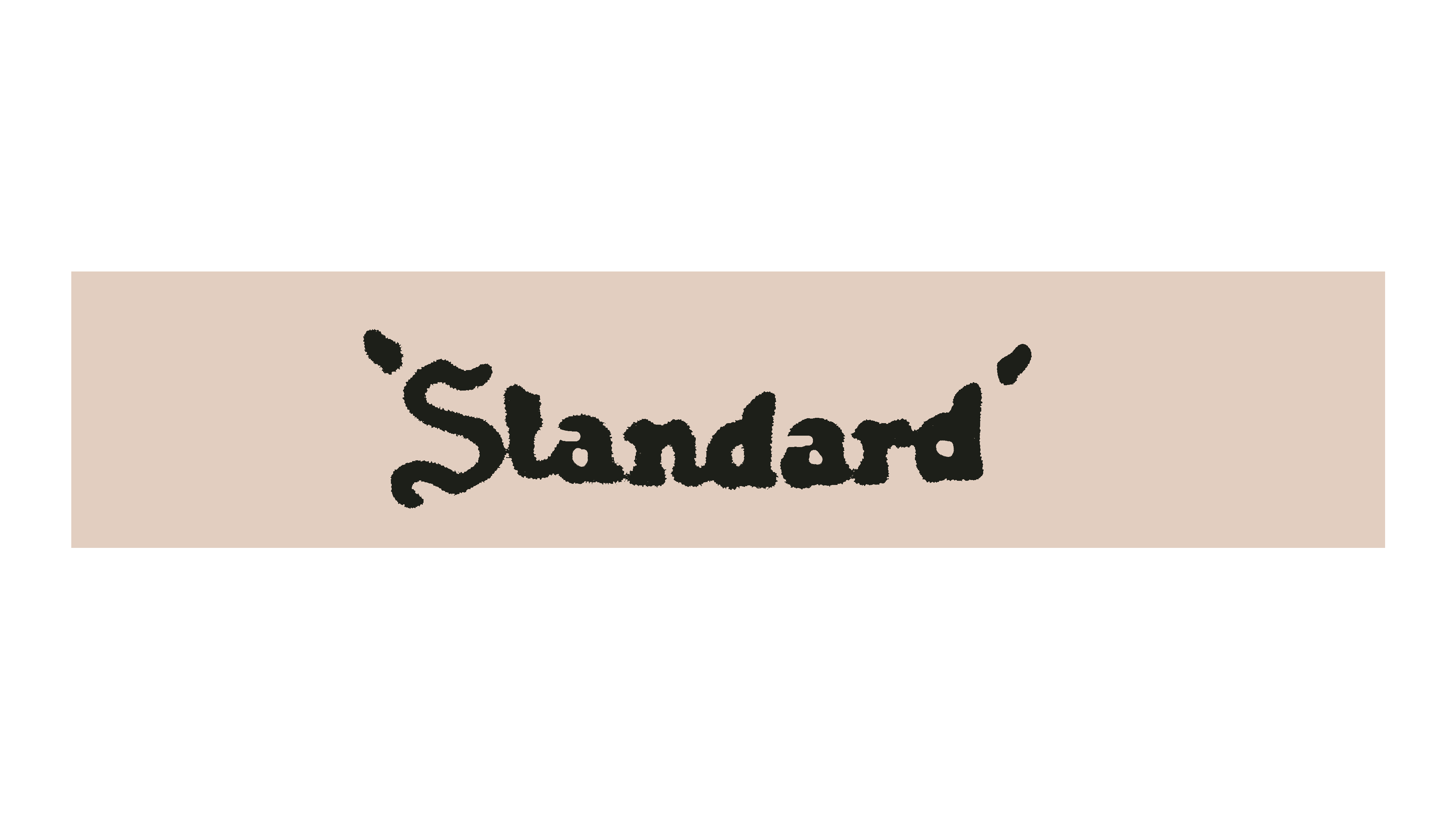
The first version of the logo appeared just after the company’s inception in 1929. It was a verbal inscription “Standard,” made in a stylish font with rounded corners. Except for the first “S,” all the letters were lowercase. It looked fascinating.
1964 – 1969
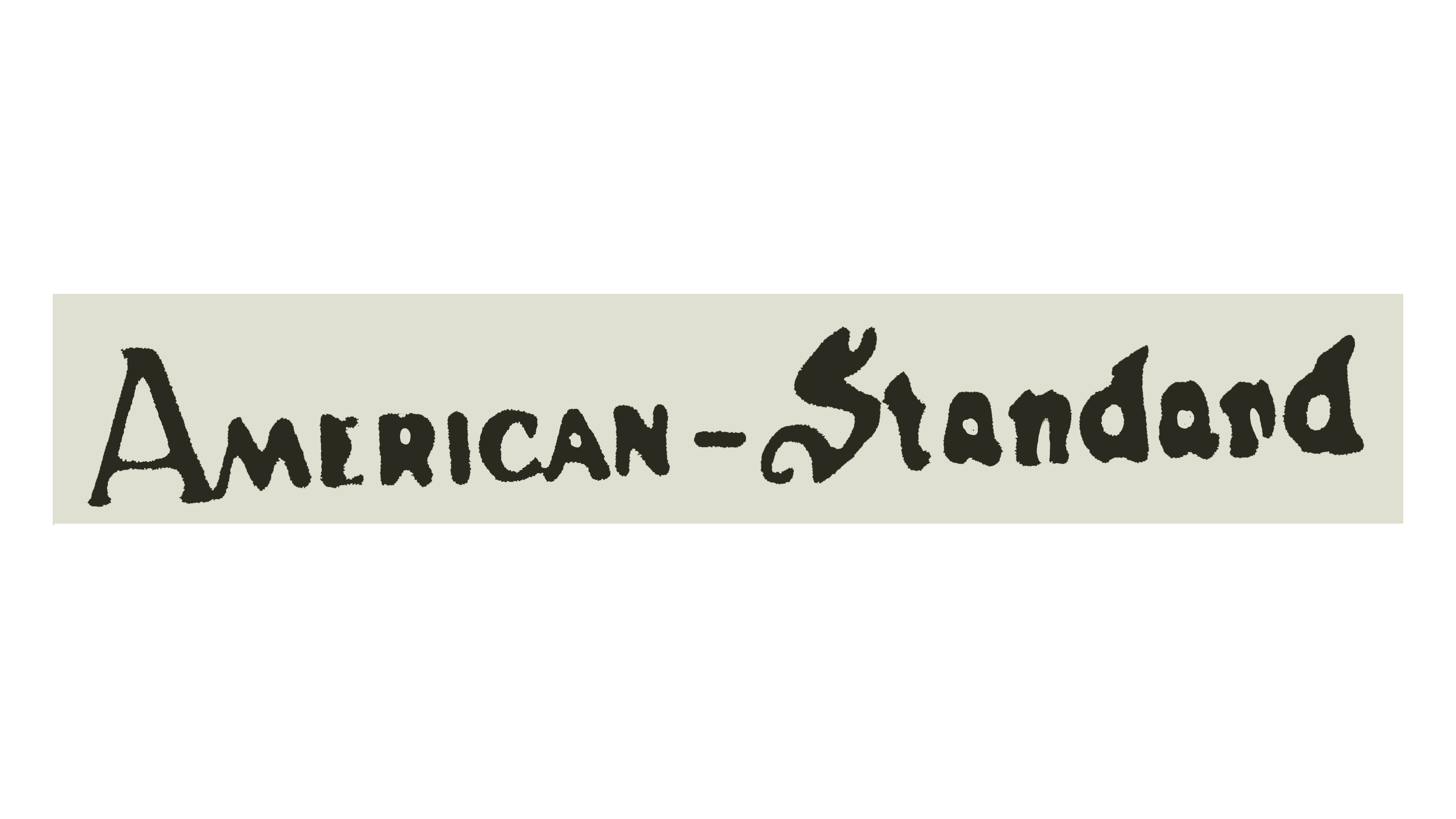
The name American Standard Corporation first appeared in 1964. It was easy to remember, sounded strong and confident, and helped the company stand out from the competition. Once again, the logo consisted solely of a verbal inscription, namely “American Standard.” A stylish serif font was used for this inscription, which looked rather old-fashioned. While “American” looked very old-fashioned, the characters in “Standard” had Gothic references. For example, with the first letter “S.” Looking at it, you get the feeling that it was copied directly from some manuscript of the Middle Ages.
1969 – 1984
The company only used the previous version for a few years. Because the ambiguous font could lead to unintended associations, the company decided to redesign it. It was now a modern logo that included not only the verbal inscription “American Standard” but also an emblem.
The emblem was a white square with thin black outlines, inside which was a black circle. At the bottom of this circle is a white triangle pointing down, and at the top is a white semicircle, a bit like a horizon.
Underneath the emblem is the verbal inscription “American Standard.” It used a classic black serif font with thin lines. All of the letters in the word inscription were capitalized. The letters were also widely spaced.
1984 – 2013
The 1984 redesign introduced an unusual element to the logo: an italic blue font, which the company used to evoke positive emotions in potential customers. The serifs and emblem were also removed. The inscription looked modern and stylish. Visually, it resembled a portrait, making the logo more approachable to ordinary people. Perhaps these changes were made to demonstrate the high quality of each product.
2013 – today
The italicized lettering remained the basis even after the 2017 redesign. At this point, the company chose the well-known agency Sterling Brands. Now, the American Standard company name looked even more elegant and modern. The diagonal lettering made this possible. In addition, you can see the connection of the first letters in words with a long line. This creates an optimistic effect. The color has been changed to navy blue, which seems more appropriate for a company that specializes in plumbing.
2017 – today
Alongside the previous version, a slightly more subdued but no less spectacular one is also used. It is also italicized, but on a horizontal line. The black color looks official and progressive, making you want to explore the project’s features.
Font and colors
The basis, as a rule, was the font, which, in its features, is close to cursive, creating the effect of a handwritten note.
The color palette, as a rule, consisted of black, white, and gray. These tones conveyed the company’s official, businesslike status and its serious approach to business.