


 Appalachian State Mountaineers Logo PNG
The letter A, often used as an emblem for sports communities, has become the main element of Appalachian State University’s sports department identity. The Appalachian State Mountaineers logo forms the shape of the region, paying tribute to the first visualization.
Appalachian State University was founded in 1899 in Boone, North Carolina, as a teacher training school for the Appalachian region. Athletic teams appeared early and adopted the name Mountaineers, reflecting the mountain setting, while the mascot Yosef, introduced in 1942, cemented the program’s image.
For much of the 20th century, the program competed in Division II and later Division I-AA. Despite its smaller scale, Appalachian State built a strong football tradition that peaked in the late 1990s and 2000s. Between 2005 and 2007, the team won three consecutive FCS national championships. On September 1, 2007, Appalachian State defeated the University of Michigan 34–32 in Ann Arbor. Michigan, representing the Big Ten and playing in a stadium of over 100,000 seats, entered as a heavy favorite.
A blocked field goal in the final seconds secured what became one of the most notable upsets in NCAA history. In 2014, the program moved to the FBS level and joined the Sun Belt Conference. he transition brought higher competition, but Appalachian State quickly established itself. From 2019 to 2021, the team won three consecutive Sun Belt championships, competing with Louisiana and Coastal Carolina. In 2022, Appalachian State defeated Texas A&M 17–14 on the road, reinforcing its record of wins over programs with larger budgets and more extensive infrastructure.
Meaning and History
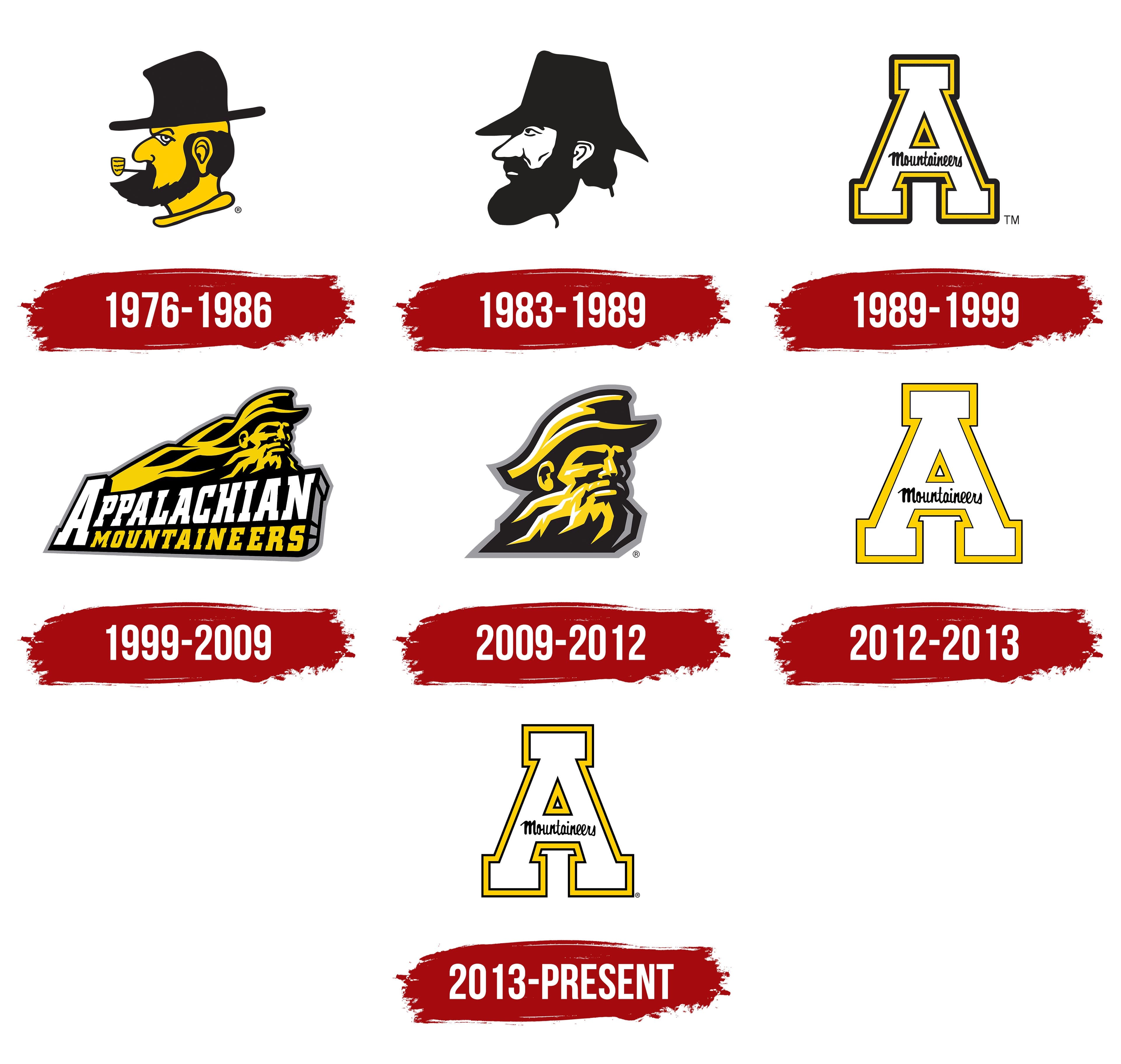 Evolution of the Appalachian State Mountaineers Logo
What are the Appalachian State Mountaineers?
Appalachian State Mountaineers are a sports team at Appalachian State University in Boone, North Carolina. The team is part of several important associations, including the Sun Belt, MAC, and NCAA, and competes in Division I. The university program includes 17 student teams.
1976 – 1986

The mountaineer in the Appalachian State Mountaineers emblem represents the Appalachian Mountains, which gave the university its name. Appalachian refers to the mountain range, while Mountaineers describes the people who live there. The name identifies the athletic teams of Appalachian State University in Boone, North Carolina. Their mascot, Yosef, entered student life decades before the introduction of the color athletic logo.
The institution began as Watauga Academy, founded in 1899 by brothers Blanford Barnard and Dauphin Disco Dougherty, along with Lillie Shull Dougherty. Its academic mission, status, and name evolved while retaining ties to the region. In 1903, it became Appalachian Training School. It was renamed Appalachian State Normal School in 1925 and became Appalachian State Teachers College in 1929. The name Appalachian State University was adopted in 1967.
Yosef first appeared in the 1942 edition of The Rhododendron yearbook after a space was left in a row of student photographs. While preparing the issue, editor James Story, assistant editor Elizabeth South, freshman Lloyd S. Isaacs, and Observer Publishing representative Bill Mitchell discussed how to fill the space. They included a drawing of a fictional freshman, Dan’l Boone Yoseff, listed as a member of the 1941–42 class. The bearded man wore a tall hat and suspenders and smoked a pipe. Students embraced the character, creating demand for sets of his portraits.
The name Yosef represented a local pronunciation of “yourself.” In the university’s interpretation, the character represents App State alumni, fans, and friends united by their loyalty to the black and gold. The yearbook joke gradually became a mascot, appearing in student publications and at events. From 1946 to 1949, newspaper columns written in Yosef’s name featured local expressions. A university-sponsored Mr. and Mrs. Yosef contest in 1947 included hog- and chicken-calling competitions. By March 1948, the student newspaper was referring to Yosef as the Mountaineers’ mascot. His beard, hat, and corncob pipe became familiar features long before the later athletic emblems.
A color profile of Yosef with a yellow face, black hair, and a black beard took shape in the 1970s. A similar image appeared on football helmets from 1971 to 1979. The Appalachian State Mountaineers logo used from 1976 to 1986 consisted of the character’s portrait. Yosef faced left with a pipe in his mouth. His long nose, large ear, narrowed eye, and protruding beard preserved the cartoon style.
His tall black hat had an uneven crown and an almost horizontal brim. Solid black shapes defined the hair, beard, and hat, framing the yellow areas of his face and neck. Small white spaces picked out the eye and the area near the pipe, completing the black-and-yellow image.
1983 – 1989

Appalachian State updated Yosef’s appearance ahead of the 1983–84 academic year. A committee of students, faculty, and university staff worked on the redesign, which affected both the emblem and the mascot costume. The athletic department needed a costumed character who could cheer on the team and interact with the crowd. Yosef performer Todd Hutchinson was the first to wear the new costume.
The profile introduced in 1983 and used through 1989 retained the left-facing head but switched to black and white. White replaced the yellow face, with a few black lines defining the eye, nose, and cheek. The pipe was removed. The beard extended downward, the hair was concentrated at the back of the head, and the hat brim acquired angular edges. The hat, hair, and beard connected the revised portrait to the earlier Yosef.
1989 – 1999

The Block A emblem originated in spring 1989, when new head football coach Jerry Moore wanted the team’s uniforms to identify Appalachian. In his office, Moore sketched an angular capital “A” on a sheet of paper and wrote Mountaineers across its crossbar. The University of Arizona already used a similar large initial, so placing the nickname inside the letter helped distinguish Appalachian’s team.
In the version used from 1989 to 1999, the angular “A” was paired with black Mountaineers lettering that resembled connected brush script. Several alternating black and gold outlines surrounded the white interior. The letter had a flat top instead of a pointed apex and heavy rectangular serifs at its base. A triangular opening occupied the interior, while the script crossed the letter along its crossbar.
The emblem appeared on football helmets in fall 1989. Moore later recalled a newspaper photograph of Richie Melchor running during a game against Wake Forest. The image offered a close view of the letter on his helmet. Seeing the logo in game action convinced the coach that the new look worked.
1999 – 2009

Yosef returned to the Appalachian State Mountaineers’ primary logo in 1999. His portrait was combined with a mountain silhouette, with his hat and hair incorporated into the mountain’s contours. His face turned right, and his beard was divided into long, pointed strands. Black areas alternated with gold bands, and a gray outline surrounded the illustration. The pipe was omitted in keeping with the university’s tobacco-free direction for its imagery.
A shared black background united the mountain silhouette with the text below. The name appeared on two lines, with white APPALACHIAN above gold MOUNTAINEERS. The tightly spaced uppercase serif letters slanted to the right, and an oversized initial “A” spanned the height of both lines. Differences in size and color distinguished the two lines within the emblem.
2009 – 2012

A standalone portrait of Yosef served as the Appalachian State Mountaineers’ primary athletic emblem from 2009 to 2012. Previously, it had been a secondary mark. The extended mountain silhouette and two-line name were removed, leaving the character’s head as the primary logo.
The face continued to point right, while the hat, beard, and gray border defined the portrait’s outer shape. White and gold bands marked highlights on the hat, cheekbone, mustache, and individual strands of the beard. Sharp, diagonally angled points formed the bottom edge.
2012 – 2013

Block A returned as the Appalachian State Mountaineers’ primary athletic mark in 2012. The mascot portrait remained in use alongside it. For a temporary throwback look, the early profile of the mountaineer with a pipe returned as Vintage Yosef.
In the 2012–2013 Block A, a gold band bordered by thin black lines surrounded the white letter. Compared with the late-1980s version, the outer black border was narrower and the gold band wider. Mountaineers remained across the crossbar.
Vintage Yosef was unveiled in July 2012 on an alternate football uniform prepared for the September 29 game against Coastal Carolina. The uniform paired a black Nike Pro Combat jersey with a gold helmet and pants. The pipe-smoking profile appeared on the helmet and jersey, reviving the image used on uniforms from 1971 to 1979.
2013 – today

An update announced by Appalachian State on November 27, 2013, retained Block A as the primary mark and restored the historic Yosef portrait as a permanent part of the athletic identity. The changes took effect on December 1. Licensing Resource Group, the university’s licensing partner, participated in the unveiling of the logo collection.
Block A was adjusted to ensure consistent reproduction. The white fill, gold band, and black Mountaineers lettering remained. The outlines, including the letters’ black border, were thickened, and the yellow was darkened by a couple of shades. The official collection included a version with a black interior, already used on the football uniforms during the 2013 season.
The Mountaineers lettering was created for the university and forms a single design with the initial.
The Vintage Yosef portrait was renamed Victory Yosef and added to the permanent collection of secondary marks. Athletic director Charlie Cobb attributed its return to support from students, alumni, and fans, citing its historic ties to the university as a reason to continue using it. The Yosef head introduced in 1999 was retired from official use. Since December 2013, Block A and the restored mountaineer portrait have formed the basis of the athletic identity.
App State Gold, black, and white are the shared colors. Gold connects generations of emblems, from the face of the early Yosef to the border around the “A.” The standards specify Pantone 116 C for coated paper and Pantone 115 U for uncoated paper. The digital color is #FFCC00.
In 2018, a horizontal APP STATE wordmark joined the letter and portrait emblems. The university’s shortened name appears in large, slanted uppercase letters in black and gold. On a black background, white replaces the black portions. On a gold background, the gold areas become black. The wordmark represents the university independently of the Yosef portrait and Block A.