 Apple Logo PNG
An apple with a bitten segment symbolizes the practical application of a brilliant idea; the monochrome color lets you focus on the main concept. This is how the Apple logo “works,” ensuring the brand’s legendary recognition.
Steve Jobs, Steve Wozniak, and Ronald Wayne founded Apple in Cupertino on April 1, 1976. Wozniak assembled the first product, the Apple I, and sold it as a bare motherboard; about 200 units sold for $666.66 each.
In 1977, Apple introduced the Apple II with color graphics and built-in BASIC, making it one of the first mass-market personal computers and driving rapid growth. By 1980, the company went public, and shares rose from $22 to $29 within minutes.
In 1984, Apple launched the Macintosh with a graphical interface, supported by the “1984” Super Bowl advertisement. Early sales were limited by price and software availability. In 1985, Jobs left after an internal conflict, and under John Sculley, Apple expanded the Macintosh line.
The 1990s brought declining market share and unsuccessful experiments such as Newton. Jobs returned in 1997 as interim CEO, cut projects, and refocused the company. The 1998 iMac marked a shift in direction.
In 2001, Apple released the iPod, followed by the iTunes Music Store in 2003, entering the digital media market. In 2007, the iPhone combined phone, iPod, and internet functions, and in 2008, the App Store created a software ecosystem.
In 2010, the iPad entered the tablet market, and Apple became the second-largest company by market value, surpassing ExxonMobil. In 2011, Tim Cook became CEO and introduced the Apple Watch in 2014.
From 2015 to 2020, the company expanded its services to include Apple Music, Apple TV+, and Apple Arcade, and launched Apple Card with Goldman Sachs in 2019.
Between 2020 and 2023, Apple introduced its own Silicon chips for Macs and announced Vision Pro, its first mixed-reality device, planned for release in early 2024.
Meaning and History
The American company’s logo appeared immediately upon its founding. Steve Jobs and Ronald Wayne drew inspiration from a quote by Wordsworth. Therefore, the emblem depicts Isaac Newton sitting under a tree, with an apple above him that, according to legend, falls on his head and inspires a brilliant idea.
Ronald Wayne combined Apple and enlightenment concepts without much effort. He depicted Newton, with a ripe fruit of “unexpected enlightenment” about to fall on him. The design was accepted as a corporate identity, but it included too many unnecessary details that distracted from the central element. Therefore, several more options were subsequently proposed.
What is Apple?
This global company develops and manufactures computers, tablets, smartphones, audio devices, and software. It leads the creation of modern personal computers and operating systems. The brand is associated with innovative online services and high-quality electronics. Founded in the United States, the company is known for devices such as the iPhone and its recognizable bitten apple logo, which symbolizes reliability and modern design.
1976 – 1977
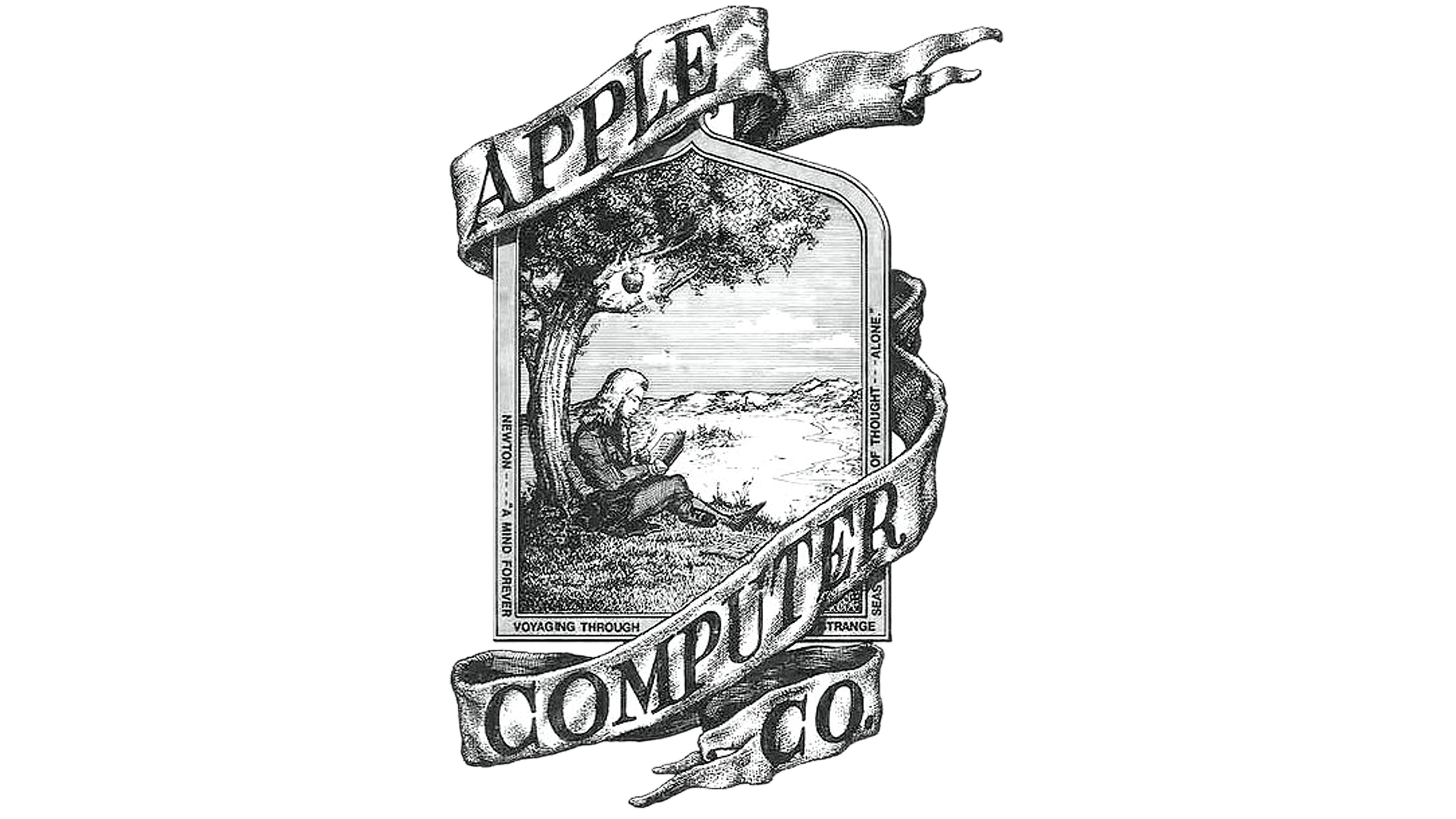
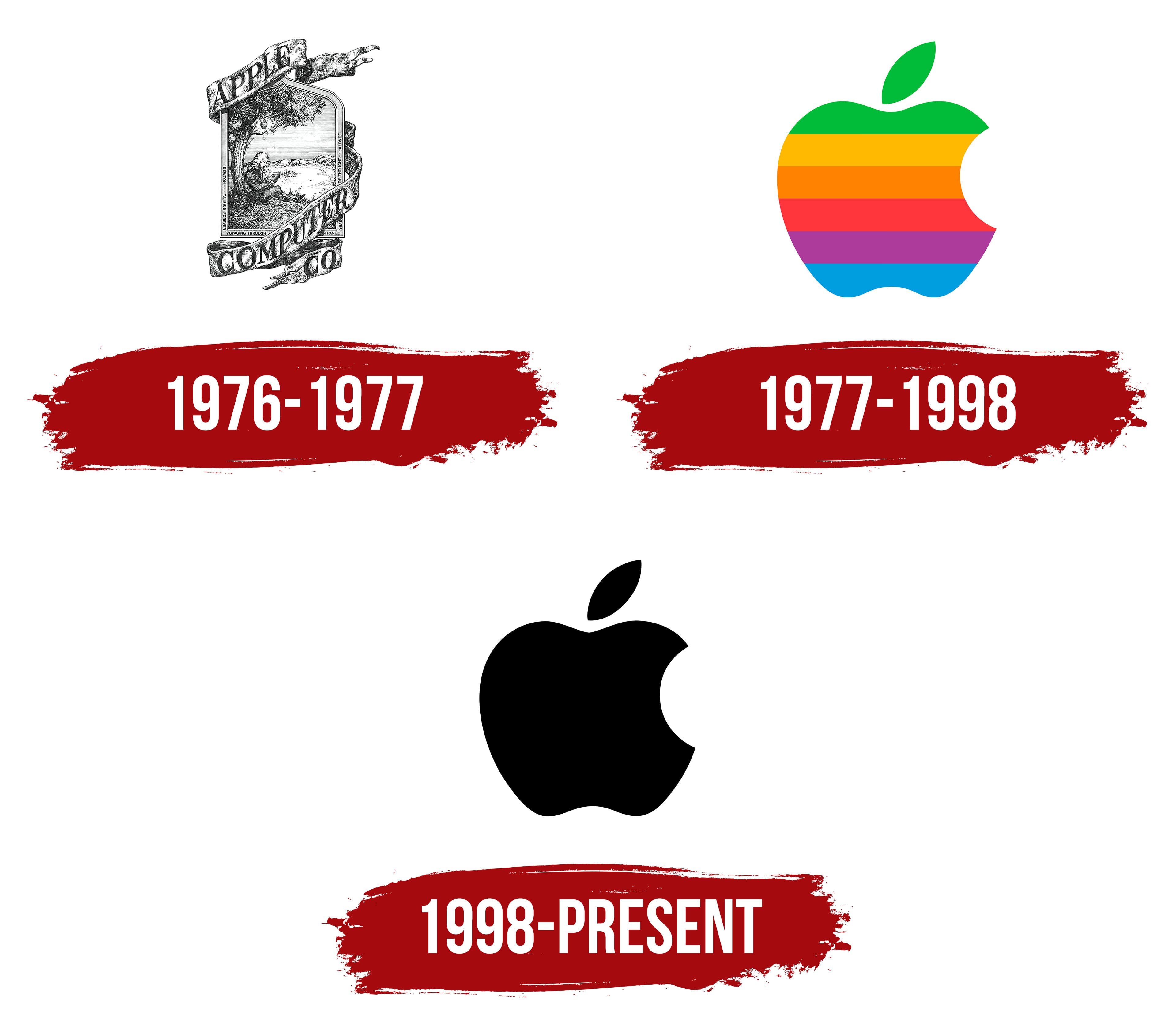
The emblem from this period resembles an artistic painting in an elongated rectangle. It depicts a man seated under the canopy of a sprawling tree, holding a book, with a large apple hanging above him. The composition is rendered in black and white. A wide ribbon with curled ends frames the logo at the top and bottom. The ribbon bears the inscription “APPLE COMPUTER CO.,” and encircles the image, emphasizing the company’s name.
The detail is striking: every line and shadow adds depth and dimension. The apple hanging from the branch references the moment Isaac Newton discovered the law of gravity, symbolizing scientific breakthroughs and ingenuity. The logo also features fine text: “Newton A Mind Forever Voyaging Through Strange Seas of Thought Alone.” This phrase conveys the company’s lofty ideals and commitment to intellectual exploration.
The visual design resembles an engraving or an illustration from an old book. The ribbon lettering uses a classic font that complements the overall retro style. However, the design’s complexity was both a strength and a weakness. On the one hand, it stood out among competitors; on the other hand, its intricacy made it harder to recognize at first glance.
One of Apple’s co-founders, Ron Wayne, created the logo to highlight the company’s intellectual foundation and innovative aspirations. However, within a year, the company abandoned this emblem for a more minimalist, modern design aligned with the spirit of the times and technological evolution.
1977 – 1998
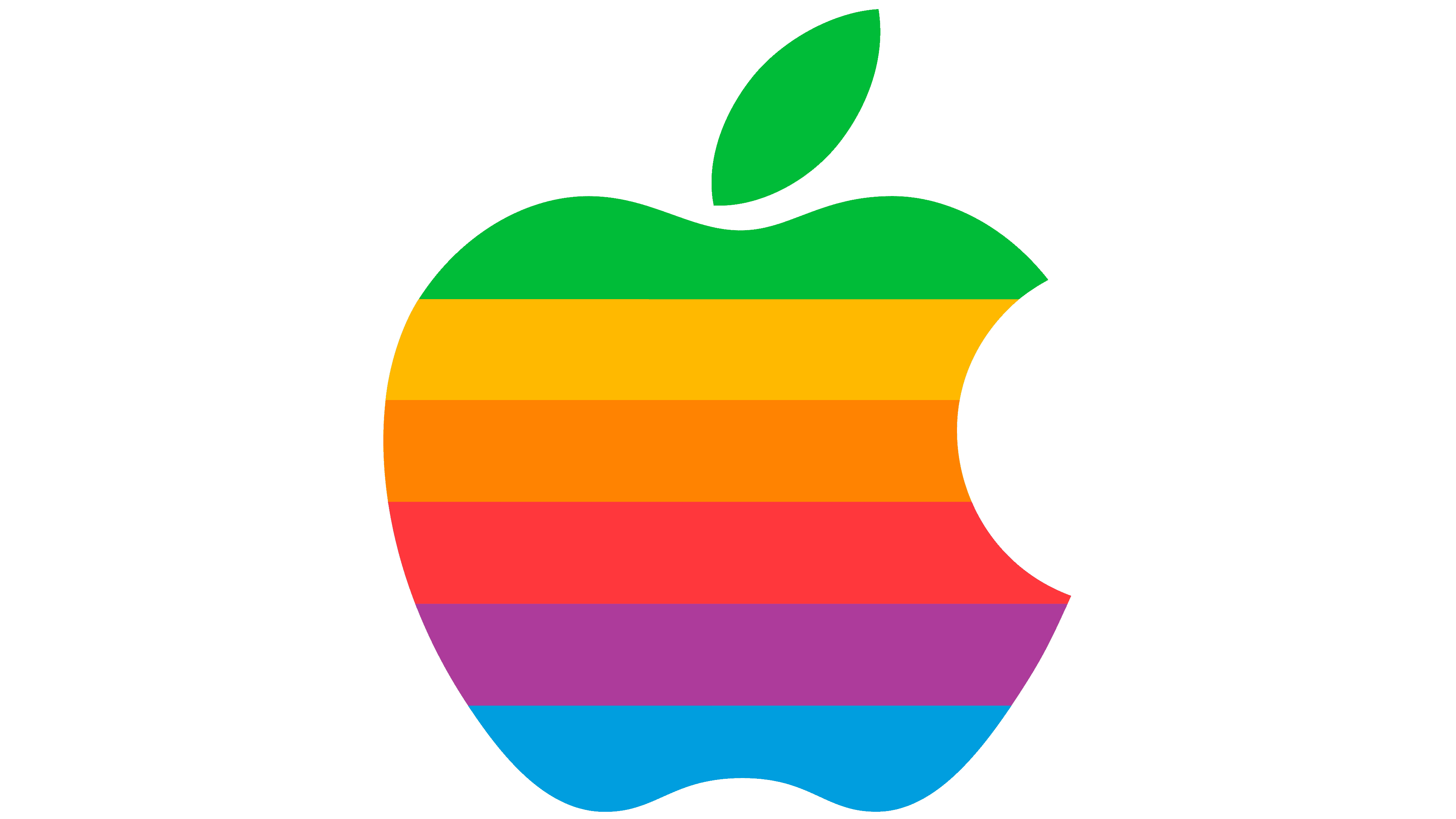
The 1977 logo starkly contrasted the previous black-and-white version. Simplicity and brightness replaced intricate details and dense symbolism. Prominent graphic designer Rob Janoff created it. After meeting with Apple’s executives, he decided to visualize the concept by picking up a bag of apples from the store. Inspired, he began experimenting with shapes and cuts to create the most expressive design.
The logo’s defining feature was depicting an apple with a “bitten” edge. This element added symbolic depth and eliminated any potential confusion with a cherry. The simplified shape proved concise and memorable, perfectly suited to the new era of digital technology.
The new symbol’s color palette featured six vibrant stripes resembling a rainbow. According to Steve Jobs, this was necessary to highlight the company’s shift to color-display computers. Each stripe’s hue appeared vivid and “juicy,” like fresh apple varieties, emphasizing the brand’s innovative approach and cheerful spirit.
The apple’s shape symbolizes creativity and scientific progress, linking the emblem to Newton’s legend. Its compact, minimalist design made it easy for the company to use the logo across media, from print to digital displays. The logo’s form has remained Apple’s hallmark for over four decades and remains one of the world’s most recognizable symbols.
1998 – today
In 1998, Apple significantly updated its logo, abandoning the bright rainbow for a monochrome version. Several factors drove this transition. First, minimalism in graphic design was becoming increasingly popular, and bright colors could distract from the brand’s core concept of innovative technology. Second, this approach emphasizes the elegance and versatility of Apple products, available in a range of color options.
While the black version of the emblem became the standard, the company rarely used it in daily operations. Instead, the company used various color solutions, from metallic shades that highlight the product’s premium quality to gradients that add dynamism. The color often depended on the product it was applied to. For example, on that era’s iMac, the logo had a metallic sheen that complemented the new approach to computer design.
This shift in form and approach moved toward simplification and foreshadowed future design trends. Decades later, many major companies, including automotive brands, began transitioning to black, minimalist visual symbols that are adaptable across color palettes. However, Apple was ahead of its time, initiating this trend as early as 1998. This decision underscored the company’s ability to stay current and shape its visual identity’s evolution.
This foresight was directly tied to Steve Jobs’s vision. He always sought to anticipate user expectations and set new standards. His decision to abandon ostentation and favor simplicity symbolized Apple’s philosophy of functionality, elegance, and versatility. This approach has kept the Apple logo relevant and recognizable for decades, despite constant technological and market changes.
Font and Colors
All Apple products, including the iPad and iPhone, bear the famous Apple logo. This legendary trademark has made the manufacturer famous and its products recognizable worldwide. The bitten fruit is synonymous with Apple and a key part of its visual identity. That’s why it has remained unchanged since 1977, except for a slight palette change.
The modern logo has no inscriptions; they appeared only on the old brand name, used from 1976 to 1977. The font was similar to Caslon’s, with minor deviations from the accepted letterforms.
In the original version, the apple was completely black, set against a pure white background. Until 1998, it was bright and colorful. The fruit had six stripes (from top to bottom): light green, yellow, orange, raspberry-red, purple, and blue.