


 Samsung Logo PNG
The Samsung logo conveys the spirit of a technology company. It represents innovation, reliability, and a drive to improve everyday life through smart devices. The symbol combines modern ideas and practicality.
Samsung was founded in 1938 in Daegu by Lee Byung-chul as a small trading firm with forty employees. The name meant “three stars,” reflecting ideas of strength and longevity. Early business focused on dried fish, noodles, and food exports to China. The Korean War in 1950–1953 destroyed the original operations, forcing a shift into sugar production with Cheil Jedang in 1954, followed by insurance in 1956 and real estate in 1958.
A major pivot came in 1969 with the creation of Samsung Electronics. The first products included black-and-white TVs in 1970, along with refrigerators and washing machines. In 1974, the company acquired Korea Semiconductor, laying the foundation for its chip business. By 1977, Samsung entered global markets, selling TVs in Europe and North America under the Sampo name. In 1983, it developed Korea’s first 64K DRAM, entering the market against Toshiba and NEC.
After Lee Byung-chul died in 1987, Lee Kun-hee took control and, in 1993, launched quality-focused reforms. In 1995, Samsung publicly destroyed defective products worth about $50 million at a factory in Gumi. During the 1990s, Samsung became a leading memory-chip producer and overtook Japanese rivals by 1996. The Asian financial crisis of 1997–1998 led to heavy debt, asset sales, and layoffs, but recovery followed in 1999.
In the 2000s, Samsung expanded globally. In 2002, it surpassed Sony in U.S. TV sales. In 2009, the company launched Galaxy smartphones on Android, followed by the Galaxy S in 2010, competing directly with the Apple iPhone. A 2012 patent dispute resulted in a major court ruling against Samsung. In 2016, the Galaxy Note 7 recall caused major losses and led to a corruption case involving Lee Jae-yong.
Meaning and History
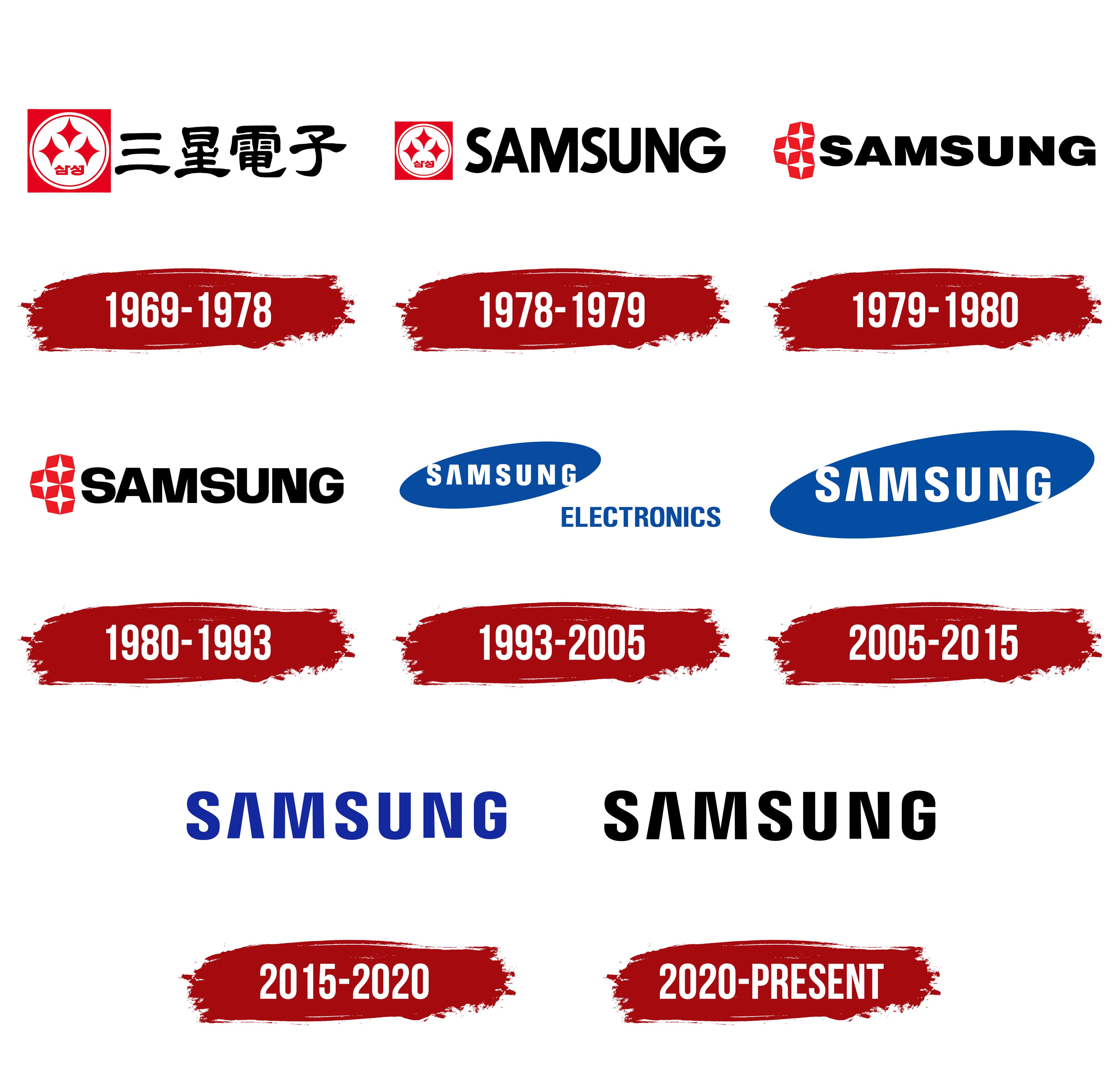
Samsung changed its business focus several times, and its logo changed with it. The current symbol is widely considered a successful rebrand, largely thanks to strong marketing and large-scale advertising campaigns. It looks completely different from previous versions, with a different color palette and font.
What is Samsung?
It is a South Korean manufacturer of home appliances, electronics, medical equipment, clothing, chemical products, and building materials. The company also operates its own hotel business and provides insurance and financial services. This giant conglomerate comprises dozens of companies. Its history began in 1938, when it sold noodles and dried fish.
1969 – 1978

Today, Samsung is most often associated with electronics and home appliances, but the company’s early history was very different. In its first years, the Samsung logo appeared on packaging for instant noodles, dried fish, rice, and even alcoholic products. The design used Korean characters, a red square, and a white circle with three four-pointed stars inside. Why three stars? The stars are connected to the brand name. The word Samsung is a Latinized form of the name used in international markets, while Samseong is the Korean spelling and pronunciation. From this comes the idea that Sam translates as ‘three’ and corresponds to Seong, which means ‘star’.
Over time, several interpretations of the name appeared. According to one account, the founder called his three sons successors to the family business. Another version links the symbol to the ambition to build a large company, like stars in the night sky. The characters themselves carry additional meaning. Sam represents strength and scale, while Seong represents permanence and infinity.
The early mark featured a red square with a white circle. Inside the circle were three diamond-shaped figures that resembled both stars and cut crystals. Below the circle was the inscription 삼성 with the company name in Korean.
To the right was an additional Chinese inscription, 三星電子, which translates to “Samsung Electronics”. The brush calligraphy featured smooth lines and soft stroke endings. This trademark marked the beginning of the company’s path toward becoming one of the world’s largest technology brands.
1978 – 1979
In 1978, Samsung changed its business direction and entered real estate and insurance. This shift affected the mark’s appearance. The company removed all references to its early food products. A link to the past remained in the white circle with three red stars inside a square.
The name SAMSUNG first appeared in English on the logo. It emphasized the company’s move beyond the domestic market and its focus on international activity. The wordmark sat to the right of the symbol and was set in uppercase letters in a strict sans-serif typeface. The overall appearance looked businesslike and restrained.
On the left was the symbol, a red square with a white circle. Inside the circle were three stylized stars with four elongated points. Below them was the Korean inscription 삼성.
1979 – 1980

At the end of 1979, the company updated the logo again. The founder considered the previous version outdated and ordered a redesign. The white circle was removed, and the three red stars were separated and spread apart. Each star was placed inside its own hexagonal shape.
The left side of the mark underwent a makeover. The symbol was assembled from three separate hexagons. Inside each shape were white elements forming diamond-like four-pointed stars.
To the right of the symbol was a black SAMSUNG wordmark. The typeface was also updated. It used dense, uppercase letters without serifs or decorative elements. The wordmark appeared heavy and business-oriented.
The company aimed to look more modern and to emphasize its focus on activity beyond the domestic market.
1980 -1993

In the new version of the Samsung logo, three red shapes resembling cut gemstones are placed on the left. Inside each is a white star. These elements repeat the earlier imagery and remain unchanged in form.
On the right, the brand name is set in all caps in black. The typeface was updated. A dense, grotesque font was used, closely resembling a modified Helvetica Black.
The color scheme remained the same. The symbol is rendered in red with white details, while the company name is black.
The layout maintained a connection to the previous mark and refreshed the wordmark, making it calmer and easier to read.
1993 – 2005
The new visual image was tied to the company’s entry into the international market and its move into the technology sector. Constance Birdsall developed the project at Lippincott and Margulies.
The name SAMSUNG appears in white letters on a blue oval background. The oval is elongated and tilted diagonally, visually resembling a capsule. Its shape aligns with the theme of technology and references the brand’s early use of the star motif.
The wordmark uses a modified version of the Linotype Univers 820 Condensed Black typeface. The letters are large, dense, and sans serif. Below the oval is the word ELECTRONICS, in elongated blue uppercase letters.
The brand began to look simpler and more closely aligned with the technology industry.
2005 – 2015

In June 2005, the company carried out another redesign. It was less a redesign and more a simplification of the logo. The word ELECTRONICS was removed from the mark. The blue oval remained, stretched diagonally upward and to the right. Inside, the name SAMSUNG continued to appear in white, uppercase letters.
The Linotype Univers 820 Condensed Black typeface was retained and refined for the brand. By then, the name SAMSUNG was already recognized independently and no longer needed clarification.
2015 – 2020

The Samsung logo shown at CES in January 2013 marked the company’s transition to a calmer visual image. The Brandstream team developed the updated style. The main focus shifted to the rendering of the name. The oval shape was removed, leaving only the word Samsung in its familiar blue color.
The new wordmark uses the same Linotype Univers 820 Condensed Black typeface, with careful refinements. In appearance, the lettering resembles the former ELECTRONICS word and is visually close to Helvetica Black and DDT Cond SemiBold, while retaining differences in proportions and minor details.
The wordmark consisting solely of the brand name gradually became the core element of Samsung’s identity. After its public debut in 2013, Samsung officially approved it as the primary mark in June 2015. The old oval symbol did not disappear; Samsung Group and several subsidiaries continued to use it.
2020 – today

In January 2020, the brand adopted a monochrome design and moved away from its familiar blue. The changes affected only the color scheme, replacing blue with a black-and-white combination. In form, the logo repeated the version used since 2015. No other changes were made.
Samsung presented the updated emblem at CES 2020, held from January 7 to 10. After that, the monochrome version became Samsung Electronics’ primary visual representation.
Font and Colors
The South Korean company’s emblem has nothing superfluous, only the inscription “SAMSUNG” in uppercase. After the 2005 redesign, the wordmark sits on a plain background. Before that, it was set inside a relief oval, meant to appeal to Samsung electronics and home appliance owners. remember
However, developers simplified the design by removing the geometric shape and leaving only the brand name. This concept differs significantly from the original because, from 1969 to 1993, the logo featured three four-pointed stars.
The word “SAMSUNG” resembles the fonts DDT Cond SemiBold and Helvetica Black. Clean lines, numerous angles, and the absence of serifs characterize it. The letter “A,” consisting of only two diagonal strokes, deserves special attention.
Another notable feature of the emblem is the dark blue color (#034EA2). It’s used for the inscription, with a white background.