


 Sony Logo PNG
The emblem symbolizes achievements in modern electronics and multimedia technologies and impeccable Japanese quality, as in the Sony logo, founded in 1946. The name and graphics reflect the national culture’s innovative views and features.
Sony was founded in May 1946 in Tokyo by Masaru Ibuka and Akio Morita as Tokyo Tsushin Kogyo, operating with minimal capital and eight employees in a damaged building. Early activity focused on radio repair and basic consumer devices.
In 1950, the company released Japan’s first tape recorder, the G-Type, demonstrating its engineering capabilities. In 1952, Morita secured a license from Bell Labs to manufacture transistors, enabling a shift toward compact electronics. By 1955, Sony had launched the TR-55 radio, followed by the TR-63 in 1957, which was designed for portability and widely adopted in the US. That same year, the company adopted the name Sony.
In 1960, Sony introduced a transistor television. In 1968, it developed Trinitron, a new display technology that strengthened its position against Matsushita and Hitachi. In 1971, the company released U-matic, a professional video cassette system used by broadcasters.
In 1975, Sony launched Betamax, entering direct competition with Matsushita’s VHS. Despite better image quality, Betamax lost market share due to its shorter recording time, and by 1988, Sony had adopted VHS as its standard.
In 1979, Sony released the Walkman, a portable cassette player built for playback only. In 1982, Sony and Philips introduced the compact disc, replacing analog formats.
In 1988, Sony acquired CBS Records, followed by Columbia Pictures in 1989, expanding into music and film. In 1994, Sony released the PlayStation after a failed partnership with Nintendo, and it reached over 100 million units by 2000.
Meaning and History
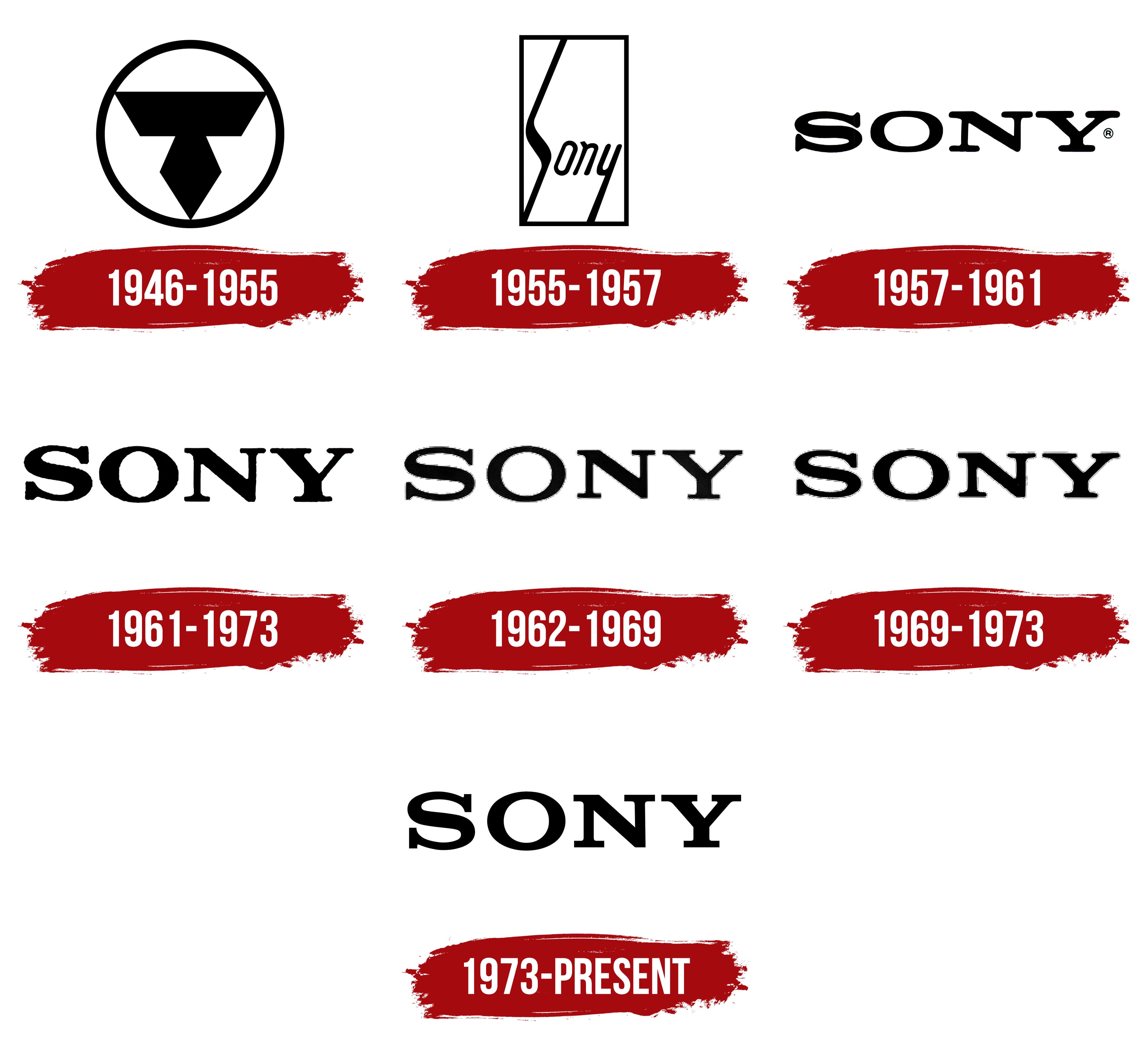
The Sony logo is one of the most recognizable. It features the company name, derived from the Latin “Sonus” (“sound”). It also connects to the word “son,” which in Japanese culture denotes young people with an innovative outlook.
What is Sony?
Sony is a Japanese corporation, the country’s richest company, spanning a wide range of industries. It manufactures electronic devices and household appliances, releases video games and consoles, produces movies, and records musical compositions. It is a multifaceted conglomerate: a record label, film studio, and electrical engineering company. The company was founded in 1946, and its headquarters are located in Japan’s capital.
1946 – 1955

The company wasn’t always called Sony. In 1946, it was known as Tokyo Tsushin Kogyo, so the letter “T” became central to its emblem. The symbol consisted of an inverted isosceles trapezoid and a rhombus located inside a black ring.
1955 – 1957

In 1955, the Sony brand appeared. Its name was different from the main logo. It was an italic inscription “Sony” placed in a rectangular frame. The elongated letters “S” and “y” gave it a special shade.
1957 – 1961

In 1958, the Tokyo Tsushin Kogyo group of companies was renamed Sony Corporation. Part of the rebranding was changing the logo. Yasuo Kuroki, a full-time company designer, invented the new version. He removed the quadrangle, leaving only the inscription “Sony.” To emphasize its importance, he chose a bold font with large serifs.
1961 – 1973

Norio Ohga, a former company president, criticized the existing logo and suggested improving it. Chief designer Akio Morita agreed and appointed Ohga to his position. Under his leadership, Yasuo Kuroki revised the trademark, making the letters “S” slightly larger than “O,” “N,” and “Y” so they wouldn’t look too small in visual displays. The logo changed several more times before the final version appeared. All versions differed only in bold letters and slightly altered font.
1962 – 1969

The 1962 logo differs from the previous version by having thinner letters: if the font was bold in 1961-1962, the designers now reduced the line width.
1969 – 1973

In 1969, changes to the emblem were minor. The developers thickened the sides of the letter “O” and the right diagonal stroke of “Y.”
1973 – today

In 1973, the designer created an emblem that satisfied the discerning Norio Ohga. The head felt that it perfectly reflected the company’s corporate image. The black-on-white design symbolizes integrity and elegance. The font resembles Clarendon with minor modifications.
The company tried several times to change the trademark, even holding a contest for its 35th anniversary. It received about 30,000 applications, but none were selected as the Sony logo.
Font and Colors

Historically, the Sony trademark contained only its name. Adhering to a minimalist concept, the designers focused on the brand and avoided bright decorative elements. The simple inscription has served as the emblem since 1957, but has undergone several changes to better reflect the manufacturer’s corporate style in electronics and multimedia. The company adopted the final version in 1973.

The logo’s font resembles Clarendon, designed by typographer Robert Besley. It is a bold font with long rectangular serifs. From 1961 to 1973, the company’s in-house designer, Yasuo Kuroki, developed the font under the supervision of the corporation’s former President, Norio Ohga. The emblem’s palette is concise, comprising just two colors: black (for the inscription) and white (for the background).