


 Vodafone Logo PNG
“Communication here is always trendy,” states the Vodafone logo. The emblem reflects the love for customers. It actively supports connections and contacts. Represents the company through which a large volume of information flows.
Vodafone traces its origins to Racal Electronics, a UK defense contractor focused on military radio. In 1981, Ernest Harrison and Gerry Whent launched Racal Strategic Radio. In 1982, Racal partnered with Millicom, founded by Jan Stenbeck, and secured a mobile license alongside British Telecom.
The Vodafone name debuted on March 22, 1984, derived from “Voice Data Fone”. On January 1, 1985, the network launched, and comedian Ernie Wise made the UK’s first public mobile call. British Telecom’s Cellnet became the main rival.
By 1987, Vodafone covered 80 percent of the population. In September 1991, Racal Telecom was spun off as Vodafone Group Plc and introduced GSM, replacing TACS. In 1994, digital data and fax followed, while acquisitions included Talkland and Peoples Phone.
In 1997, Christopher Gent became CEO and drove expansion. In 1999, Vodafone acquired AirTouch Communications for $62B, forming Vodafone AirTouch and gaining a stake in Mannesmann. US assets were transferred to Verizon Wireless as part of the Bell Atlantic merger.
A hostile bid for Mannesmann began in November 1999, after Vodafone purchased Orange. On February 3, 2000, Mannesmann accepted a £112B offer, the largest deal at the time. The EU required the sale of Orange to France Telecom. In July 2000, the company returned to Vodafone Group Plc.
The merger created Europe’s largest mobile operator. In 2001, partner networks launched with TDC Mobil, and it acquired Eircell. Vodafone Live! followed in 2002. Expansion continued into Turkey, the Czech Republic, and India via Hutchison Essar. In May 2006, losses reached £14.9B after asset write-downs.
Meaning and History
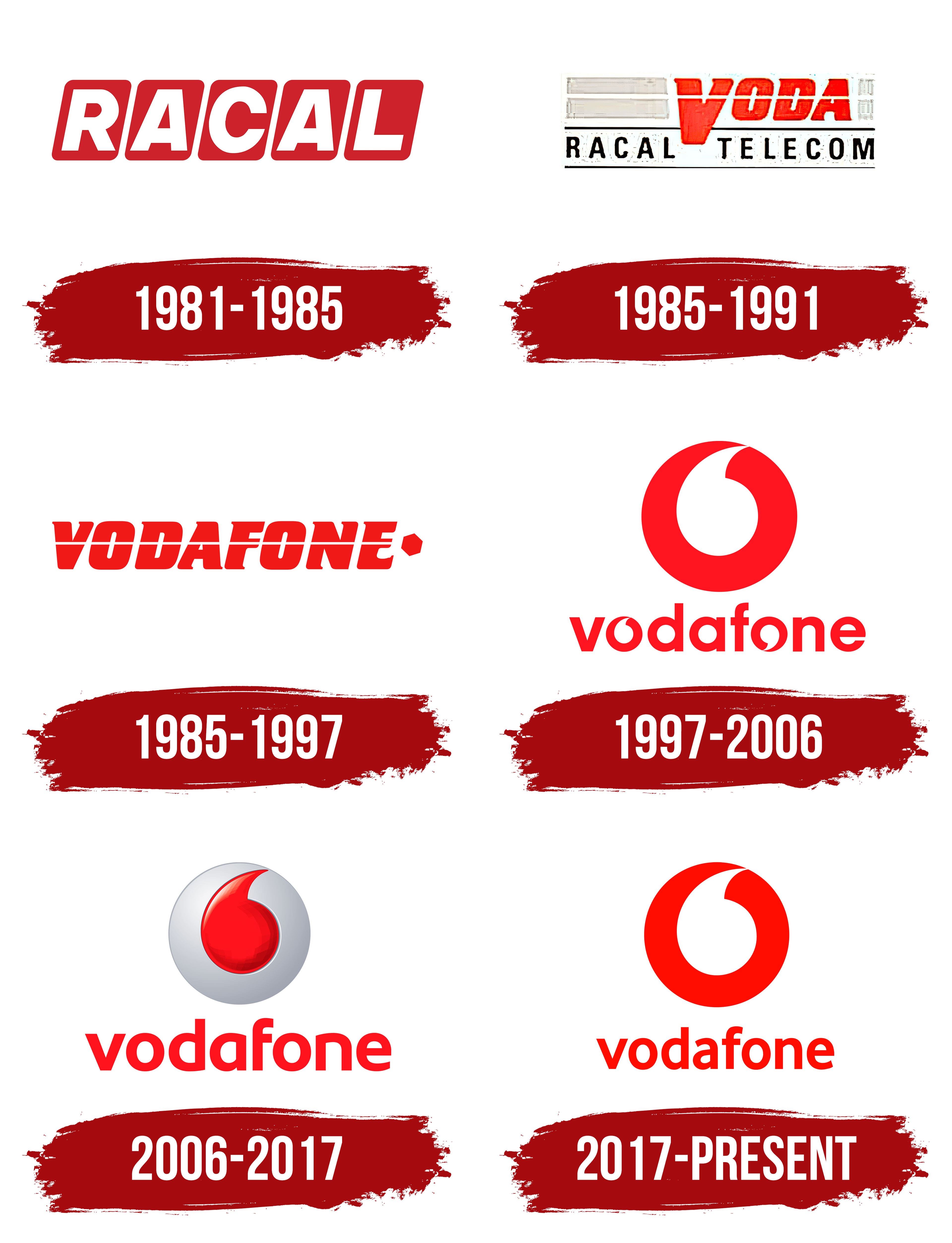
On September 16, 1991, Racal-Vodafone separated from its parent company and became Vodafone Group. One of its founders, Gerry Whent, led it. This marks the first time the logo featured the new structure’s official name. It uses the word “Vodafone”, formed from fragments of the phrase “vo ice” + “da ta” + “fone.” Throughout its history, the service has had six logos.
What is Vodafone?
Vodafone is a British telecommunications operator that provides mobile and fixed communication services, internet television, and digital television. The brand emerged in 1991 from the merger of two companies. Ernest Harrison and Gerry Whent founded it. The company primarily operates in Europe, Africa, Asia, and Oceania.
1981 – 1985

The debut emblem is the word “Racal,” written in capital white letters in separate red squares.
1985 – 1991
During this period, the emblem featured the company’s second name, Racal-Vodafone, with “Racal Telecom” at the bottom and a large “Voda” at the top.
1985 – 1997
From 1985, another version of the logo was used in parallel, based on the company’s new name, “Vodafone.” The symbol consisted of thin serifs in red capital letters and a straight white line crossing the word horizontally.
1997 – 2006
In 1997, the telecommunications service emblem was redesigned. It looks like a red circle with a white quotation mark in the center.
2006 – 2017
During this period, developers proposed another version of the logo, changing the previous version’s colors. It appeared as a combination of gray and red, with volumetric reflections and shadows.
2017 – today
In 2017, management returned to the 1997 logo: a two-dimensional, flat, white-and-red design.
Font and Colors

The London studio Brand Union created the new logo. It emphasized the quotation mark (in quotes) and offered various branding packages. It features the main visual identification sign and icons, buttons, short symbols, and inscriptions.
If the previous version was simple and smooth, the current one is more complex. For example, the thin sans serif font plays with the letter “O,” which repeats the graphic symbol. But the color palette has always been the same, a combination of red and white. At one point, they added gray.