


 HP Logo PNG
Going beyond the known, expanding horizons, and being ahead of its time- all this is the HP logo. The emblem’s shape is visually pleasing. The color scheme symbolizes a business approach and innovation. The sign reflects the desire to create maximum comfort for users in the future.
In 1939, Stanford graduates Bill Hewlett and Dave Packard started work in a rented garage at 367 Addison Avenue in Palo Alto with $538. Walt Disney soon bought their first product, the HP Model 200A audio oscillator, for the film Fantasia, marking the company’s first commercial deal. The firm was incorporated in 1947, with Packard as president and Hewlett as vice president. By 1948, revenue had reached $2.2 million, and the company employed 128 people. During the 1950s, Hewlett-Packard expanded internationally, including a 1963 joint venture with Yokogawa in Tokyo.
In 1968, HP introduced the 9100A, later described as an early personal computer. In 1972, the HP-35 became the first handheld scientific calculator, replacing large desktop machines. HP entered the personal computer market in 1980 with the HP-85. In 1984, it launched the LaserJet printer, its most commercially successful product. By 1993, it had sold ten million units. That same year, Packard stepped down as chairman. In 1997, HP joined the Dow Jones Industrial Average.
In 1999, HP spun off non-core operations into Agilent Technologies. CEO Carly Fiorina led the company through a controversial merger with Compaq, completed in 2002 despite opposition from Walter Hewlett. After Fiorina’s departure in 2005, CEO Mark Hurd increased revenue, surpassing $100 billion in 2007. Acquisitions included Electronic Data Systems, 3Com, Palm, and 3PAR.
By 2011, HP employed 350,000 people globally. A series of acquisitions and management issues strained its finances. In 2015, the company split into HP Inc. and Hewlett Packard Enterprise. HP Inc. continued competing with firms like Dell in PCs and printers. In April 2024, HP became the title sponsor of Scuderia Ferrari, marking a new phase in the brand’s visibility in Formula 1.
Meaning and History
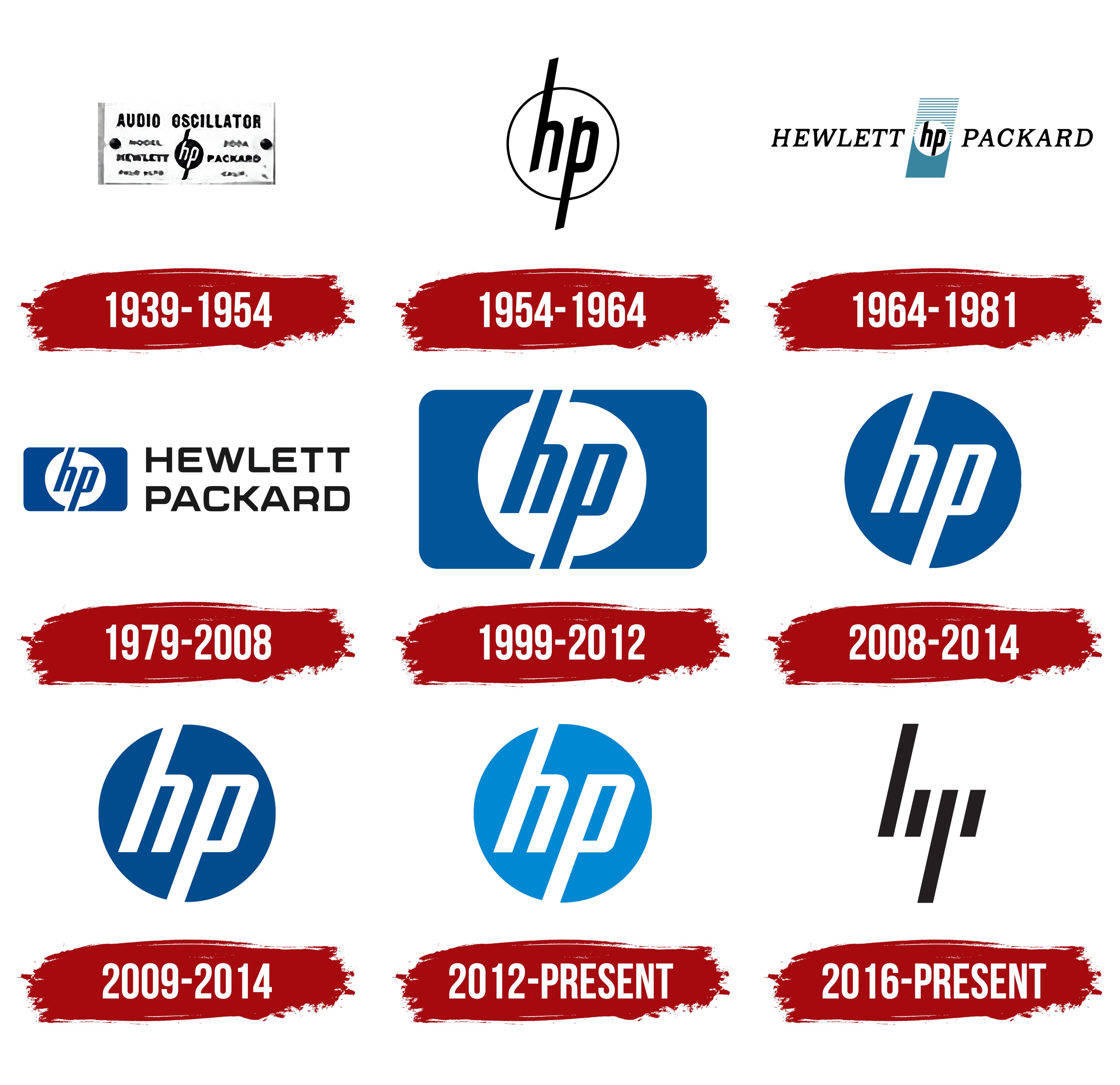
The evolution of the HP logo reflects all its transformations, from the company’s founding in a garage to its division into two parallel structures. HP Inc. was the direct successor to the parent corporation. Its visual identity mark appeared in 1939 and has not changed dramatically. The original version is black-and-white. The logo was colored only in the late 1970s. An innovative version is currently in use.
What is HP?
HP is a company that succeeded Hewlett-Packard. It was founded in 2015, while its predecessor was established in 1939. It is an American corporation that manufactures PCs, scanners, printers, and software, and provides IT services. It is best known for its computers and has competed with market leaders such as Apple, Lenovo, and Dell.
1939 – 1954
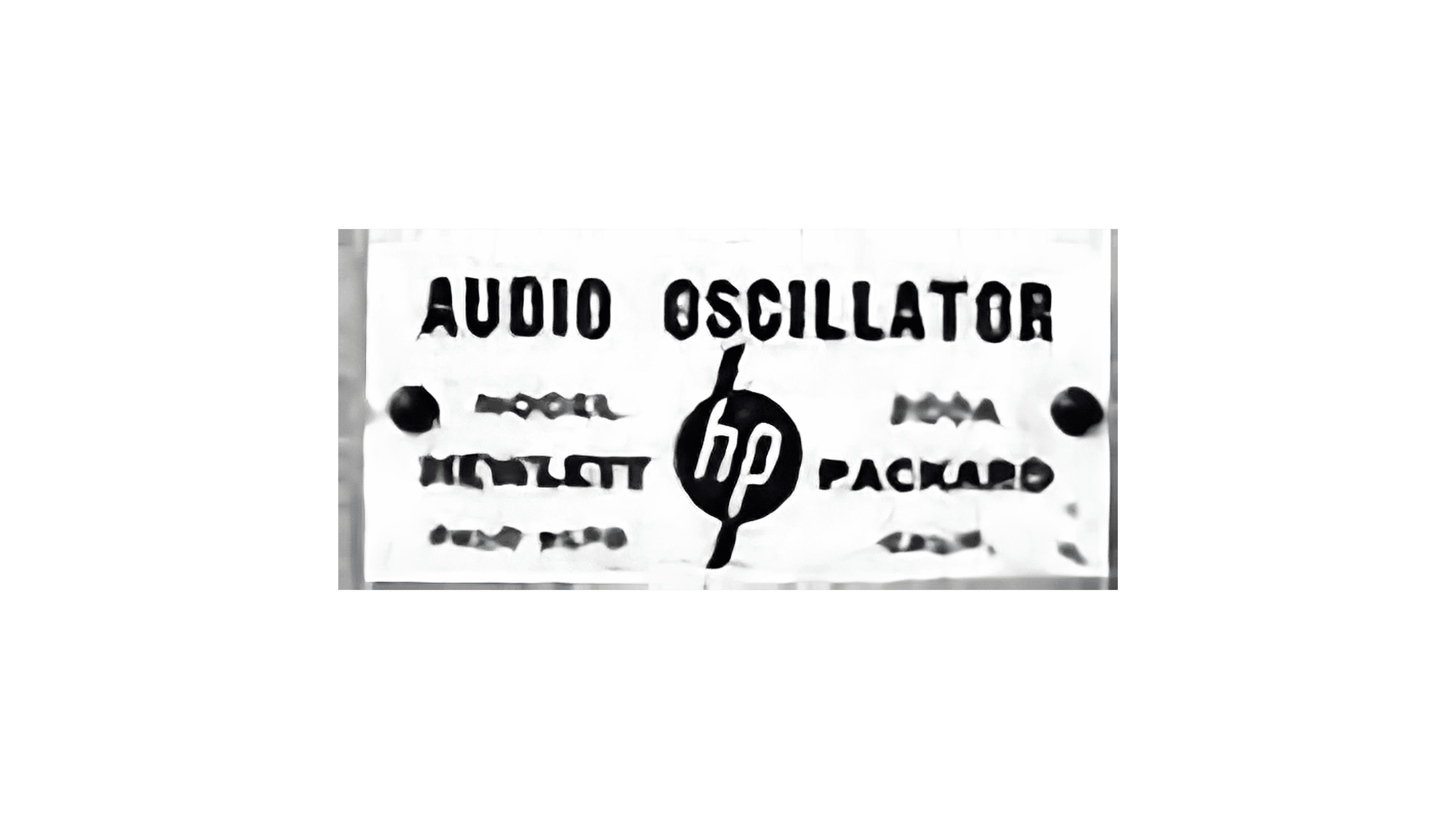
The debut emblem directly reflects the company’s name, composed of the founders’ names, Hewlett and Packard. The logo also included a lot of marketing-related information. In the middle of the rectangular background were the lowercase letters “hp” enclosed in a circle. Their ends protruded outward.
1954 – 1964
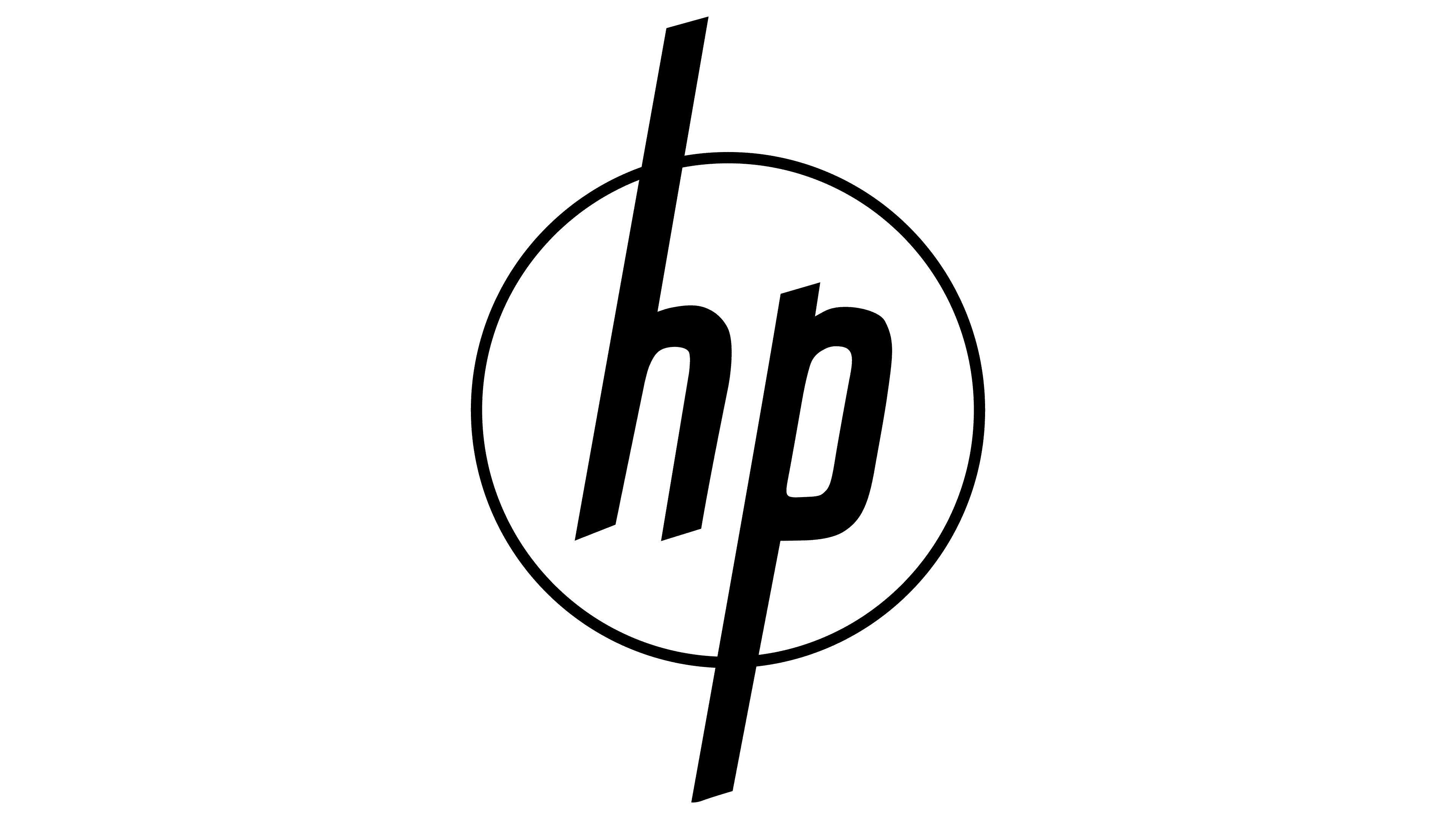
In 1954, the company reduced the branding to a single “hp” in a circle. The leg of the “h” points up; the “p” points down. They extend beyond the edges by the same distance. The letters and the thin line surrounding them are black, and the background circle is white.
1964 – 1981

This period is very significant for the HP emblem, as it appeared in blue. The HP monogram is now positioned between two narrow multidirectional rectangles that form around white space at the junction. The abbreviation is located within it. The lower part is solid black; the upper part is blue, composed of wide, separate stripes. There is complete decoding of the corporation’s name to the right and left of the graphic sign – the names of its founders (the first is Hewlett, the second is Packard). They are in thin capital letters. The logo has a slight rightward slope.
1979 – 2008
The developers made the lowercase abbreviation into a vertical rectangle to highlight it, since they placed the full company name next to it. The letters “hp” have the same design as the previous logo, but without vertical elements. They are painted blue, sit diagonally within a white circle, and sit against an elongated background at the legs’ locations. On the right side, two-level “Hewlett Packard” lettering appears in bold, smooth sans-serif glyphs.
1999 – 2012
In 1999, the Siegel + Gale design bureau improved the logo, offering a more concise version. As a result, the logo became completely blue. It consists of a horizontal, rounded rectangle with “hp” centered on a white background. Its width corresponds to the length of the protruding legs.
2008 – 2014
The emblem returned to a round shape. A blue or black circle with the white abbreviation “hp”.
2009 – 2014
At first glance, this version may seem identical to the 2008-2014 version, but it is not. There are differences between them. Here are larger signs with increased intra-letter spacing and a slightly lighter color, literally one tone lighter.
2012 – today
In 2012, the round logo began to be used in a softened palette. But at the end of the period, a turning point in the IT corporation’s work came: it was divided into two independent companies. The legal successor was HP Inc., which took over the production of computers and other digital equipment.
Initially, the company reverted to the 1981 emblem, which features a blue rounded rectangle and an “hp” monogram on a white background.
A round version uses soft colors, with white letters on a light blue substrate.
2016 – today

In 2016, the company adopted a new trademark developed by Moving Brands studio from 2008 to 2011. It features four oblique black strokes and appears on premium products.
Font and Colors
The logo consists of four lines at a 13-degree angle. Each line has a different length and represents a specific part of the corporation name. The emblem is sleek, elegant, innovative, but hard to read. As a result, consumers may not understand its meaning at first.
The abbreviated company name is lowercase and part of the brand’s graphic identity. It was always in uppercase and set in thin characters, with a slight slope depending on the version. The typeface is simple, sans serif.
The logo’s color appeared in 1974. The designers chose blue to embody reliability and professionalism. It also symbolizes protection and the latest technology, which the corporation sought to emphasize. The emblem is black and white.