


 Arizona Coyotes Logo PNG
The Arizona Coyotes logo is created in a Cubist style. It depicts the team’s main symbol, the coyote. The image conveys qualities close to the spirit of hockey: endurance, the ability to respond to sudden attacks, and the ability to act together.
The Arizona Coyotes’ history begins far from Arizona. On December 27, 1971, a franchise was founded in Winnipeg as the Winnipeg Jets and joined the rival World Hockey Association. Before their first season, the club signed Bobby Hull from the National Hockey League, a move that raised player salaries across the league. The Jets won three WHA titles in 1976, 1978, and 1979.
In 1979, after the WHA collapsed, Winnipeg joined the NHL alongside Quebec Nordiques, Edmonton Oilers, and Hartford Whalers. Early seasons were difficult, with just nine wins in 1980–1981. The rebuild began with the 1981 draft pick of Dale Hawerchuk, leading to regular playoff appearances through the mid-1980s.
By the early 1990s, financial pressure intensified because of a currency imbalance. In 1996, owner Barry Shenkarow sold the team to US investors, and on July 1, the franchise relocated to Phoenix, becoming the Phoenix Coyotes.
The Arizona period exposed structural issues. America West Arena was unsuitable for hockey, prompting a move to Glendale in 2003. Wayne Gretzky became co-owner in 2000 and head coach in 2005, though results remained weak. By 2009, the team filed for bankruptcy with debts exceeding $200 million, and the NHL took control for four years.
New ownership arrived in 2013, followed by a 2014 rebrand to Arizona Coyotes. The 2011–2012 season brought a division title and a run to the Western Conference Final. In 2019, Alex Meruelo acquired a controlling stake, but arena projects failed, and since 2022, the team has played at Mullett Arena, which has 4,600 seats.
In April 2024, the NHL approved the sale of hockey assets to a Salt Lake City group led by Ryan Smith. Players and staff moved to a new franchise later named the Utah Mammoth, while the Coyotes’ branding rights returned to the league.
Meaning and History

The team debuted as the “Winnipeg Jets,” became the “Phoenix Coyotes” in 1996 after moving to Phoenix, and, in 2014, became the “Arizona Coyotes” after moving to Arizona. The emblem reflects this history and has changed many times. The team is expected to return to the Central Division in 2021, when an expansion franchise from Seattle joins the league.
What is the Arizona Coyotes?
It is a hockey team formerly known as the “Phoenix Coyotes” from 1996 to 2014 and as the “Winnipeg Jets” before 1996. It began as a WHA franchise but later joined the NHL. One of the team’s main achievements was winning the championship title in the 2011-2012 season.
1972 – 1973

When the Arizona Coyotes were still playing in the WHA, the team was originally known as the Winnipeg Jets. That period was marked by a bright, saturated symbol in which hockey stood at the center of the overall idea, expressed through a bold, simple style.
The logo is a black circle. Inside, a rich red color dominates, filling almost the entire space. A white curved stripe in the lower section represents an airplane’s flight path seen from above. The upper part contains the city name WINNIPEG written in rounded sans-serif letters.
The emblem’s main accent is the word “Jets,” rendered in a dynamic handwritten style. The smooth letters are elongated and connected.
On the right is a schematic figure of a hockey player shown in a playing stance. The athlete has bent knees and is preparing to strike with the stick. The image is rendered in dark blue with white accents. It is schematic, showing only the main contours and silhouette.
A special symbol revealing the meaning of the club name is a blue jet aircraft. The airplane is placed above the circle’s top, followed by a white trail.
On the white stripe representing the aircraft’s stylized flight path, the phrase HOCKEY CLUB appears. It is set in uppercase letters using a narrow sans-serif typeface in dark blue. The text color matches the shade of the airplane and the hockey player, forming a unified composition and a harmonious color balance.
Earlier, one year before the approval of this red-and-blue version, the team took the ice with a different emblem. A player rendered in white and blue lines appeared on a crimson background. Beneath him ran a white stripe with the club’s name, Winnipeg Jets.
1973 – 1979

Continuing to compete in the WHA, the Winnipeg Jets introduced a new logo in 1973, designed by Robert Riddell, Eaton’s art director. The team retained the key elements but reworked the structure and component placement.
The logo remained circular with a bright red border. The main interior of the circle is filled with a deep blue shade, against which the name Jets is dynamically placed in white letters. The wordmark features a pronounced rightward slant, broad strokes, and a distinctive custom typeface that emphasizes a sports aesthetic. The first letter J is stylized as a hockey stick, drawing attention to the club’s core identity.
A red circle, stylized as a hockey puck, with a dark blue airplane silhouette inside, sits above the wordmark. The airplane is simplified and angular, directed upward and to the right, referencing the aviation theme embedded in the team name. The fuselage, wing, and tail outlines are rendered without excessive detail, reflecting jet speed.
The word Winnipeg completes the composition below in a semicircular arrangement. Red lowercase letters smoothly follow the curve of the logo’s lower arc.
1979 – 1990

In 1979, the World Hockey Association and the NHL merged, and the Winnipeg Jets entered a new chapter. The team chose not to abandon the emblem Robert Riddell created six years earlier, making only subtle color adjustments.
The logo retained its circular form and the placement of all elements. The background inside the circle became an even darker blue. The previously bright red color was replaced with a rich burgundy tone.
These minor color changes were the only update to the team’s visual style upon entering the NHL, emphasizing its transition to the new league while preserving its established identity.
1990 – 1996

In 1990, the Winnipeg Jets gave their logo a new look by updating their old emblem. The new logo became lighter and brighter with a white background, and the inscriptions reflecting the team and city name were arranged differently.
The mark’s outer shape remained circular, outlined in bright red. The logo’s interior became white. A long blue diagonal line crosses the entire composition, stylized as a hockey stick. This symbol forms the first letter of the word “Jets”. The letters are wide and solid, colored dark blue.
The city name WINNIPEG has been moved to the top and set in a narrow, right-slanting typeface. The letters are sharp, sans-serif, and in the same shade of blue.
Between the two words on the left is a red silhouette of a jet aircraft. It reinforces the aviation theme introduced early in the team’s history and strengthens the club’s connection to its name.
The logo redesign reflected management’s desire to refresh the image while preserving symbols familiar to fans.
1996 – 1999
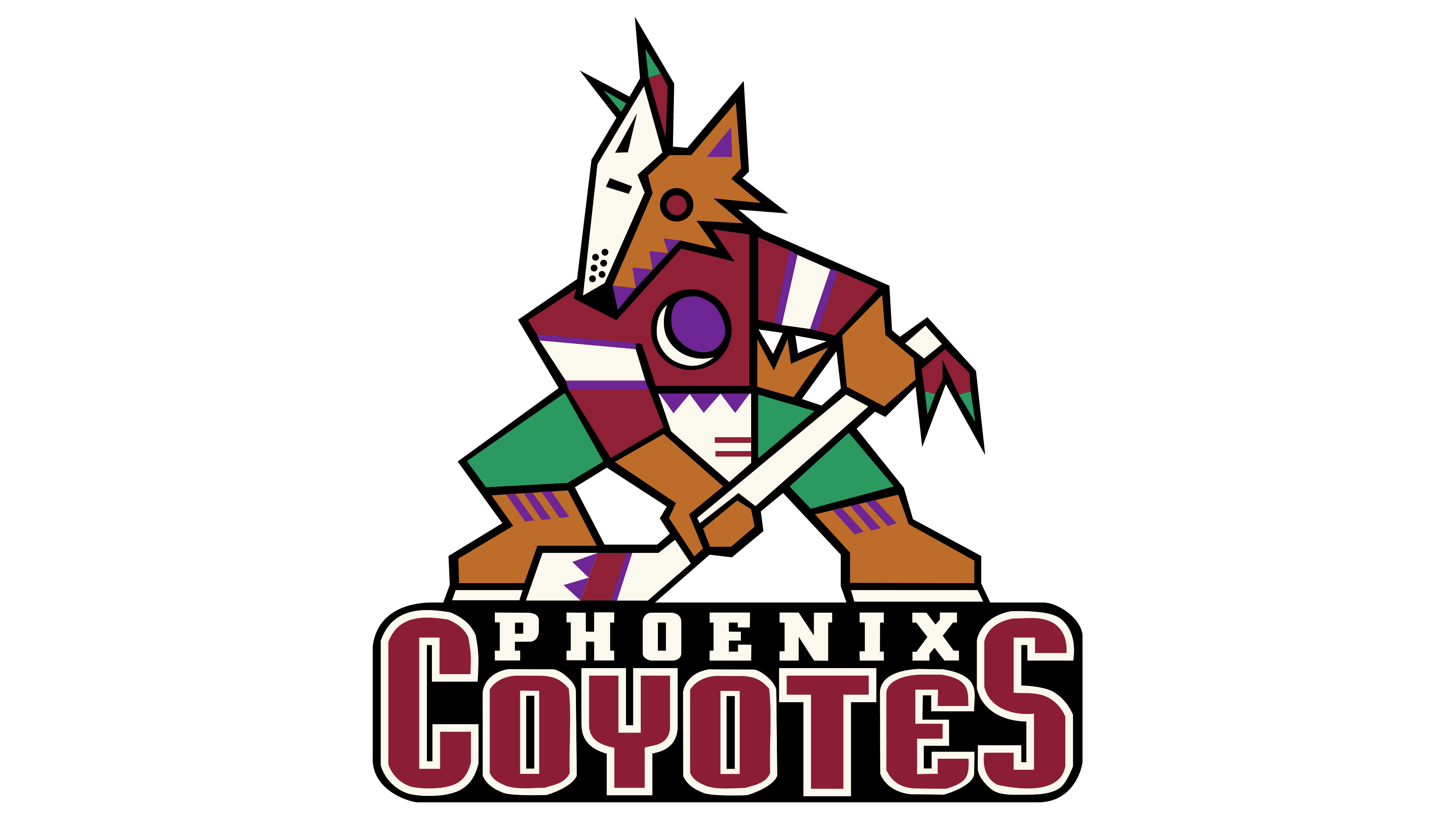
In 1996, the club relocated to Phoenix and adopted the new name Phoenix Coyotes. The move also brought new symbolism created by designer Greg Fisher of the Campbell Fisher Ditko agency. The logo was far from typical hockey standards and drew attention with its artistic approach and the colors of the American Southwest.
It consisted of a stylized coyote figure wearing hockey gear. The pose is tense, with the body slightly leaning forward and a stick ready for a shot or an interception. The image stands out for its geometric, almost cubist style reminiscent of tribal motifs and mosaics of Arizona’s Indigenous peoples.
The animal’s head resembles an ethnic mask with pointed ears. The coyote’s body is layered and vivid, rendered in burgundy with elements of green, white, sand, and purple tones. A circle sits at the center of the chest, with triangles and stripes below forming an ethnic pattern. The limbs are colored in brownish-orange hues.
The hockey stick is white. Decorative feathers are visible on it, reinforcing the regional style. The coyote’s hands grip the stick, showing readiness to act.
Below the image is the club name PHOENIX COYOTES. The first word is set in small white uppercase letters, while the second word is larger and more prominent. COYOTES is highlighted in burgundy and outlined in white and black for added depth.
Fisher deliberately used bright colors and angular forms to convey the uniqueness of local culture and visually distinguish the team from other NHL clubs. The symbol became one of the most unusual in hockey.
1999 – 2003
After a redesign, the club emblem dropped the large “PHOENIX COYOTES” wordmark and adopted a completely different look. Greg Fisher again created the update from the Campbell Fisher Ditko agency. He brought the coyote image to the forefront and added greater color expressiveness.
The coyote figure, executed in the same ethnic style with geometric patterns, now became the sole element of the composition. The animal is shown in the same hockey stance, holding the stick and watching the opponent. Compositionally, nothing changed, with the same elements and placement, but the previous color palette became richer and more vivid.
2003 – 2014

In this new version, the club’s management shifted its focus to the image of a true predator, and the new emblem featuring a coyote fit the team’s athletic character well. The coyote reflects hockey’s style: sudden bursts, unexpected attacks, and an untamed temperament that forces opponents to make mistakes and retreat.
The Adrenalin Design Group studio proposed this bold silhouette of a coyote’s head with its snout raised and mouth open. The predator displays sharp, tense fangs, emphasizing readiness to attack.
The image uses three colors. The upper part of the head is burgundy, while the lower section, including the mouth and throat, is a light beige. A black outline separates the two colors.
The overall style became sharp and energetic, conveying the animal’s character. Experts recognized the logo as one of the league’s most successful and consistently ranked it among the leaders.
2014 – 2021

After the club moved to Arizona and changed its name to the Arizona Coyotes, the team retained the familiar desert coyote image. The animal is associated with local character and the state’s desert landscape.
The club chose to keep a symbol already strongly associated with the team and popular with fans. The predator, native to Arizona’s arid surroundings, reflected the team’s temperament particularly well.
2021 – 2024
The club made an unexpected move by bringing back, in the 2021-2022 season, the emblem that fans remembered from 1999. The Kachina-style mark once again became the Coyotes’ main symbol, pushing aside the logo used since 2003. The move was justified. The emblem is so popular among fans that any change to it is perceived as an unnecessary risk.
The central figure remains the Kachina-style silhouette depicting a coyote in a hockey stance, executed in the style of the Indigenous peoples of Arizona. Visually, the emblem closely repeats the original, with a small addition. An extra beige outline appeared around the figure, helping it stand out against different backgrounds and making the colors appear even brighter.
In April 2024, the Arizona Coyotes announced a relocation to Salt Lake City for the 2024-2025 season. However, former owner Alex Meruelo retained the rights to the team name, symbols, and history. As a result, the new team in Utah will operate as a separate franchise with no connection to the Arizona club’s legacy.
After a land auction for a site where Meruelo had planned to build an arena collapsed, he returned the franchise to NHL control. The league is currently keeping its plans for the future of the Arizona Coyotes brand and symbols confidential, without disclosing next steps regarding the club’s return to Arizona or a potential relocation to another region.
Font and Colors

The emblem features a howling coyote with a half-open mouth, its sharp fangs symbolizing courage and aggression. The head is raised, the eyes are narrowed, and the ears are pressed and laid back. The lines are straight and confident, and the strokes are voluminous, with shadows. The Adrenalin Design Group designed the logo.
Although the current version contains no text, earlier versions do. During the club’s debut, the sign’s lettering was individual, with wide uppercase letters. When the team was based in Phoenix, it used a logo with the name, with the word “Coyotes” very large and the letters “C” and “S” in uppercase. It served as the platform for the second part, “Phoenix.”

In terms of the palette, the franchise is more consistent: the same colors appear across all emblems, albeit in different combinations. Specifically, these are red, beige, brick, white, and black. For some time, dark blue and brown were also used.