


 Montreal Canadiens Logo PNG
The team uses a text emblem. The Montreal Canadiens logo lacks obvious graphic elements, but designers transformed the letters into hand-drawn elements. They harmoniously combined the letters “C” and “H” to make a horseshoe. To do this, the artists narrowed and widened the letter “C,” making it resemble the most common symbol of luck.
The Montreal Canadiens were founded in 1909 in Montreal as a member of the National Hockey Association, organized by John Ambrose O’Brien. The project aimed to attract a French-speaking audience in a city where anglophone clubs had dominated hockey. The team predates the National Hockey League, established in 1917.
Early policy limited the roster to francophone players, aligning the club with the local working-class population. The debut season brought weak results, and in 1910, the franchise was sold to George Kennedy for $7,500 after a dispute over rights to the “Canadiens” name.
Under Kennedy, the identity shifted Athlétiquehlétique Canadien, with a “C” enclosing an “A.” In 1917, following league restructuring, the hockey division separated to become the Club de Hockey Canadien, introducing the “CH” monogram that remains in use.
Throughout the 1920s and later decades, the club became a regular finalist, reaching the Stanley Cup Finals 34 times and winning 24 titles, a league record. Rivalry with the Toronto Maple Leafs defined many of those seasons.
In 1924, Tex Rickard publicly claimed the “H” stood for “Habitants.” The interpretation was incorrect, but the media adopted it, and it became the nickname “Habs.”
The emblem was finalized in 1925 and saw only minor changes in striping and color balance. A short-lived globe symbol appeared on jerseys after a Stanley Cup win in 1924, then was removed.
In 2004, the club introduced its first official mascot, Youppi!, previously associated with the Montreal Expos, marking a rare transfer between major North American leagues.
Meaning and History
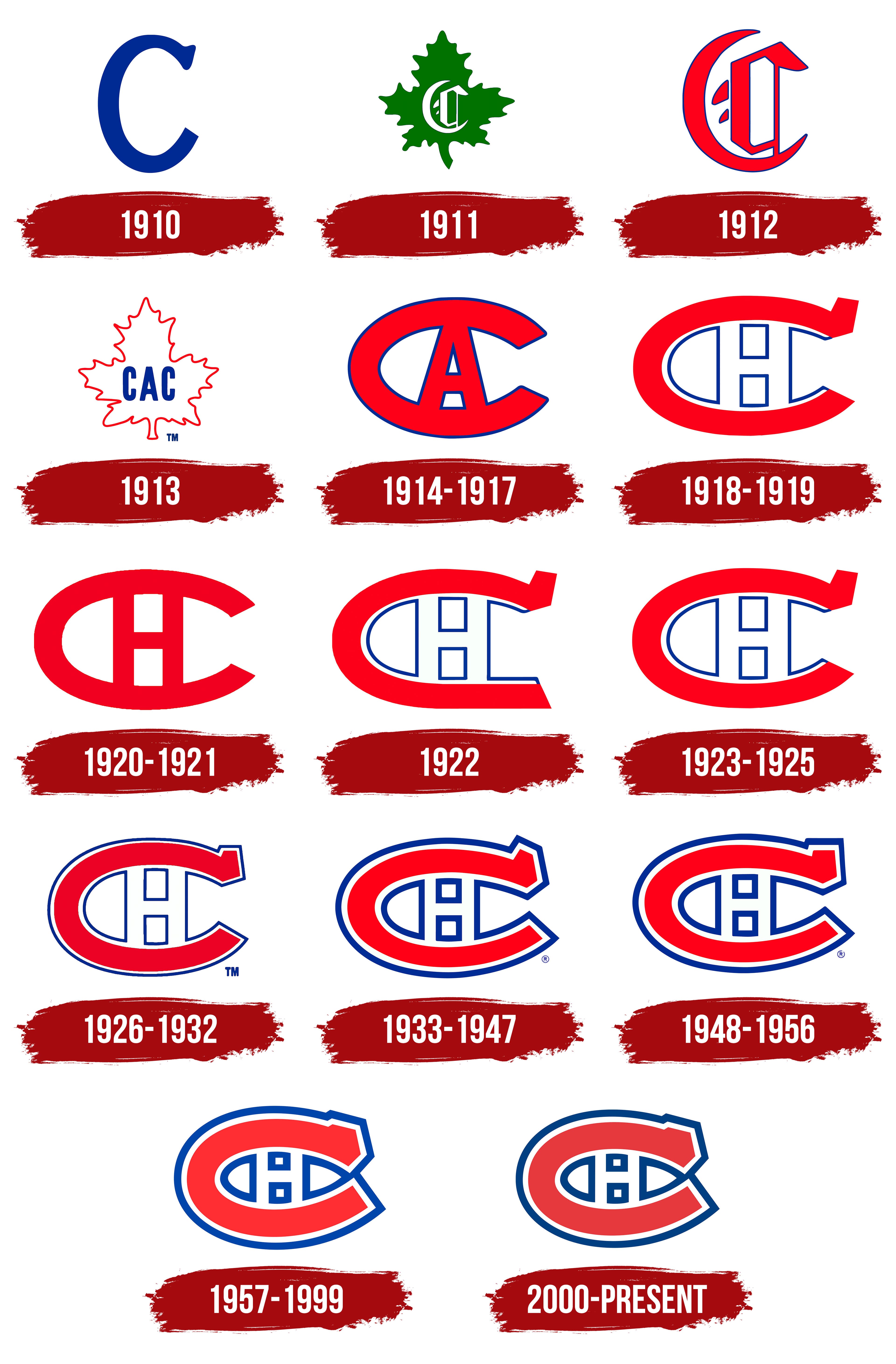
The Montreal Canadiens were the first hockey team in the sport’s history, founded in Montreal, Quebec, in 1909. Diversity and consistency distinguish the Montreal Canadiens’ fourteen logos. On the one hand, there are many variations, but on the other, the core elements remain the same. Rebranding and other changes hardly affected them. The letter “C” remains the central and only element. The differences are minor drawing details that do not affect the overall picture or concept. The iconic Canadiens logo appeared in 1918. It consisted of just two Latin letters: “C” and “H”. This logo marked many historic NHL moments. The letter “H” in the logo stands for “Hockey,” not “Habs,” a common misconception. The Canadiens logo with the letter “C” wrapped around the letter “H” is the oldest and one of the most recognizable and famous logos in NHL history.
What is the Montreal Canadiens?
The Montreal Canadiens are the most-titled NHL club, with 24 Stanley Cups. They play in the Eastern Conference and represent the Atlantic Division. The team is based in Montreal, Quebec, Canada. Its formation year is 1909.
1910

The Montreal Canadiens’ emblem was very simple in the first season. It was a blue “C” letter, signifying the Canadiens. It was used only in the 1909-1910 season
1911

For the second season, the team adopted a new Montreal Canadiens logo featuring a green maple leaf with a stylized Old English letter “C” signifying the Canadiens.
1912

A year later, the club changed its emblem again. This time, the emblem included the same Old English letter “C” as before, but it was red with a thin blue outline.
1913

The team’s fourth logo resembled the 1911 emblem. It was a white maple leaf with a thin red border, with “CAC” written in blue, signifyiAthlétiquehletique Canadien.
1914 – 1917

The 1914 logo was the first to resemble what we see today. It featured a red letter “A” inside an elongated blue-outlined letter “C”. The logo had three letters: an A and two Cs, signifying Athlétic Club de Montréal.
1918 – 1919

In 1918, a white “H” inscription for “Hockey” replaced the letter “A.” This change followed the Club de Hockey Canadien’s purchase of the team, which George Kennedy managed. The external blue outline of the red “C” was removed, but the internal one remained.
1920 – 1921

The 1920 emblem became the franchise’s most experimental. The bright red color was replaced with a darker shade, and the letters “C” and “H” were written without outlines, making the logo more symmetrical.
1922

The seventh logo change occurred in the 1922 season. This time, it was almost identical to the 1918 logo. A spur appeared in the upper right corner of the “C.” The blue outline rounded the inner letter.
1923 – 1925

In 1923, the “Canadiens” returned to the white “H” and red “C” emblem of 1918.
1926 – 1932

The tenth-anniversary logo again featured a thin blue outline around the Montreal Canadiens emblem. Everything else remained the same as in the 1923 emblem.
1933 – 1947

The next logo change happened in 1933. The thin blue outline was thickened around the logo’s entire perimeter. The Montreal Canadiens’ emblem also appeared visually wider, making the “H” seem smaller. This emblem lasted for 12 years until the rebranding.
1948 – 1956

Changes included visual enhancements in graphics and color contrast. The letters remained surrounded by a thick blue border, but the serifs were modified.
1957 – 1999

The Canadiens updated their logo in 1957, and it remained in use for nearly 50 years. The opening side of the “C” was outlined in a thick blue, forming an elongated oval with an “H” inside.
2000 – today

The current emblem continues all previous ones. It features a closed red oval “C.” The top and bottom parts connect and curve inward symmetrically. The large “C” and small “H” are merged. A thick blue contour line outlines all elements.
Font and Colors

The early version was the simplest, featuring a single “C” that designers transformed many times until they reached the horseshoe-shaped variant, a horizontally extended letter. Initially, it representeAthlétiquehletique Canadien,” then “Canadien Athletic,” and, much later, “Montreal Canadiens.”
From 1911 to 1913, the emblem acquired an Old English style and a maple leaf, a symbol of Canada. In 1914, an “A” appeared in the middle of the “C,” which was later changed to “H” because of a name change. In 1918, they added an upper serif to the letter. The “C”‘s upper and lower ends gradually fused throughout the remaining period.

The emblem never had a full inscription, only a fragmentary abbreviation (1913) and a single letter. Initially, the symbols were blocky, but in 1918, the “C” acquired a serif, which remains today.
The logo’s main unchanged colors are white, blue PMS 2758 C, and red PMS 187 C, with their respective shades. In 1911, the maple leaf was still green.