


 Australia Post Logo PNG
The symbols in the Australia Post logo convey a wide range of services and a commitment to reaching the country’s most remote parts. The emblem shows that the department is always nearby, on the road, making it easy to resolve all issues.
Australia Post dates back to colonial New South Wales, where no organized mail system existed before 1809. Letters arrived through ship captains, traders, and private contacts, often causing chaos on Sydney’s wharves. On April 25, 1809, Isaac Nichols became the colony’s first postmaster. A former convict, he was authorized to collect mail directly from arriving ships. On June 26, 1809, he received the first mailbag from Britain on the brig Experiment. Nichols used his house on George Street as the first post office, posting recipient lists outside and publishing notices in the Sydney Gazette.
In 1825, the New South Wales Postage Act brought postal services under the governor’s control, set fixed rates, and expanded offices beyond Sydney. By the 1840s, post offices operated in Bathurst, Hobart, Adelaide, Melbourne, and other settlements. Until 1901, each Australian colony ran its own postal system. After federation, the services were merged into the Postmaster-General’s Department (PMG), which handled mail, telegraph, and, later, telephone services.
In 1914, Australia began its first airmail service. In 1967, it introduced four-digit postcodes and opened the world’s first mechanized mail-sorting center. On July 1, 1975, PMG split into the Australian Postal Commission and Telecom Australia. The postal side began using the name Australia Post.
In 1989, it became the Australian Postal Corporation, gaining commercial freedom while keeping nationwide delivery duties. As letters declined in the 1990s and 2010s, Australia Post expanded into retail, financial services, and parcels. It bought Star Track Express in 2012 and invested in parcel lockers, tracking tools, and automated sorting while competing with DHL, FedEx, and CouriersPlease.
Meaning and History
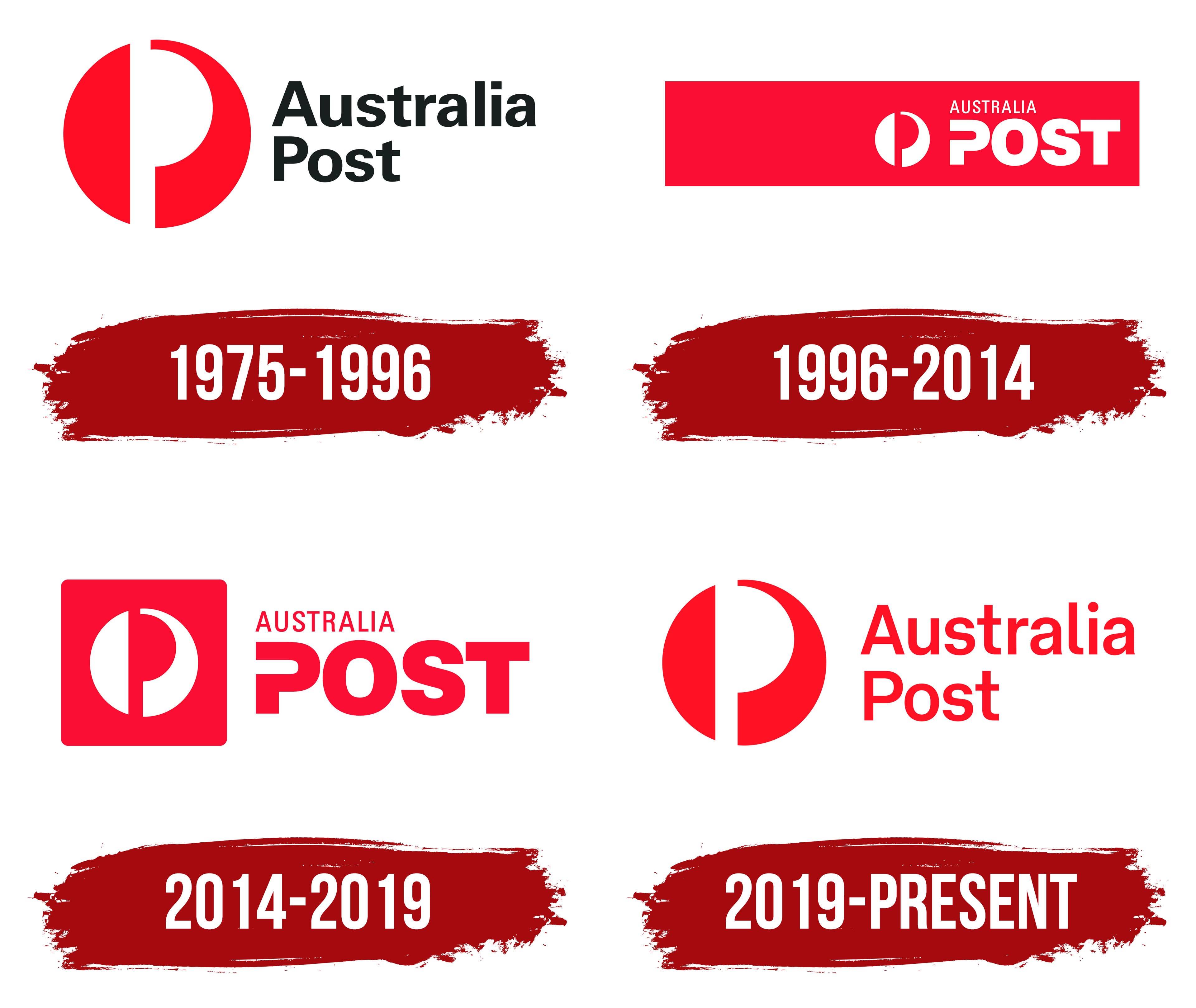
Australia Post was established in 1975, but its history dates back to April 25, 1809, when the first colonial letter-delivery service was introduced. After the unification of the colonies in 1901, the Postmaster-General’s Department brought the disparate postal systems under one umbrella and provided telecommunications services to the continent’s inhabitants. In 1975, the department was abolished, and special commissions took over its functions. The Australian Postal Commission was among them and later became Australia Post.
As the postal service evolved, a new positioning was needed, more modern and appropriate to the era of e-commerce. At the same time, the visual identity had to preserve the brand’s heritage, despite the desire to move forward. Therefore, any changes were minor.
What is Australia Post?
As its name suggests, it is a post office operating in Australia. It has 4,462 branches and serves more than 10 million customers daily, offering standard, courier, and express mail delivery.
1975 – 1996

Pieter Huveneers was hired to create Australia Post’s first logo. The artist played with the letter “P,” depicting it as a strip and a semicircle in negative space. The stylized “P” divides the red circle in two. The left side looked like half an oval, and the right had the shape of a horn, which was used in the Middle Ages.
The inscription “Australia Post” on the right in two lines complemented the drawing. The designers made it black and chose a simple sans-serif font. The first letter of each word was capitalized.
1996 – 2014

In 1996, the logo featured a long red rectangle. In this case, the semi-oval and the pictogram were repainted white, and the “P” was painted red. Next to them was the postal service name. The word “AUSTRALIA” was written in small print. By contrast, “POST” immediately caught the eye with its large letters and stylized “P.” The same wordmark, “POST,” with an open “P,” was created in 1991. The designers moved it into a rectangle to complement the circular emblem.
2014 – 2019

Australia Post redesigned it again after acquiring the StarTrack delivery service. The developers visually separated the horn symbol by removing the rectangle’s common base. But they put the icon inside a red square, so it stays white. Only the inscription’s color has changed; it now appears on a light background.
2019 – today

In 2019, the Melbourne-based firm Maud revived the original Australia Post logo, created in 1975. Designers only slightly redesigned the typography, making the letters large and red. Before the rebranding, executives and general managers participated in a survey. Experts gathered stakeholders’ opinions and developed a business strategy based on the data.
As part of the project, the designers gave the Pieter Huveneers horn a second life. The iconic symbol has returned to uniforms, signage, liveries, merchandise, and automobiles, and burst into the digital world in its original form. It is now found in post offices nationwide with a new wordmark. In the classic version, the inscription is on the left, but there is also a horizontal version in which the phrase “AUSTRALIA POST” appears at the bottom.
The logo features an icon of a wind instrument once used to signal a postman’s arrival. Messengers blew the horn when they brought mail or left the city. This attribute, popular in the Middle Ages but whose original meaning has been lost, has survived as a traditional element of many emblems, including the Australia Post branding.
Font and Colors

On logos from 1996-2019, sans serifs from the Zurich family are presented: Zurich Condensed was used for the first word, and a modified Zurich Extra Black for the second. In 2019, the designers emphasized Australia’s importance by increasing the country’s name and equating it with “Post.” A custom sans-serif font balances out the stylized “P” in a circle. It is similar to the Brix Sans Medium created in 2014 by Livius Dietzel and Hannes von Döhren. A similar typeface is Neology Grotesque Regular. Shinntype released it the same year.

Both the inscription and the post horn are colored red. The rich shade # DD1223 is the foundation of Australia Post’s visual identity. White complements it, serving as the background and forming a “P”-shaped gap within the circle.
FAQ
What colors are Australia Post?
The brand uses red and white as its main colors. Bright red appears on vehicles, uniforms, and other materials. White is used with red to create an easily recognizable image. Red shows urgency and efficiency. White is used for logos and text to make them easy to read. This color scheme is used on mailboxes, RVs, their websites, and marketing materials.
What is the Australia Post symbol?
The symbol combines history and modern design. It is inspired by the shape of the postal horn European postmen used to announce their arrival and deliver messages. This design element brings a sense of tradition and reliability to the brand.
The letter “P” is formed in the logo’s negative space and directly refers to the “post.” This letter is seamlessly integrated into the horn’s shape, making the logo expressive and meaningful. The logo’s overall round shape symbolizes the comprehensiveness of the brand’s services and its global reach.
The red-and-white color scheme increases visibility and recognition. The bright red signifies urgency and efficiency, key qualities for a postal service. The white provides a clean contrast, making the logo easy to read and stand out on mailboxes, delivery vehicles, and marketing materials.
The symbol represents the brand as a reliable, forward-thinking service provider, ready to meet customers’ needs locally and internationally.
What is the Australia Post logo?
The logo combines two important symbols. The first is the letter “P,” seen in negative space, representing “post.” This design makes the brand’s values clear. The second symbol is a stylized postal horn, historically used by European postmen to make deliveries. Together, these two symbols create a unique, memorable logo that is easily recognizable and meaningful.
The red-and-white color scheme improves visibility. This logo represents the brand’s personality. The design ensures the logo is functional and symbolic, reflecting the brand’s mission to connect people and businesses worldwide.
What font is Australia Post?
The logo font has changed over the years. For a long time, it used a font similar to Helvetica Heavy. This bold, clean font is easy to read and gives the logo a modern look. Eduard Hoffmann and Max Miedinger developed Helvetica Heavy.
The use of Helvetica Heavy demonstrates the brand’s focus on reliability and efficiency. The bold font ensures the logo’s visibility and readability, which is important for the postal service. The brand has slightly changed the logo typography to keep up with design trends. Despite these changes, the font’s basic features remain the same, keeping the logo recognizable and impressive.
Is the Australia Post symbol copyrighted?
The symbol is protected by copyright and trademark laws. The logo features unique design elements such as a stylized “P” and a postal horn that are original and creative. These elements make the logo easily recognizable and associated with the brand.
The symbol is not available for public use. Unauthorized use may have legal consequences as it violates the brand’s intellectual property rights. Companies register their logos to protect their identity and prevent misuse.
In addition to copyright protection, the symbol is a trademark. This provides additional legal protection by ensuring no other organization can use a similar logo.
How is Australia Post funded?
The brand is self-financing and generates its income for development and profit. It operates as a government business, using its assets and income from various services to cover expenses and invest in growth.
Its main income sources are postal services, parcel delivery, retail services, and digital services. Postal services process and deliver letters and parcels domestically and internationally. Parcel delivery has become a major revenue driver due to the rise of online shopping.
The Australian Government is the sole shareholder. The profits made are returned to the government, contributing to public funds. The government monitors the brand to ensure it operates in line with national interests and public service obligations.