


 Avicii Logo PNG
Tim Bergling, a DJ and producer, maintained his fame not only due to his talent. The Avicii logo is integral to the image of a global star and symbolizes stage presence, brutal performance, and unparalleled talent.
Tim Bergling was born on September 8, 1989, in Stockholm. As a teenager, he produced tracks in his bedroom and posted them on electronic music forums, building a reputation for strong melodic hooks. The name Avicii derives from a Buddhist term for the lowest level of hell.
In May 2007, at 16, he signed with the Swedish label Dejfitts Plays. By 2009, he was releasing electro house singles and performing in Miami, where promoters noted his inexperience but clear potential.
The breakthrough came in 2011 with “Levels”, built around a sample of Etta James. The track triggered a bidding war between labels. Compared to figures like David Guetta and Tiësto, Avicii leaned toward melody and radio accessibility.
His debut album, True, arrived in 2013, mixing EDM with country and bluegrass. It reached the top 10 in over fifteen countries, while “Wake Me Up” topped European charts and hit No. 4 in the US.
Health issues followed. In 2012, he was hospitalized in New York with acute pancreatitis linked to alcohol use. In 2014, he underwent gallbladder surgery after postponing it due to touring.
The second album, Stories, came out in 2015 and performed less well. That year, Laidback Luke described him as exhausted during a meeting in Ibiza. In 2016, Bergling ended touring, giving his final show on August 28.
He returned to studio work, set up in Tuscany, and planned a series of EPs. The first, Avīci (01), was released in 2017.
On April 20, 2018, Bergling died near Muscat at age 28. In 2019, the Tim Bergling Foundation was created, and the posthumous album Tim was released. In 2021, Stockholm’s Ericsson Globe was renamed Avicii Arena.
Meaning and History
In Stockholm, on September 8, 1989, Tim Bergling was born into a large, underprivileged family. Despite limited means, the boy was interested in music from an early age and helped musicians and DJs as a favor because they taught him and let him play various instruments. Everyone in his family loved music – his father adored Ray Charles’s songs, his sisters listened to glam rock, his brothers listened to hard rock, and a neighbor, who cared very much about the boy, showed him the beauty of classical music.
As a teenager, Tim began writing his own songs. He once told journalists that, as a child, like all boys, he loved video games and decided to remix the soundtrack of the popular video game, Lazy Jones. The game developers liked the single and gave Tim access to a professional studio to record it, and it quickly became popular as “Lazy Lace.” A major production company took an interest in the talented guy and signed him to a contract.
At 21, Tim was already a well-known singer. His singles “Seek Bromance,” “My Feelings for You,” “Levels,” and “Blessed” reached the top of the Swedish, then European, charts. Then, the guy performed under the pseudonyms Tim Berg and Tom Hangs.
He adopted the stage pseudonym Avicii in 2011, when he became the leading DJ in Stockholm. Tim said that this word in Buddhist philosophy means hell, where sinners go after death. He then created an original logo that became part of his image.
Many global stars gladly performed with the handsome young man who wrote songs that thrilled audiences. In 2011, he had his first tour across Europe. In 2012, a major scandal broke out over singer Leona Lewis, who allegedly stole Avicii’s melody for her song “Penguin.” The plagiarism case went to court, and the singer was forced to recognize Avicii’s authorship. This loud scandal added to his popularity.
In 2012, Avicii, in collaboration with David Guetta, wrote the song “Sunshine,” which was nominated for a Grammy Award.
Then Tim’s childhood dream came true: he went on stage and sang his remix of “Girl Gone Wild” with Madonna. The singer really liked the duet and invited Avicii to do a separate show with her. But then preparations stalled for unknown reasons.
In 2013, Forbes magazine ranked him among the top 10 highest-paid DJs in the world; Avicii earned more than $20 million a year. In 2016, the guy canceled all tours and retired.
On April 20, 1918, while on vacation in Muscat (Oman), Avicii committed suicide in a hotel room by cutting his veins. He left a suicide note explaining the reasons for voluntarily leaving life at the age of 28, at the peak of fame, and as a very wealthy person. It turned out that for several years, the young man, who wrote cheerful, groovy music, was in deep depression, which he could not cope with.
At the end of 2018, DJ Magazine posthumously ranked Avicii 15th among DJs of all time.
What is Avicii?
Avicii is the stage pseudonym of Tim Bergling, a Swedish DJ and music producer born in 1989 and who began his career in 2008. He became one of the world’s most famous and popular electronic music DJs, thanks to international hits like “Hey Brother,” “Wake Me Up,” and “Levels.” Tim struggled with depression and alcoholism for a long time and voluntarily left life in 2018, leaving behind an inspiring, creative legacy.
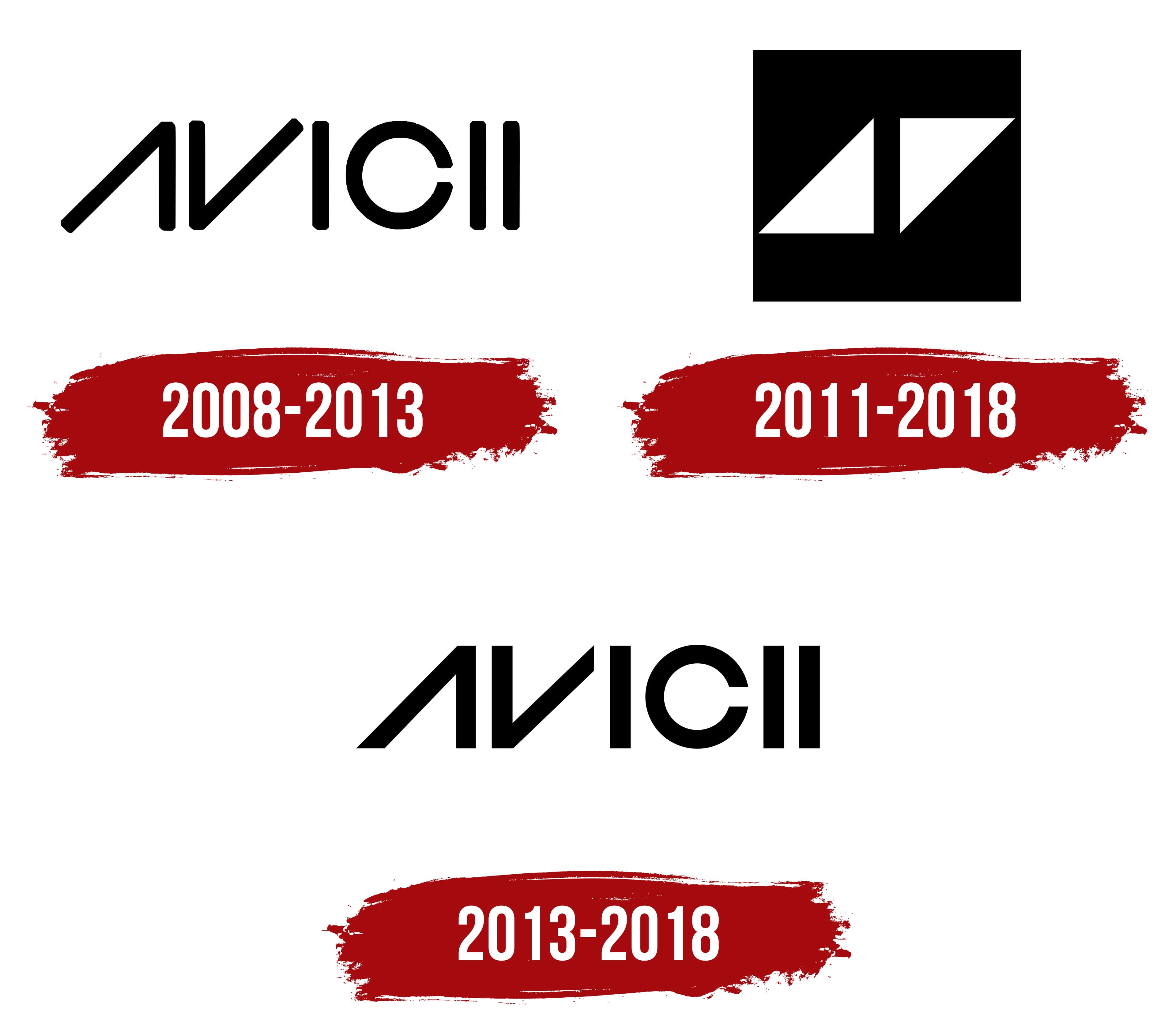
2008 – 2013

The debut logo is the basis for all subsequent variations, including the icon. It is recognizable in every stroke and tilt, as the developer interestingly played with the DJ’s pseudonym. The first two symbols look the same, as if they are mirror images. The letter “A” lacks a central bar, and “V” is slanted. The other characters match the chosen style: “C” resembles a slightly serrated circle, and all three “I”s are drawn as vertical stripes without dots.
2011 – 2018

The emblem was created in 2011 and plays on the musician’s pseudonym. It consists of two black triangles facing each other, with their diagonal sides (hypotenuses) meeting at right angles. Avicii once used this pseudonym on social media, and when he found success, he adopted it as a stage name.
The two triangles are stylized with the first two letters of his name: one denotes “A,” and the other, flipped, denotes “V.”
2013 – 2018

In this version, designers adjusted the letterforms’ legs and used straight cuts rather than rounded edges. As a result, the word “AVICII” looks more brutal because each side of the characters represents an exactly cut plane. In addition, the right cut of “V” was made vertically, not horizontally, like the other characters. The developers also slightly thickened the letters, making them bolder.
Font and Colors

Avicii uses the ITC Avant Garde Gothic font as a visual reference, though some see more resemblance to Vermin Vibes 2 Soft and Vermin Vibes 2 White.
The first logo was aggressive in depiction, with sharp angles. But in 2013, on the albums “Wake Me Up” and “True,” the author used a softer, more attractive version and began using white, black, and gray. Later, he used three variants of his emblem:
- white letters on a gray background;
- gray letters on a white background;
- white letters on a black background.
The Avicii logo is recognizable and integral to his image as a musician and DJ. It will remain in world culture forever, just like the music created by this talented man.
