


 Bacardi Logo PNG
Connoisseurs of good rum know that the distinctive bat image on the emblem has been used for three centuries. In Cuba, this bat once symbolized success and health. The Bacardi logo is a tribute to the alcohol company’s rich history; in 1862, it owned an old distillery with a whole brood of bats. At least, so the legends say.
Bacardi was founded on February 4, 1862, in Santiago de Cuba by Don Facundo Bacardí Massó, a Catalan wine merchant who had emigrated from Spain. Before opening the distillery, he had spent years refining rum production through charcoal filtration and aging, turning a harsh drink into a lighter, cleaner-tasting spirit.
The bat became the company’s symbol after Facundo’s wife, Amalia, suggested using it as a trademark. A colony of bats lived under the roof of the first distillery, and in Cuban culture the animal was linked with luck and family well-being. During the late nineteenth century, Bacardi survived earthquakes, epidemics, and political unrest, while Emilio Bacardí Moreau expanded the business and became involved in Cuba’s independence movement.
By the early twentieth century, Bacardi had won international awards and was exported outside Cuba. During Prohibition in the United States from 1920 to 1933, many Americans traveled to Cuba, where they discovered rum cocktails such as the daiquiri and Cuba Libre. After the 1959 Cuban Revolution, the family lost its Cuban assets. Still, production in Mexico, Puerto Rico, and the Bahamas helped the company continue abroad.
In 1992, Bacardi acquired Martini & Rossi, becoming Bacardi-Martini. Later deals added Dewar’s and Bombay Sapphire from Diageo in 1998, Cazadores in 2004, and Grey Goose from Sidney Frank Importing Company in 2009. The company remained family-controlled while competing with Diageo and Pernod Ricard, owner of Havana Club, in a long dispute over Cuban rum names.
Meaning and History
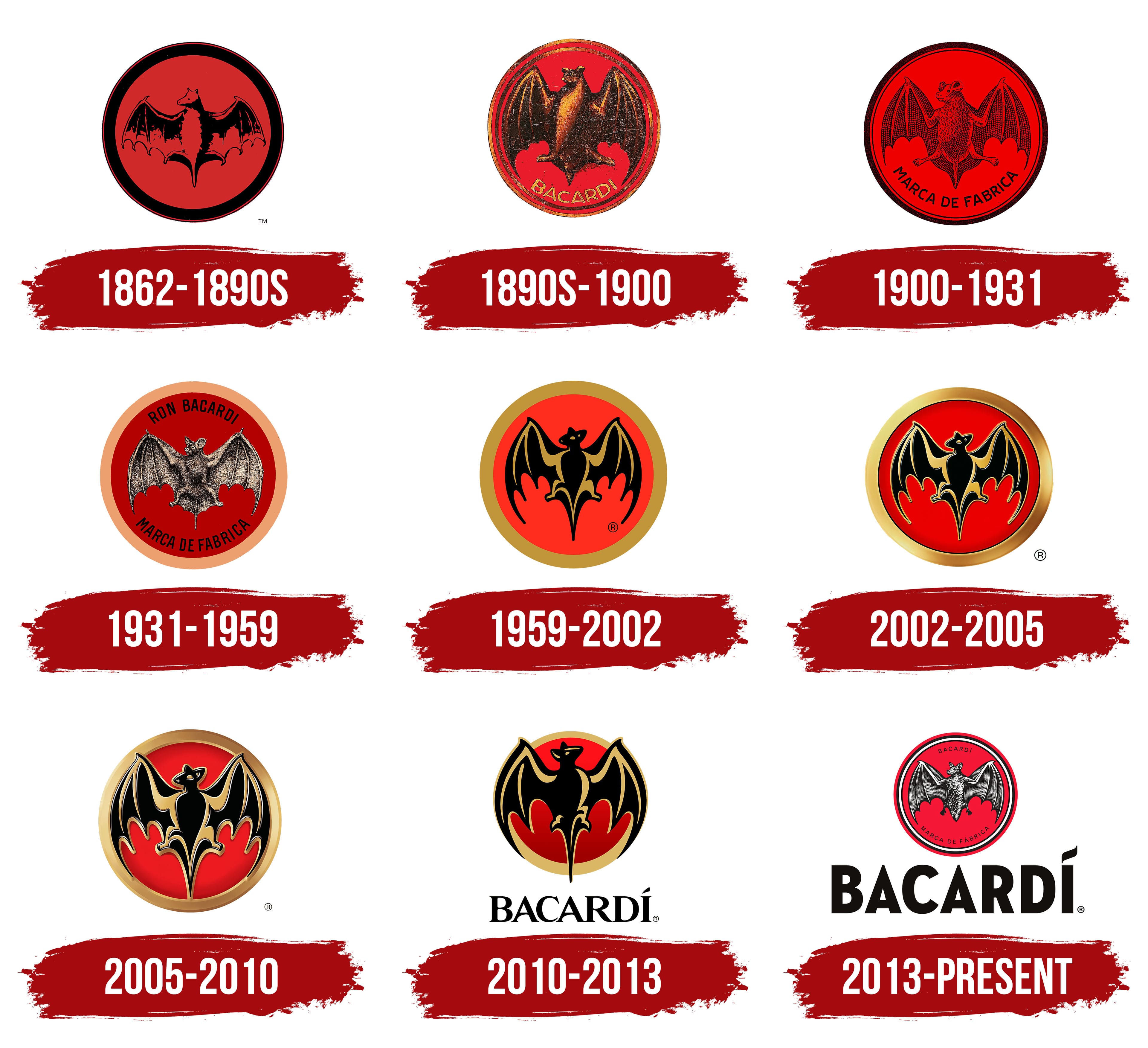
Bacardi Limited Group’s recognizable logo features a bat. For a century, designers have only changed the graphic sign’s style, leaving the brand’s identity untouched.
What is Bacardi?
Bacardi is one of the largest family-owned companies producing strong spirits. Its primary product shares the same name: Cuban rum. It uses special sugarcane yeast in its production. The first Bacardi distillery opened in 1862.
1862 – 1890
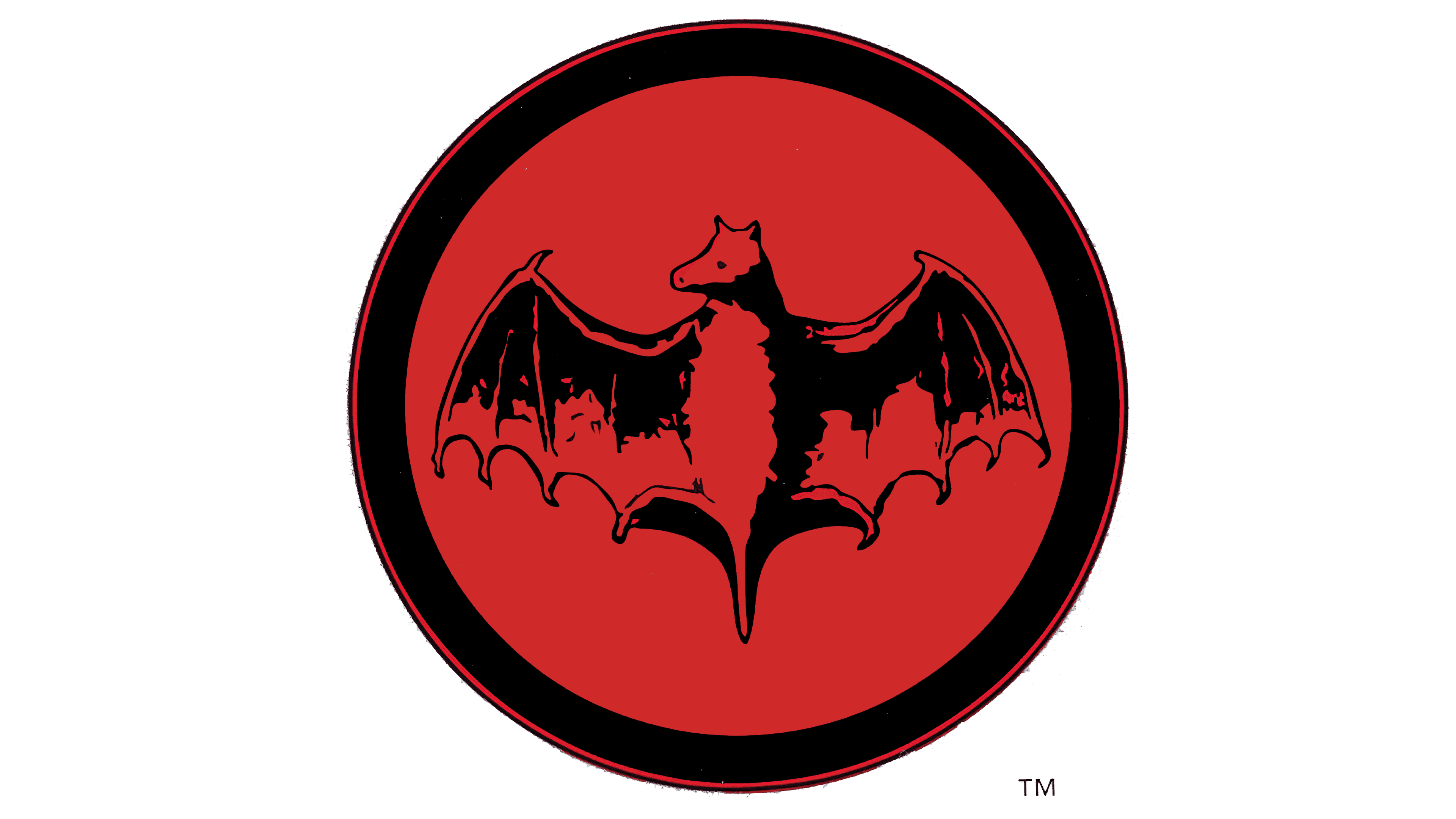
In 1862, the Italian entrepreneur Facundo Bacardi Masso acquired a distillery building. It was so old that fruit bats had taken up residence in its rafters. These animals became the prototype for the emblem, taking center stage within a red circle outlined in black. According to another version, the company’s founder was inspired by numerous Cuban legends in which bats symbolized health and success.
the 1890s – 1900
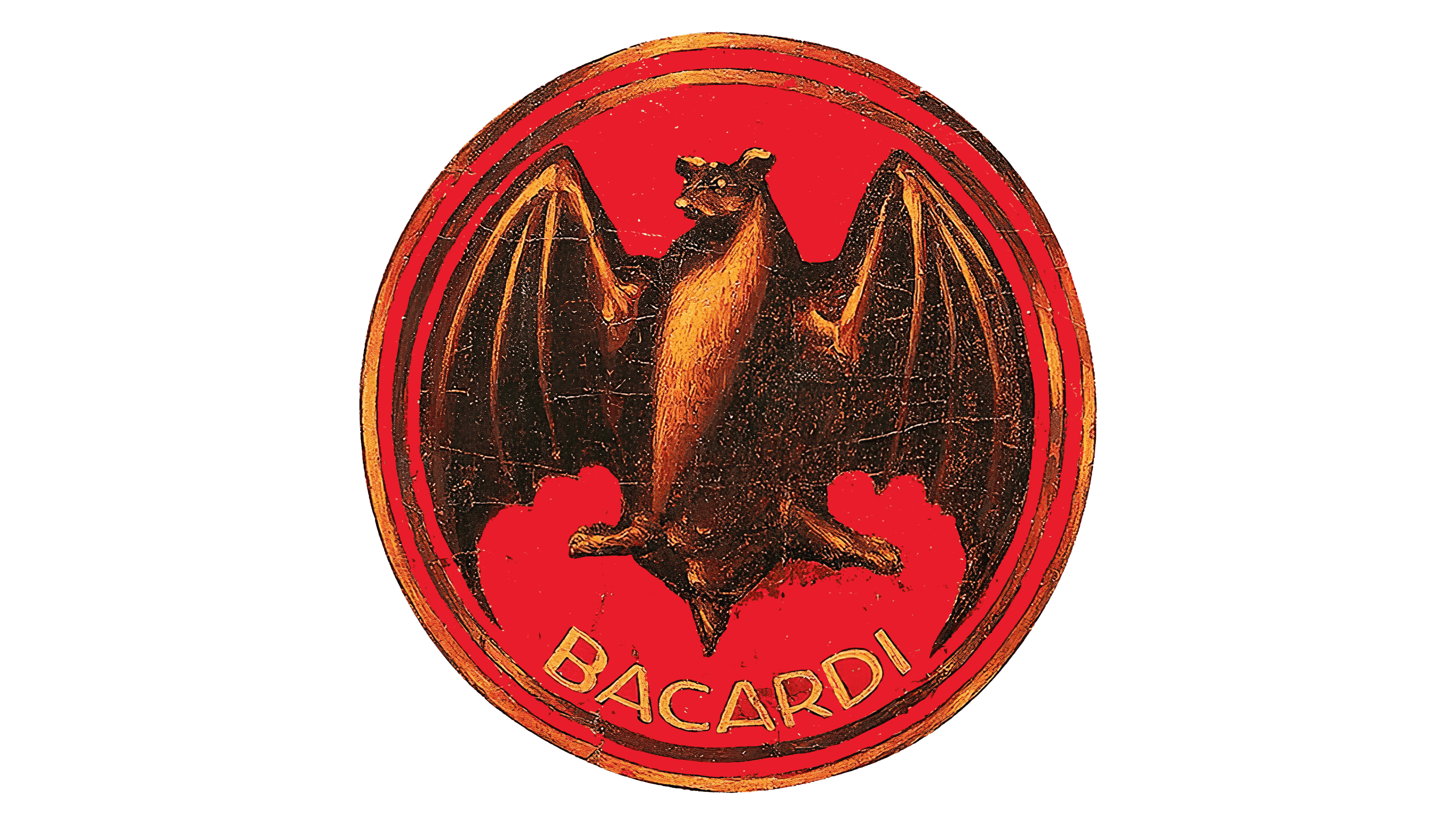
This period is significant in the brand’s history, as it marked the first time the striking combination of black, burgundy, and gold was used. Compared to the previous version, the bat became much more realistic. To this end, designers drew light spots along the wings’ skeletal bones and added brightness to the front to highlight the fur. They also colored the ears, eyes, and tip of the nose in yellow. The frame near the circle also became golden, with double edging and highlights. Under the widely spread paws, the inscription “Bacardi” appeared, which was pushed from the right and left into the sharp ends of the wings, as if the bat took the distillery under personal protection.
1900 – 1931

The logo featured a structured bat image. Each scale on the wing membranes and each hair of fur is visible. The head acquired realistic features. However, designers removed the gold color and reduced the animal’s size. Along the edges of the circle, they placed two black stripes: one wide and one narrow, resembling a thread. The word “BACARDI” was replaced by the phrase “MARCA DE FABRICA.”
1931 – 1959
The company continued its search for a realistic logo and adopted a new look for the bat. It now smiles, with a natural gray coat and large ears. It is complemented by a double inscription around the circle: “RON BACARDI” on top and “MARCA DE FABRICA” on the bottom. The burgundy circle has a gradient and a wide gold edging line.
1959 – 2002
In 1959, the era of realistic images ended. From then on, the bat is depicted in contour. The authors left only the head turned to the left, kept the animal’s size the same, and stylized the rest in black and gold. The background and frame were retained. Compared to previous logos, such an emblem looks friendlier on the label, without aggression.
2002 – 2005
Thanks to double underlining and shadows, the lines became smooth and relieved. A 3D effect is traced throughout: in shape, edging, and even the background, which slightly protrudes above the edge. The red gradient is preserved, as is the traditional black-and-gold combination.
2005 – 2010
This logo enhances the embossing effect through its clear central form. The bat looks more voluminous not only because of the shading but also because of the lighting. White lines draw attention to the animal’s wings, paws, head, and body. At the same time, shadows are present mainly along the border and on the red background, forming a gradient. All strokes are smooth and long. The wings extend beyond the inner circle and merge with it in color.
2010 – 2013
In 2010, another redesign occurred. In this version, the designers moved toward sharper strokes and figurative elements. The Gothic’s clear contours are gone, so the emblem looks modern. The only thing that remained unchanged was the black-and-gold color combination. Otherwise, the redesign completely changed the logo. The bat’s head now faces right instead of left. The massive wings and tail are larger, so they protrude beyond the circle’s outer border. The edging strip is uneven: it is narrow at the top and wide at the bottom. Under the symbol is the printed inscription “BACARDÍ” with an elegant flourish over the letter “i” instead of the classic dot.
2013 – today
The last changes occurred in 2013. Specialists from the London studio Here Design turned to historical archives. They combined three emblems used from 1890 to 1931. As a result, they created an authentic bat image that closely follows classical canons.
Designers also updated the wordmark. Now, it conveys the retro vibe of Cuban art deco from the early 1900s, characteristic of the architecture of the Edificio Bacardi headquarters in Havana.
Font and Colors
The history of the Bacardi logo is a movement from the old to the new. This paradox is confirmed by the 2013 transition back to the original design. The Here Design studio in London handled it. Developers traced the similarities among the first three emblems and proposed a combined version with historical roots. But there is no gold on it, only black, red, and gray colors. A large inscription remains at the bottom.
The word “Bacardi” is written in bold capital letters. The letters are classic, without serifs, with slight curves. The font resembles an elegant version of Varvara Bold. With this style, designers shaped the text in 1900s decor, characteristic of the Cuban spirit. The logo’s colors are stable, consisting of red, black, gray, and gold, though they sometimes appear and disappear.
FAQ
What is the Bacardi symbol?
Bacardi’s iconic symbol is a bat depicted inside a circle. In Spain, where the company’s founder is from, it is considered a protector of luck, health, and family unity. It is also the main protector and pollinator of sugarcane crops, which are necessary for rum production. In addition, bats lived in the rafters of the first Bacardi brewery.
What animal is depicted on the Bacardi logo?
The Bacardi logo depicts a bat from the Phyllostomidae family. Artists detailed the anatomical details: the membranes between the wings, fingers, hind limbs, ears, head, and other body parts.