


 Fanta Logo PNG
The Fanta logo evokes fruity freshness, fun, and lightness. Through its visual image, the brand conveys the mood of a carefree summer day filled with the bright, juicy taste of ripe fruit. It symbolizes sweet soda that quenches thirst and lifts your spirits anytime.
Fanta was created in 1940 in Germany during wartime restrictions. Because of a trade embargo, Coca-Cola could not ship syrup to its German plant, forcing local management to improvise. Max Keith kept production running and instructed his team to develop a new drink from available ingredients, including apple pomace from cider production and whey from cheese making. The name emerged during an internal discussion in which employees were asked to use their imagination; Joe Knipp proposed “Fanta,” derived from the German word “Fantasie.” The first version differed sharply from today’s formula, with a cloudy color and a taste shaped by limited supplies. Despite this, demand increased, and by 1943, annual sales reached about three million cases, with the drink even used in cooking as a sugar substitute.
After the war, Coca-Cola regained control of the German operations, Fanta production stopped, and the plant resumed bottling Coca-Cola. The brand disappeared for several years before being revived in 1955 in Naples. This relaunch introduced an orange-flavored soda, benefiting from local citrus availability and growing interest in fruit drinks. The updated product gained traction in Italy and soon expanded beyond the country.
During the 1960s, Fanta entered dozens of markets, with flavors adapted to regional preferences, including mango, grape, pineapple, and strawberry. In the 1970s and 1980s, it became one of the leading brands in the Coca-Cola portfolio, ranking behind Coca-Cola and Sprite in sales volume. Marketing targeted younger audiences and tied the drink to music and youth culture. In the 2000s, packaging shifted to a spiral-textured bottle and a redesigned logo, while animated advertising focused on teenagers. By the mid-2020s, Fanta was sold in more than 180 countries, with over 100 flavor variations.
Meaning and History
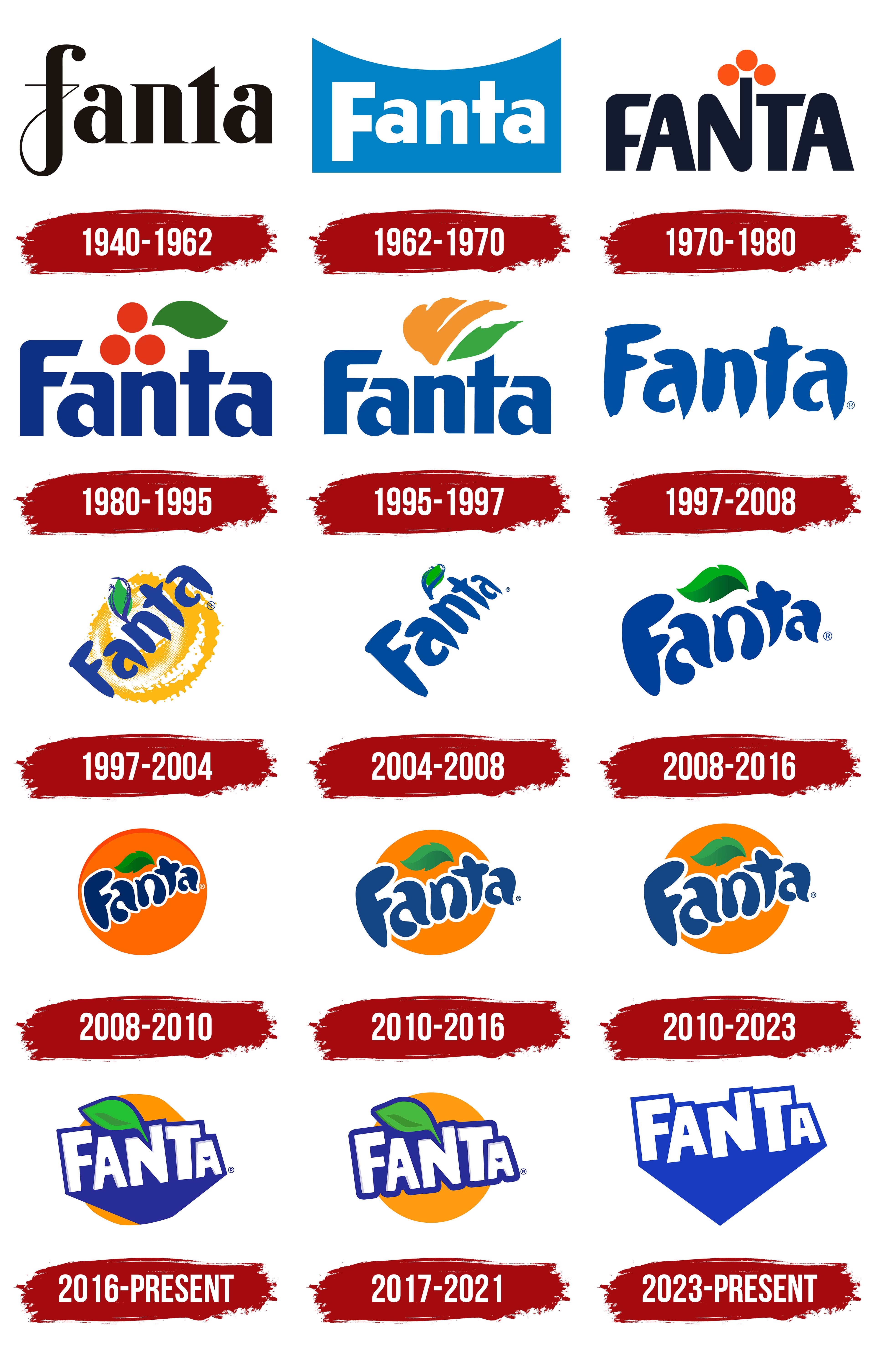
The brand’s emblem is bright, cheerful, and energizing. However, it wasn’t always like this; it used to look gray and dull. Over time, it has evolved through many stages.
What is Fanta?
Fanta is a non-alcoholic drink made from water, sugar, and natural flavorings. It was created in Germany as an alternative to Coca-Cola. The original flavor is orange, but it now comes in variants with different fruits, including peach, strawberry, grape, apple, and lemon.
1940 – 1949

Fanta appeared in Germany in the early 1940s, when ingredients for Coca-Cola were in short supply. The product had a short history, with production ceasing in 1949.
The first Fanta logo reflected a strict style. The word “fanta” is written in lowercase, black letters in an antique serif font. The vertical strokes are thick, while the horizontal strokes are thinner and lighter.
The composition’s main emphasis falls on the initial letter “f.” Its crossbar curves in a smooth arc, reminiscent of a neat hand flourish.
Despite the early brand’s short life, the techniques established at the time became the basis for the further development of Fanta’s identity.
1954 – 1958

In the mid-1950s, Fanta got a new lease on life when SNIBEG, a Naples company that produced products under the Pepsi-Cola brand, took it over. They changed the drink’s recipe by adding orange flavor and then launched the updated Fanta in international markets. Within four years, the brand had spread to 47 countries, and in the fall of 1958, it entered the US market.
The well-known studio Raymond Loewy/William Snaith Associates created the updated drink’s identity. Their work stood out for its simplicity of form and color.
The logo consists of a blue trapezoidal shape. Its sides gradually widen towards the bottom; the lower edge is straight, and the upper edge curves inward in a gentle arc. This shape evokes the silhouette of a bottle neck.
The drink name, “Fanta,” sits on the trapezoid’s blue background. The inscription is in white, a sans-serif font. The first letter is larger than the rest.
The entire brand identity is built around a combination of large shapes and simple letters. The blue-and-white color scheme complements each other, emphasizing the drink’s freshness and the overall lightness of the image.
1958 – 1970

In the late 1950s, Fanta slightly refreshed its logo. The overall style remained unchanged, with only the shade of the shape changing. The brand image continued to center on the same expressive trapezoid, with sides that gradually widened toward the bottom. The top line was given a barely noticeable, slightly deeper curve, forming a characteristic arched cutout.
The drink name, written inside the shape, remained unchanged and was still rendered in white.
The logo’s main innovation was the color transition. The previous bright blue was replaced by a more subdued tone, revealing shades of pearlescent gentian blue.
1970 – 1988

In the 1970s, Fanta adopted a new identity that emphasized playfulness and freshness. The designers added three expressive orange dots above the center of the word. This additional symbol clearly refers to oranges, the drink’s base, and also resembles gas bubbles.
In the logo version from that period, the name FANTA appears in large capital letters. The font is most likely a modified Peignot sans serif, with massive strokes and smooth lines. The rounded edges of the letters create a light silhouette, softening the perception.
Above the central letter N is a small graphic element crowned with three circles. They are arranged in a triangle: one circle at the top and two below on the sides. The circles are bright, contrasting with the dark blue of the inscription. This blue-and-orange combination reflects the drink’s fruity nature, emphasizing its association with juicy citrus.
The new style cemented Fanta’s image as a fun, vibrant brand focused on positive emotions and vivid taste experiences.
1980 – 1995
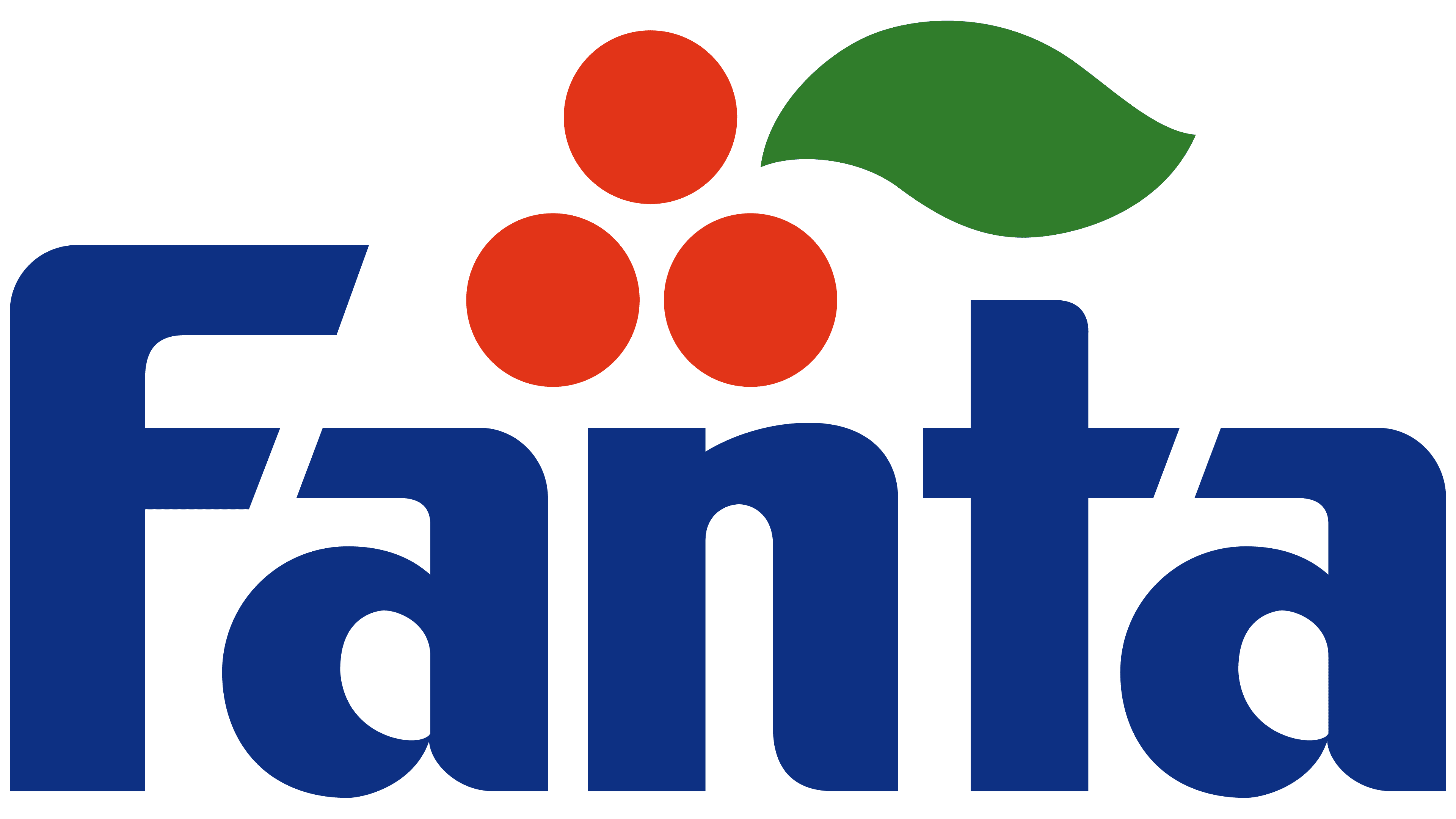
During this period, the Fanta logo became more colorful and closer to the drink’s fruit theme. The letters took on a rich blue hue, retaining the bold sans-serif font. The first letter remained the only capital letter, with the rest in lowercase.
Three orange circles sit above the center of the inscription. The circles form a triangle reminiscent of an orange. On the right, a green leaf complements the composition. It curves with a soft line and ends in a point. The new element visually emphasizes the drink’s natural composition, complementing the brand’s fruit theme.
The three colors emphasize the drink’s freshness, brightness, and natural character. As a result, Fanta became more attractive than in previous versions.
1994 – 1997

In 1994, the Fanta brand decided to give its logo a more emotional image. Instead of strict forms and clear contours, it introduced a style reminiscent of free brush strokes. Abstract orange and green elements replaced abstract geometric shapes. In the new logo, the orange is stylized, with light, wavy lines that bear no obvious resemblance to the real fruit.
To the right of the main symbol, a green leaf appears, elongated with a smooth curve and a pointed tip. The leaf is also rendered in a free, lively manner.
The drink name is set in massive, light-blue letters in a sans-serif font. The font retains the general structure of previous years, with minor changes to letter details. The inner corners are still softly rounded.
The logo retains its association with the drink’s natural fruit flavor and conveys the lightness and cheerfulness that are part of the Fanta brand.
1997 – 2008
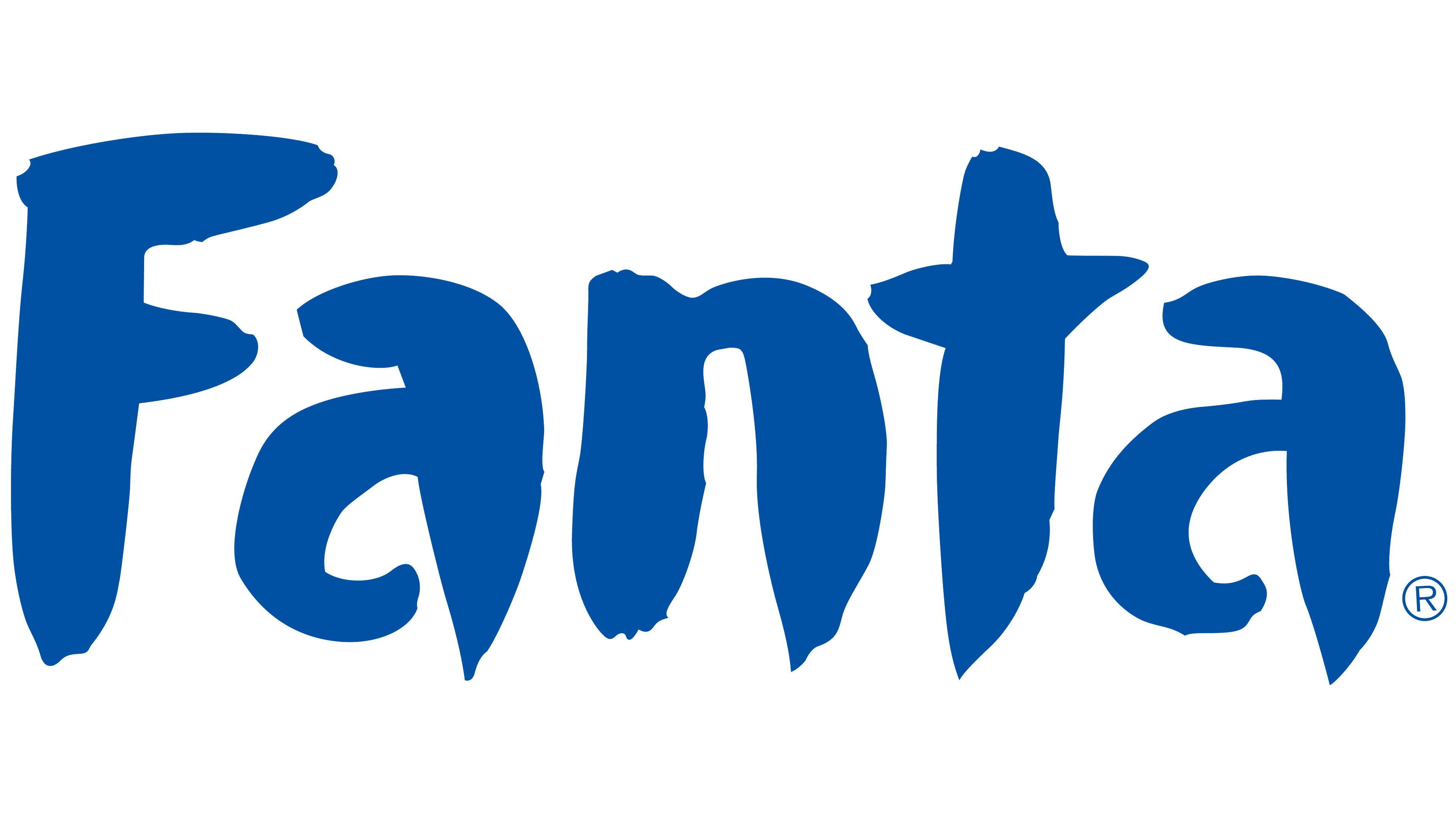
In 1997, Fanta changed its image, adopting a completely new logo. The image was stripped of symbols and made as concise as possible. The entire emphasis shifted to typography, with letters becoming the main expressive tool.
The drink’s name is written in blue. The font is completely new. Strict geometry gave way to a free, almost handwritten style. The letterforms are slightly uneven, with jagged edges and thickening, as if painted with a brush. This unevenness makes the logo lively and emotional.
The entire inscription is in lowercase letters, with only the first letter F remaining uppercase. Thanks to its plasticity and unevenness, the font seems informal and relaxed, perfectly conveying the mood of a fruity, positive drink.
1997 – 2004
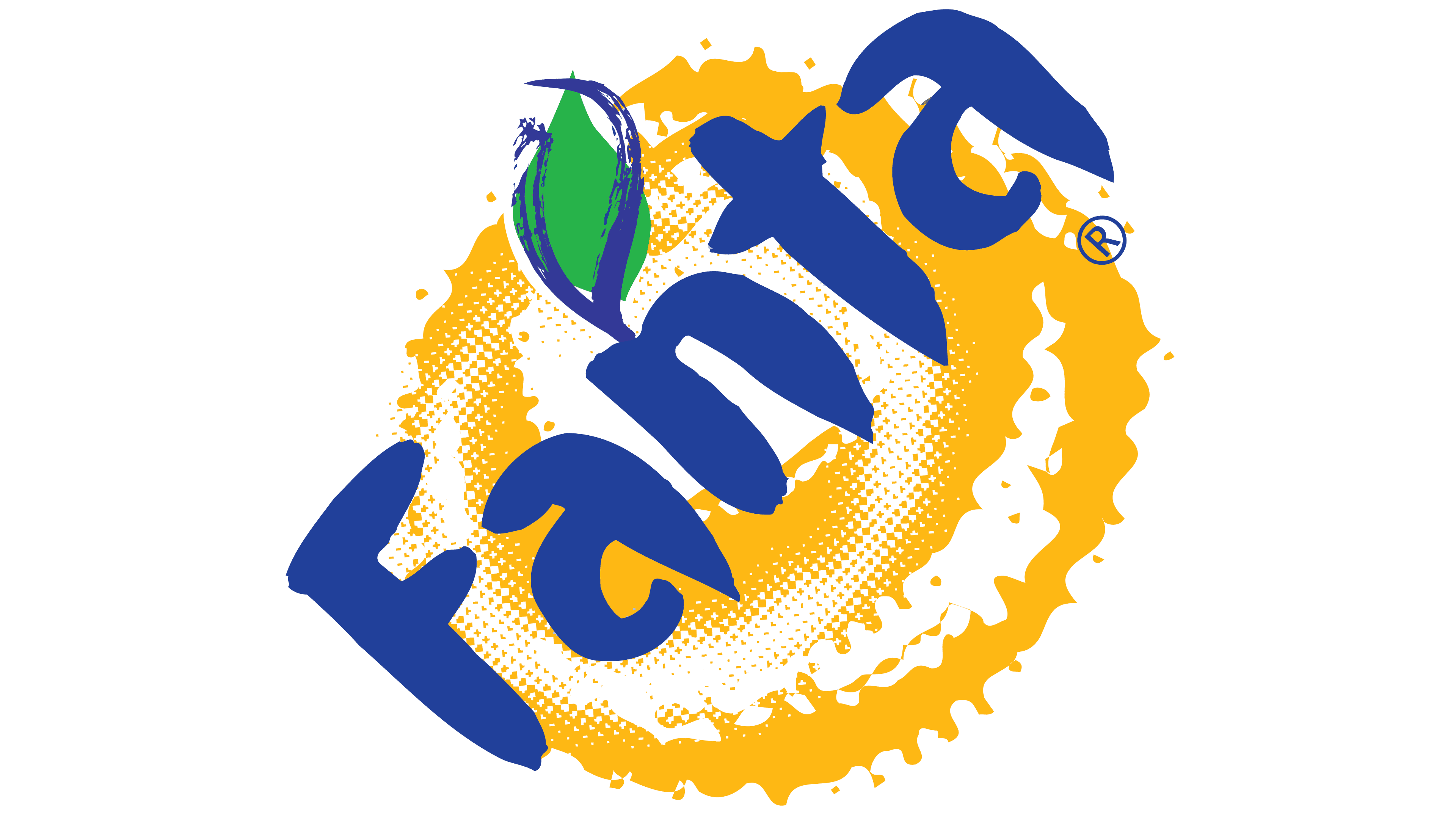
In the late 1990s, Fanta introduced a new logo, which is still used for the Mexican version of the drink in the US. The identity shifted to a livelier, more multi-layered style. Dry typographic approaches gave way to bright graphics and color combinations.
The main background is a bright orange splash, uneven in shape and reminiscent of spilled juice. Small splashes and protrusions line the outline, emphasizing the drink’s freshness and liveliness. Within the splash, a texture of light dots resembling gas bubbles or fruit pulp adds realism and depth.
The drink name is written diagonally. The font remains unchanged. It is free, almost handwritten, with variations in line thickness and jagged edges. The letters are dark blue, contrasting with the bright orange background.
A new symbol has appeared above the letter “n.” It consists of a green leaf, painted with free strokes using shades of blue and green. The leaf covers part of the orange spot and reinforces the association with natural fruits, which are part of the drink’s recipe.
The logo emphasized Fanta’s brightness and fruity nature, highlighting the brand’s emotional appeal and distinguishing it from other carbonated drinks.
2004 – 2008
In the early 2000s, Fanta refreshed its logo, simplifying the composition and making it lighter. The bright splash-effect background disappeared, and the focus shifted back to the drink’s name. The logo looks more compact while retaining its emotional appeal.
The name is placed diagonally from the lower-left corner to the right. The dark blue letters have uneven contours, as if written with a brush. The front characters are larger than the back ones, creating an illusion of perspective and depth, as if the word is receding toward the viewer.
Above the central part is a green leaf with an elongated shape, a slight bend, and a sharp end. Blue strokes run along the leaf’s edges. The leaf is slightly tilted and repeats the general direction of the name.
The new style helps preserve naturalness and liveliness, keeping the logo relevant as market conditions change.
2008 – 2016
In 2008, Fanta softened the logo’s shapes, emphasizing freshness and naturalness. The letters became squat and blue, reminiscent of drops of liquid, reinforcing the connection to the drink. The diagonal placement of the name was retained, but the perspective was now more restrained than before.
The letters’ silhouette became voluminous and rounded, with smooth edges and no unevenness. The style resembles inflated shapes, emphasizing softness and natural perception. The inscription remains dark blue.
Above the letter “n” is a green leaf with a modified shape. It now looks more realistic than in previous versions, with the curve pointing left. The leaf’s gradient enhances the sense of volume. It has a light green hue that gradually transitions to dark green.
The updated style remains emotional and emphasizes the drink’s bright, fruity image.
2008 – 2010
In the late 2000s, Fanta returned to a closed-oval logo based on a bright, rounded element. The visual image is associated with orange, the drink’s main flavor, but it also resembles the sun, thereby enhancing the logo’s emotional character.
The circle is a rich orange color with a neat, thin line around the contour, slightly darker than the main color. This adds depth and a slight sense of volume. Inside, the name Fanta is written diagonally in a dark blue font. The inscription remains the same in style and form, but now has a white outline that makes it stand out against the bright background.
Above the letter “n” is a green leaf with a light-to-dark gradient. It is directly on the orange base, supporting the drink’s natural fruit theme.
The combination of blue text, an orange background, and a green element emphasizes the drink’s brightness.
2010 – 2023
In the next version of the Fanta logo, the emphasis shifted to enhancing the image’s volume and lightness. The main orange circle shrank and now appears as a compact, stylized background resembling the sun. Its color has remained saturated and bright, preserving the drink’s fruity character.
The brand name was enlarged, moved outside the circle, and placed diagonally as before. The blue letters grew lighter, taking on soft, slightly rounded shapes with white outlines separating them from the orange background.
The green leaf above the letter “n” has been retained, with its gradient fill and realistic curve.
Thanks to the new proportions, element displacement, and soft color transitions, the logo now feels lighter and more receptive.
2016 – 2023 (international)

In 2016, the UK-based agency Koto, in collaboration with the brand team, presented an updated Fanta logo style. A year later, the logo appeared worldwide, becoming one of the most recognizable designs of the last decade.
The logo is based on strict geometry and a handcrafted feel. The designer created all details by hand on paper, then converted them to digital format. The design includes three key elements: a bright orange circle, a polygonal blue shape, and a green leaf.
The orange circle is partially hidden and perceived as a background element, maintaining a connection to the drink’s fruit profile. Above it is a blue plate tilted left, with corners, inside which the brand name is inscribed in white letters. The inscription uses the Fanta Playful font, with straight lines rather than smooth curves. A light gray shadow inside the letters gives them volume and depth.
At the top, a green leaf completes the logo, with a smooth curve and a dark inner shade that enhances the sense of volume. It visually connects the blue shape and the orange background, emphasizing the composition’s integrity.
2017–2021 (Japan)

The Japanese version of the Fanta logo, introduced in 2017, adopted a distinctive style that reflected the preferences of the country’s young audience. It retained the main details of the previous design, but the logo became softer and more closely aligned with natural forms.
The logo’s foundation is a large orange circle, which conveys the drink’s citrus base. The name is written in bold white letters with a thin gray fill inside, emphasizing a slight volume. Instead of a large plate, the designers used only a dark blue outline of the letters, freeing up space for a bright background.
The font in the Fanta Playful logo is in all caps, sans serif, with a slight leftward tilt. The letterforms are smooth and rounded, with virtually no corners, making the logo easy and friendly to look at.
Above the central part, a green leaf complements the logo with a neat, smooth curve and an inner shade of dark green that enhances volume.
The overall style reflects the brand’s positive energy and freshness, emphasizing its appeal to younger consumers in Japan.
2023 – today
In February 2023, Fanta unveiled an updated visual identity, unifying the style across all markets for the first time. This coincided with a change to the popular drink’s recipe. The brand abandoned the fruit imagery and other unnecessary elements, leaving only the name and color in the foreground.
The agencies Jones Knowles Ritchie and Gretel developed the new design. Instead of separate versions for different flavors, the brand now uses a single style. It features a bright blue, non-standard-shaped badge with white letters. The name is written in Fanta Pop, a proprietary font developed specifically for this logo. Fanta Sans, the second corporate font, was created for general corporate communications.
The badge is tilted left; its upper border repeats the letters’ silhouette, and the lower part is elongated and pointed. The logo is easily recognizable and lively, retaining its recognizability even without fruit associations. The letters are large, geometric, and slightly slanted. The plate’s bright blue color is uniform and saturated, with no gradients or shadows.
Now, every drink flavor is represented by a single recognizable style, and the new style emphasizes the power of the name without tying it exclusively to orange.
Font and Colors
The trademark’s graphic symbolism is the color orange. It is present in almost all versions of the emblem, as it is the main ingredient of the “sunny” drink.
In the new emblem, flat, angular letters replace the thick, squat ones. The unconventional font creates the impression of cut paper. It was proposed by the studio “Colophon.”
The color palette is diverse. This reflects the drink’s expanded flavor profile, now including rich orange and pale mandarin, as well as yellow, green, and purple. Therefore, the palette is now differentiated by codes.