


 Sprite Logo PNG
The Sprite logo conveys the freshness and lightness of drinks with the natural taste of berries and fruits. The emblem conveys movement and energy, which is what makes lemonade on a hot day. The highlight is the sharp gas bubbles hidden in the sign’s elements.
Sprite began in the late 1950s as a spin-off of two Coca-Cola product lines. In 1956, the Coca-Cola Company tested a clear citrus soda in several US states. In West Germany, the local Fanta division introduced Fanta Klare Zitrone in 1959, a clear lemon drink that became Sprite’s direct model.
In 1960, Coca-Cola acquired the name “Sprite,” which had been used for Sprite Boy, a blond elf featured in Coca-Cola ads in the 1940s. On February 1, 1961, Sprite launched across the US Coca-Cola bottling network as a direct answer to 7UP, then the main name in lemon-lime soda.
The brand expanded quickly. By 1967, Sprite was sold in 39 countries and reached about 85% of US consumers. In 1978, it passed 7UP and became the leader of the lemon-lime segment. Early marketing framed Sprite as a refreshing adult drink and cocktail mixer. By the 1980s, though, the focus shifted to younger consumers.
Sprite then became one of the first major soft drink brands to work with hip-hop. Campaigns featured Rahim, Kurtis Blow, LL Cool J, Kris Kross, A Tribe Called Quest, and later Drake. In 1994, the brand launched “Obey Your Thirst,” later tied to Grant Hill and Kobe Bryant. In 2014, Sprite released Sprite 6 Mix with LeBron James, and in 2016, it issued cans featuring lyrics from Drake, Nas, Rakim, and Notorious B.I.G. In July 2022, Coca-Cola announced that Sprite would switch from green plastic bottles to clear packaging on August 1.
Meaning and History
The Coca-Cola Company launched its lemon-lime brand in 1961, determined to displace 7 Up sodas from the market. The recipe behind it had previously been used in Germany for another product, Fanta Klare Zitrone.
Interestingly, Coca-Cola patented the name “Sprite” in the 1940s. To advertise it, they used the image of a little elf, Sprite Boy, which appeared on screens until 1958. The character then disappeared as his name was assigned to a new brand. That’s what the focus group decided.
To compete with 7 Up, the drink needed a recognizable logo. It was modernized many times, with minor changes, until the brand name remained within the “star.” The product’s design helped popularize it in the United States and in dozens of other countries.
What is Sprite?
This famous non-alcoholic beverage has gained global popularity for its signature lime-and-lemon blend, served crystal-clear. Its unique advantage lies in a powerful, refreshing formula with high carbonation that gives each sip a distinctive tingling sensation on the tongue. The lineup includes the original version, a sugar-free option, and limited-edition flavors made for specific regions. Its clear, unclouded taste and mixability make it a popular base for cocktails and mixers. At the same time, the recognizable green bottle with a silver label and bubbles has become a symbol of youth culture.
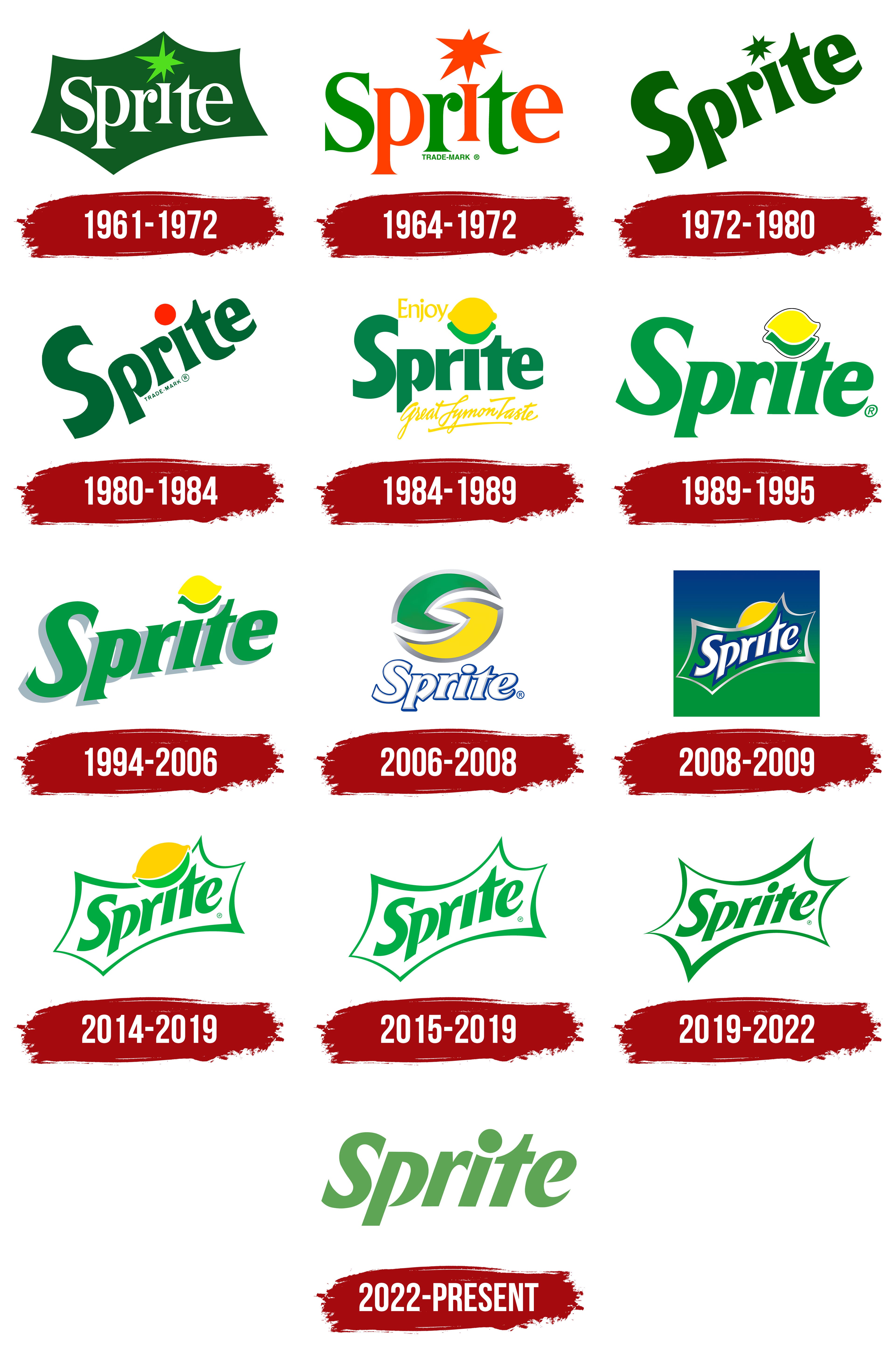
1961 – 1972
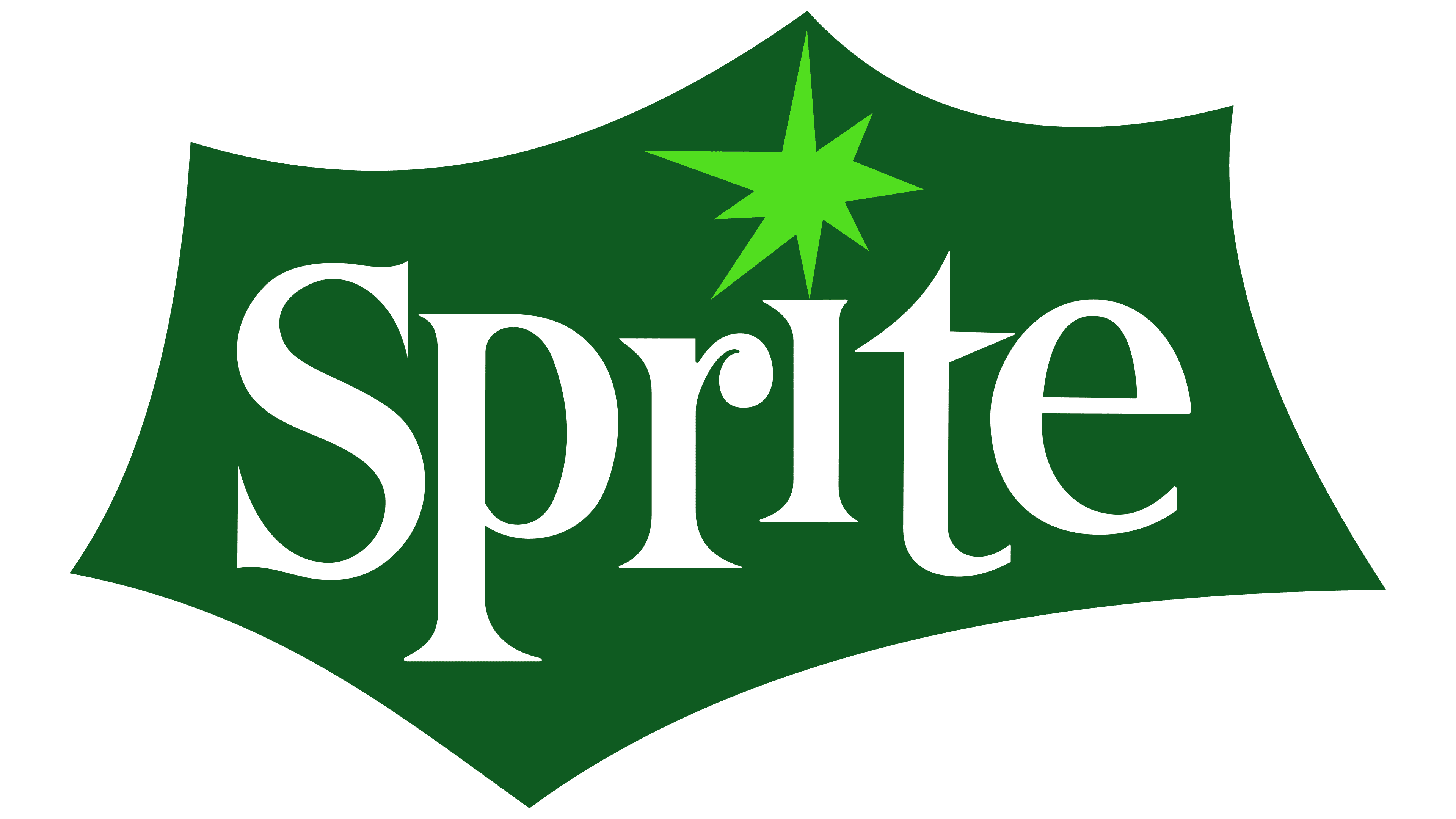
To create a new brand, the Coca-Cola Company preserved its individuality. Coke’s art department created labels associated with sustainability. They featured the blue-green “Sprite” logo in a high-contrast font with long, thin serifs. Above the letter “i,” instead of a dot, was a greenish-yellow star with eight asymmetrical rays. Below the drink name was a barely visible postscript: “TRADEMARK.”
1964 – 1972
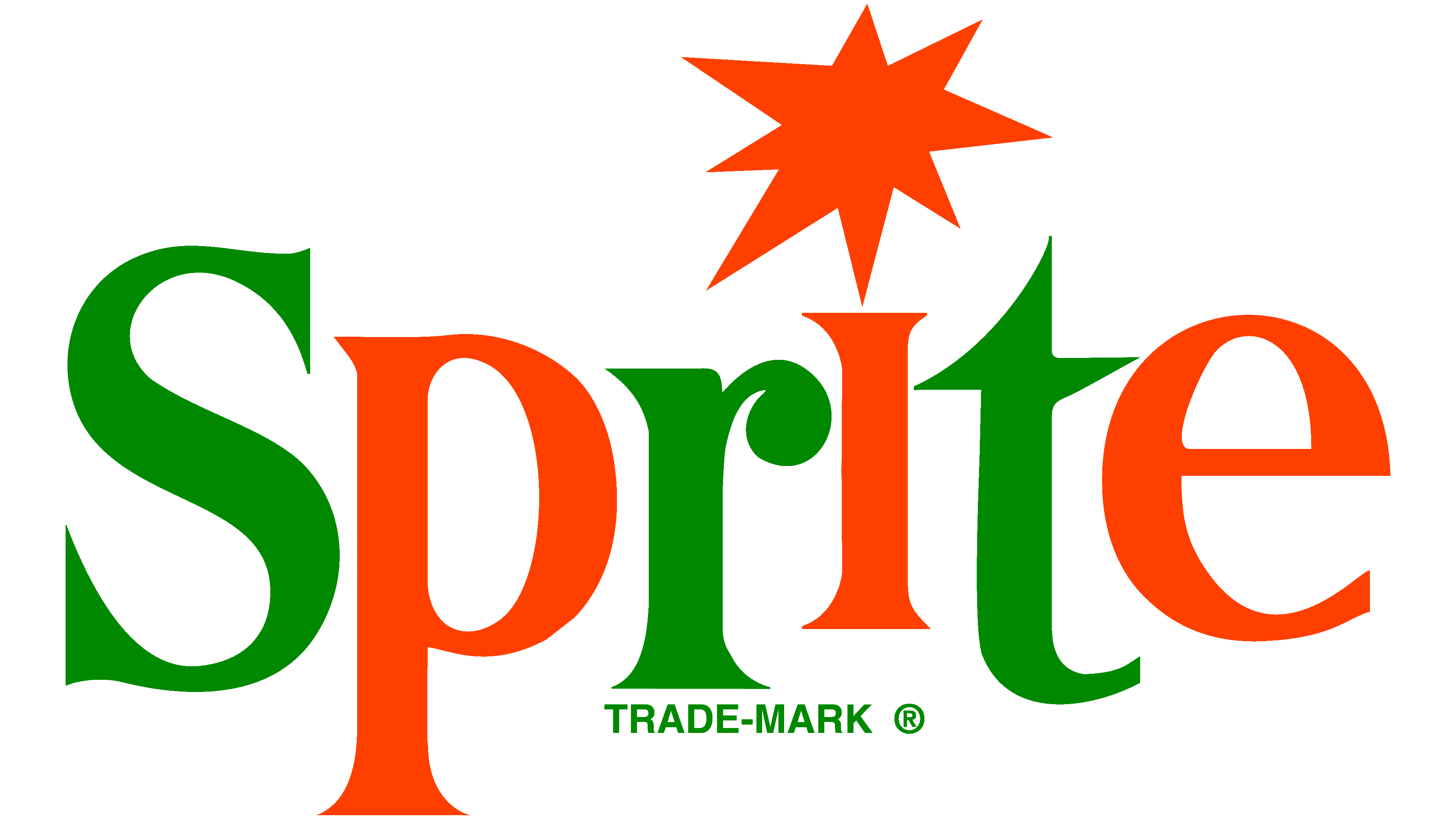
The letters “S,” “r,” and “t” are bright green, while “p,” “i,” and “e” are orange. The star above the “i” was also repainted orange with one additional facet. In addition, the designers added a hyphen between the words “TRADE” and “MARK.”
1972 – 1980
Not only did the Sprite logo turn green, but it was also tilted to the side. The designers found this arrangement most successful, as it emphasized the drink’s explosive “character” upon opening. In addition, the diagonal inscription harmonized well with the element that replaced the dot above the “i.” After all, such a sign is usually used when it is necessary to show an explosion – in this case, an explosion of flavor.
1980 – 1984

For the next ten years, the brand name was dark green and diagonal. Only the element above the letter “i,” which for the first time turned into a dot, remained orange. The lettering used a bold sans-serif font, combining angularity with rounded forms.
1984 – 1989
In 1984, the logo design became more promotional. The “Sprite” lettering was repainted white and lost most of the rounding; instead of an orange circle above the letter “i,” a large yellow-green lemon was used. To its left was the word “Enjoy,” and the phrase “TRADEMARK” at the bottom was replaced with the handwritten “Great Lymon Taste” slogan.
1989 – 1995
In the late 1980s, the trademark returned to green and horizontal. All additional lettering disappeared. The typeface became old-fashioned, with a slight slant. The citrus silhouette above the “i” became smaller, with the yellow lemon and green lime clearly distinguishable.
1994 – 2006
The designers raised the right side of the word again to create a dynamic effect. To the same end, they added asymmetrical gray shadows behind each letter.
2006 – 2008
In 2006, the logo’s style changed completely. The “Sprite” lettering became white, with a double blue outline. The letters had no spacing between them. The word was aligned horizontally to fit atop a large green-and-yellow symbol with two “petals” in a silver frame. This element took up more than half of the space. It replaced the lemon and lime that used to replace the dot over the “i.”
2008 – 2009
The slanted word “Sprite” was inside an asymmetrical silver frame with six corners (three on each side). The geometric shape resembled the star from the drink’s original logo. But here, the liquid was about to spurt out of the lemon that had fallen from above. The citrus fruit was two-colored: the yellow top contrasted with the green “sunken” part. At the same time, the logo’s base was square and featured a blue-green gradient.
2014 – 2019
The designers removed the mottled background and changed the color scheme. The letters and frame are now completely green; the upper part of the lemon remains yellow, and the lower part brightens slightly. The font has also been updated.
2015 – 2019
For the first time in a long time, the lemon is gone. The lettering in the frame has not changed.
2019 – 2022
In 2019, the designers reduced the angle and used a modified font – bold sans serif. A familiar round dot appeared above the letter “i.” The frame also looks different due to the new line thickness.
2022 – today
The current logo is laconic. It is horizontal, pastel-green, with a large dot above the letter “i.” To make it look harmoniously surrounded by lowercase letters, the designers made deep cutouts at the “i” and the neighboring “t.” And they shortened the cap of the letter “r.”
Font and Colors
At first, the Sprite brand used very simple symbolism: the lemon and lime clearly hinted at the product’s composition. But then the manufacturer began to use different flavors, so he needed a universal emblem. The uneven frame, shaped like an elongated six-pointed star, proved to be the optimal solution.
The word “Sprite” doesn’t use a standard font; it uses a set of glyphs designed specifically for the brand. The letters are bold, sans-serif, and slightly slanted to the right.
Green has been the brand’s signature color since 1961. It is associated with Sprite soft drinks, much as orange is with Fanta and red with Coca-Cola. The packaging and promotional materials are colored green. The logo uses a cool shade of #009539.