


 Bajaj Logo PNG
The Bajaj logo is progressive, sustainable, and stylish. The emblem indicates constant growth and development. Traveling more than one road improved the brand’s transport system.
Bajaj Auto grew from the Bajaj Group, founded by Jamnalal Bajaj, a close associate of Mahatma Gandhi. After Jamnalal died in 1942, leadership passed to his eldest son Kamalnayan. On November 29, 1945, Kamalnayan registered M/S Bachraj Trading Ltd., which later became Bajaj Auto.
In 1948, the firm began importing and selling two- and three-wheelers, working at first as a trading company rather than a manufacturer. In 1959, Bajaj received an Indian government license to produce such vehicles, and in 1960, it became a public limited company. That same year, 22-year-old Rahul Bajaj arranged licensed production of Vespa scooters with Italy’s Piaggio. The Vespa 150 soon became a major seller in India.
By 1970, Bajaj had produced its 100,000th vehicle. When the Piaggio agreement ended in 1971, the company lost the Vespa name but kept the equipment and production base. In 1972, Bajaj launched the Chetak, named after the horse of Maharana Pratap. Its “Hamara Bajaj” campaign turned the scooter into a household symbol. At the same time, India’s license system created waiting lists that could stretch up to ten years.
Bajaj expanded further with the RE rear-engine three-wheeler in 1977 and a technical partnership with Kawasaki in 1986, which led to the KB100 and KB125 motorcycles. As Hero Honda gained ground, Bajaj answered with the Pulsar in 2001, aimed at younger city riders. In 2007, Bajaj bought a stake in KTM, later raising it to 48%. The Kawasaki partnership ended in 2016-2017, while Bajaj shifted toward exports across more than 70 countries.
Meaning and History
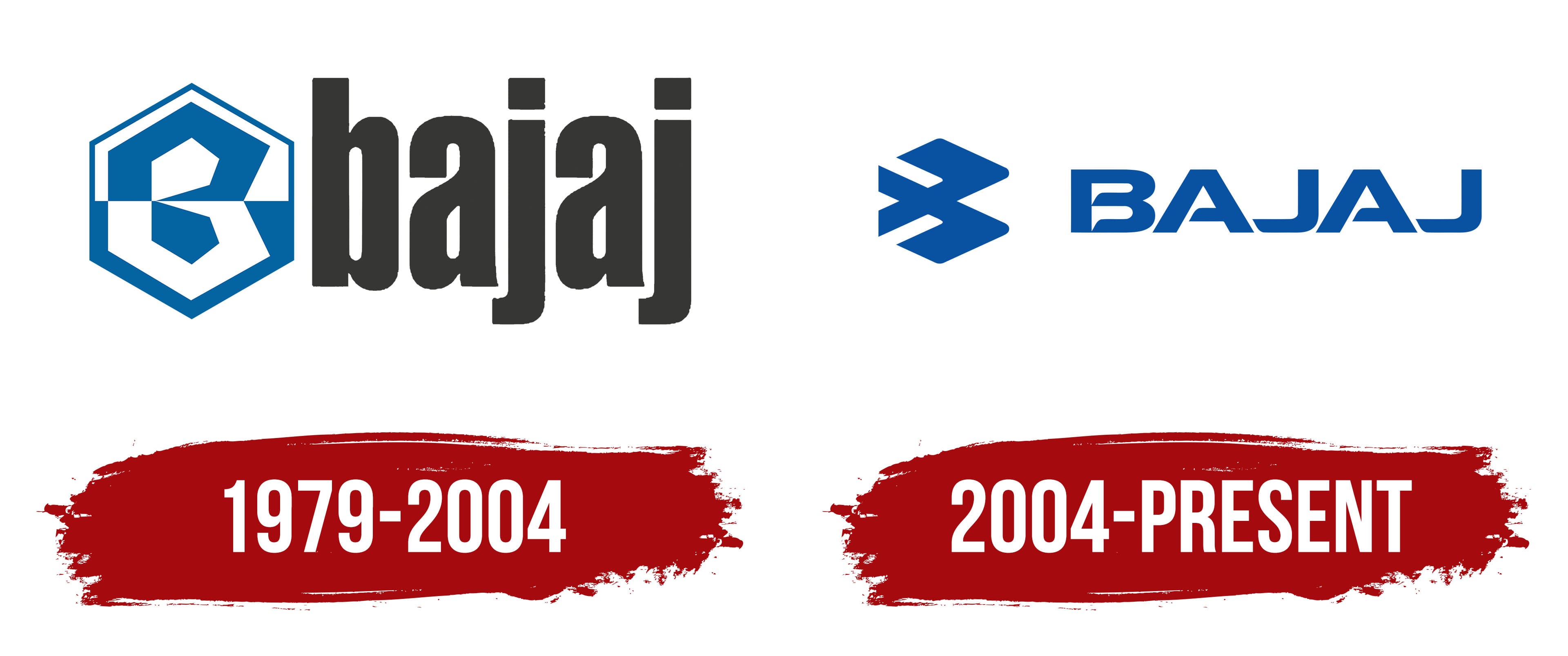
The Bajaj Auto logo conveys the company’s commitment to creating fast and sustainable modes of transport. It was designed by the famous Indian design bureau Elephant Design. It consists of a symbol and a brand name.
What is Bajaj?
It is an Indian multinational company primarily known for manufacturing two-wheelers and three-wheelers. Headquartered in Pune, India, the brand is one of the world’s largest manufacturers of motorcycles and auto-rickshaws. The company’s lineup includes a range of motorcycles, scooters, and commercial vehicles for both domestic and international markets. In addition to the automobile division, the brand is interested in other sectors, such as finance, home appliances, and steel.
1979 – 2004

From 1979 to 2004, Bajaj integrated deep Indian symbolism into its logo to reflect the brand’s philosophy and highlight the unique characteristics of its vehicles. The main design element became the hexagon, which traditionally symbolizes the six chakras in the human body in India. These chakras are considered energy centers controlling various aspects of life, and their harmony is seen as key to physical and emotional well-being.
In the context of the Bajaj logo, the hexagon serves as both a decorative element and a metaphor for the balance and harmony the manufacturer strives to achieve in each car. This is particularly significant since Bajaj vehicles have just two or three wheels, yet they provide remarkable stability and balance, making them ideal for daily use in dense urban traffic.
The logo’s hexagon is divided into two halves, white and blue, symbolizing the company’s main focus areas. This division emphasizes Bajaj’s commitment to a dualistic approach: combining technological innovation with traditional values.
The central element of the logo, the large letter “B,” is designed to resemble hands folded in prayer, turned inward. This is not merely a design choice but a profound symbol of balance, tranquility, and attention to detail, reminding us that every Bajaj vehicle is developed with special care for the user’s comfort and convenience.
2004 – today
The symbol resembles the halves of a bumper, folded like a bird’s wings. It rushes forward parallel to the ground, depicting a moving car. The figure makes it clear that:
- Brand products fly like birds. Motorcycles and auto rickshaws are delivered quickly to their destinations.
- Airflow blows over the driver. The company creates open transport modes, and riders can enjoy the flow.
- The company takes care of the environment. Using a bird as a sign draws an analogy between transport and wildlife, showing that the products organically fit into the surrounding space. Since 2022, the corporation has begun producing electric vehicles.
- The giant is constantly striving forward. Develop new prestigious models.
The bird is a stylized letter B, the first in the brand name. The manufacturer’s name is derived from the founder’s name, a name associated with Mahatma Gandhi. Jamnalal Bajaj grew up in a foster home and belonged to the business-savvy Agrawal community. His roots and connections allowed him to start his own business. The letter B, with the right side open, indicates that Jamnalal rose independently, using what the world gave him.
Font and Colors
The logo’s color is blue, which is also the color of many autorickshaws. It refers to the blue spinning wheel of the Indian flag. In the country, it is believed that the sun’s true color is blue. Therefore, the shade represents the rise to heaven. In the country, the company ranks 10th in terms of scale.
Blue is associated with wisdom. Bajaj employees’ experience and knowledge enable us to create modern, high-quality models. European manufacturers approach the company for joint work. The corporation helps English Triumph and owns KTM Racing and HUSQVARNA.
The font is slightly modified to Corporate Normal. All letters are incomplete, with open areas on the left, indicating a willingness to absorb new knowledge and grow.