


 Barracuda Networks Logo PNG
Barracuda Networks’ logo is always watching the situation. The emblem evokes sharpness, extremity, and alertness. It represents an experienced information defender, ready to strike at any moment.
Barracuda Networks was founded in Campbell, California, in 2003 by Dean Drako, Michael Perone, and Zachary Levow. Drako had grown up in Detroit, started an early software company focused on bulletin board systems in high school, studied electrical engineering at the University of Michigan, earned a master’s degree at Berkeley, and later worked at Silicon Valley startups before entering information security.
The company’s first warehouse was Drako’s mother’s garage. Finished devices were taken by cart to a nearby UPS office, and larger batches were loaded into an employee’s station wagon. Its first product was Barracuda Spam and Virus Firewall, a hardware anti-spam gateway for corporate email. Unlike Symantec and Cisco, which sold expensive integrated platforms, Barracuda Networks focused on small and mid-sized businesses with a simpler and cheaper appliance.
In January 2006, the company raised its first outside funding, 40 million dollars from Sequoia Capital and Francisco Partners. In 2007, the headquarters moved to Campbell, and an office opened in Ann Arbor, Michigan. The product line later expanded from anti-spam tools to firewalls, web filtering, backup, and data archiving. In December 2008, Barracuda opened the Barracuda Reputation Block List to public access, its dynamic database of known spam servers.
By the time of Ako’s departure in 2012, Barracuda had more than 150,000 customers and over $20 million in annual revenue. In 2013, it went public and acquired SignNow; in 2015, it bought Intronis. Thoma Bravo acquired Barracuda in a 1.6 billion deal closed in February 2018, and the company later added PhishLine. On August 16, 2022, KKR completed its acquisition of Barracuda Networks from Thoma Bravo.
Meaning and History
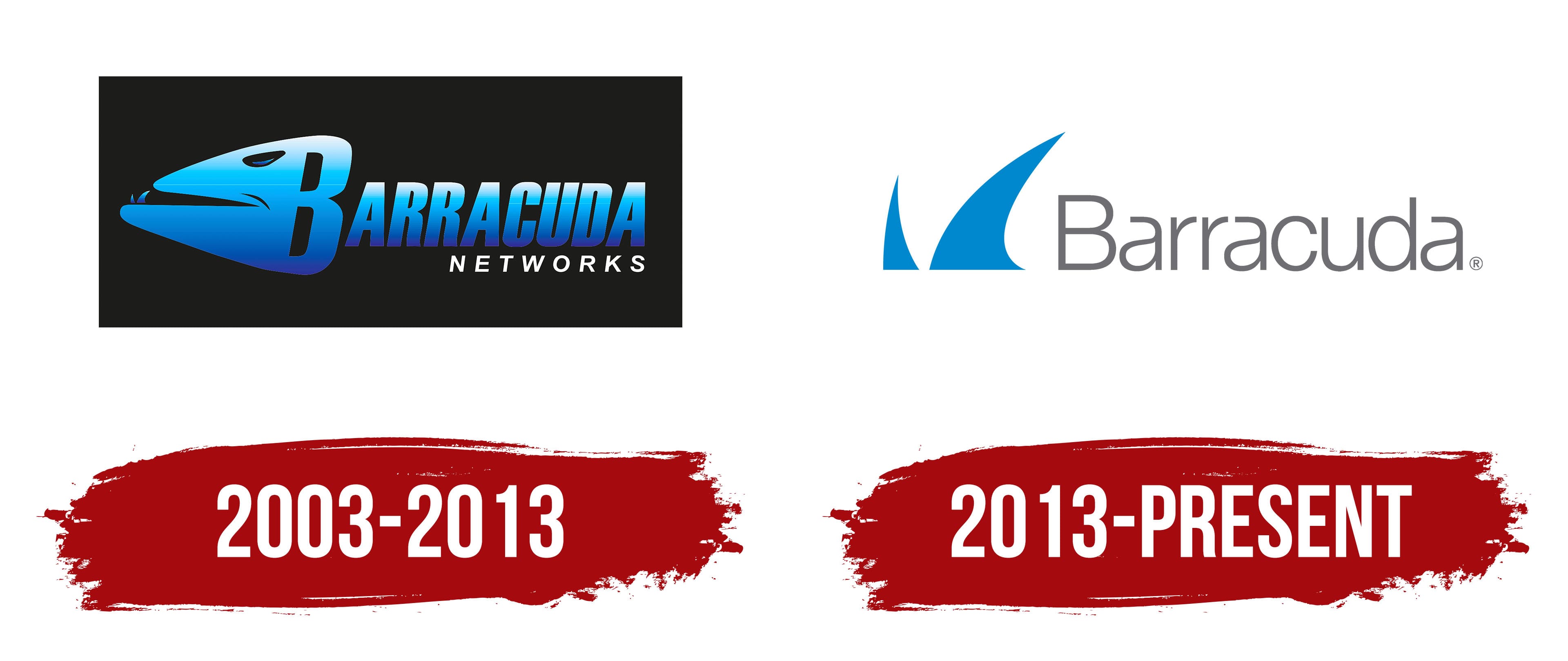
The young company chose a successful analogy to present its activities and built a stylish identity around it. One rebranding for Barracuda Networks’ 10th anniversary significantly changed the image. However, the logo continues to match the chosen theme. Each visual element of the logo conveys a sense of suddenness, the ability to stand up for oneself, and the ability to protect the client.
What is Barracuda Networks?
A California IT company founded in 2003, specializing in network security. It has helped 200,000 clients worldwide. The developer’s arsenal includes 20 algorithms and programs for detecting viruses, preventing intrusion, and protecting information from theft through the network. Its headquarters are in Campbell.
2003 – 2013

The emblem consists of a black rectangle with the name set in two levels inside. A large blue “Barracuda” and a smaller white “Networks.” The first capital, B, is transformed into a fish head. The other characters resemble its skeletal structure.
The predatory fish, the Barracuda, was chosen as an analogy for the company’s name. These powerful attackers can reach up to 2 meters in length. Escaping from the jaws of an attacking fish is impossible. It acts swiftly, and once its jaws close, it never releases its prey. Such “fish” in the form of powerful protective programs and algorithms guard the client’s network. No virus or spy can penetrate inside. Information and data are completely secure.
The black rectangle symbolizes enclosure, a safe, and information storage. The dark background conveys concealment and secrecy. The attacker doesn’t even suspect that, under cover of darkness in these dark waters, a “guard dog” is waiting for them.
The analogy with a fish was chosen because of the Internet’s association with the sea or the boundless ocean of information. The company protects only a small portion of it; the rest belongs to the client.
The size difference between the developer’s name and the inscription “Networks” demonstrates the security system’s complete control over the object.
The play of colors is also not accidental. White represents important new information – everything that is in the client’s email or website. The shade speaks of freedom, openness, and safety. The owner can use it, and clients can visit, read, and correspond. Beyond visibility, the enormous guard, Barracuda, watches over it all. Blue is the color of technology, computerization, and software. They are the ones guarding the network.
2013 – today
In 2012, the company’s president and CEO changed, prompting a rebranding.
The fish in the logo hides its face, but the two sharp fins sticking out of the water serve as a reminder that it’s always on guard. The emblem consists of an inscription and two elements rising in front of the name. In the new interpretation, the logo became simpler and more modern. It looks brighter and points to hidden possibilities.
The massive black rectangle cast a gloomy shadow over the emblem. It conveyed the idea of fighting evil, nights, and secrecy. In the new interpretation, the war continues subtly in broad daylight. The element of fear and concern associated with network protection has been removed. Everything is in order, under control.
The letters’ semi-transparency and the name’s light color present the developer as a business professional. Security through their software operates discreetly. It is present in the background and does not distract attention. However, it works continuously.
The elements of sharpness and danger are evident in the fins’ spikes. The cyber protector is ready to inflict painful harm on the thief if the thief crosses the line.
Font and Colors
Blue and light gray form the basis of the modern sign.
- Blue is the color of water, which corresponds to the fish theme. The shade of blue is used for the programming niche, the IT sphere, engineering developments, and technical software. The palette indicates the threat-detection algorithms through the system’s clear, logical actions.
- Gray is the shade of methodical, consistent work. Boring and monotonous. But only persistence and repetition of the same operations can reliably support protective barriers.
The font resembles Alegreya Grotesk Normal Ul, but with a more concise “a.” Thin, light letters with unusual bends resemble a web or a trap, ready to catch a cybercriminal.