


 BCG Logo PNG
The BCG logo’s expression underscores the firm’s importance. Its confident, flowing lines convey the dynamism this business requires. Its style is distinctive, inviting, and memorable.
Boston Consulting Group began in 1963, when Bruce Doolin Henderson, a Tennessee-born former Westinghouse manager and Arthur D. Little consultant, was asked by Boston Safe Deposit and Trust Company to create a consulting unit for corporate clients. He started almost alone, in what he described as “a room with one desk and no telephone.” First-month revenue was $500, and Arthur Contas became the first full-time consultant in December 1963.
Henderson wanted the firm to avoid copying older consultancies. In 1964, he launched Perspectives, a series of short essays on business strategy sent free to executives. In 1966, BCG became the first Western strategy consulting firm in Japan when it acquired TFM Adams. That year, Henderson introduced the experience curve, showing how unit costs could fall as accumulated production doubled.
In 1968, the unit officially became Boston Consulting Group. Around 1968-1970, Alan Henderson and Alan Zakon developed the growth-share matrix, later known as the BCG matrix. It divided business units into “stars,” “cash cows,” “question marks,” and “dogs.” Mead Paper was the first client to use it, and by the 1970s and 1980s, nearly half of Fortune 500 companies reportedly used it.
By 1973, BCG had revenue above $7 million and offices in London, Paris, Munich, and Milan. Henderson began buying the firm out from the bank in 1974, and BCG became independent in 1979. He handed leadership to Alan Zakon in 1980. Later, BCG developed ideas such as time-based competition, completed its first project in China in 1985, and grew into one of the major global consulting firms alongside McKinsey & Company and Bain & Company.
Meaning and History
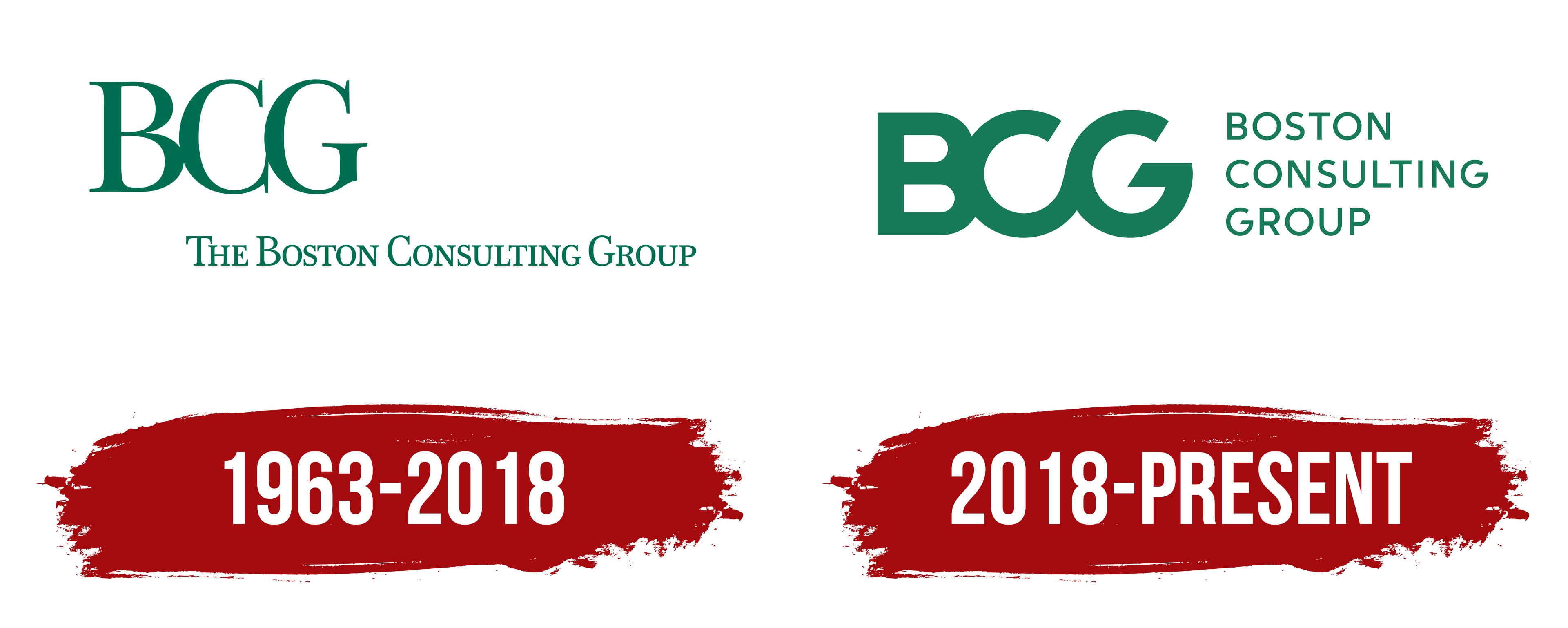
BCG was founded in 1963 by the head of the consulting division of The Boston Safe Deposit and Trust Company. It became a subsidiary department of the bank, responsible for advising the bank’s clients. By the end of the year, the company had a second consultant (Bruce Henderson was the first). In 1966, the Boston Consulting Group expanded beyond the US by opening an office in Japan’s capital.
The firm began separating from its parent organization in 1974, when the founder first proposed transferring BCG shares to employees. This allowed her to gain independence. This process was completed in 1979. The company is one of the top 3 consulting firms in the United States. Moreover, it follows a strict corporate policy, so it has only two logos in its history: the original and the current one.
What is BCG?
BCG (Boston Consulting Group) is a private consulting company in the USA. It supports business development and related issues. In particular, it helps create an effective management model and determine the best development strategies. It was founded in 1963. The founder is Bruce Doolin Henderson. Its headquarters are in Boston, Massachusetts. The company is international, with 90 offices in 50 countries.
1963 – 2018

For a long time, the consulting company used the logo with the classic spelling: all the letters in the name were capital, thin, and printed. Their only distinguishing characteristic was the bond. The symbols in the abbreviation were so close together that they were perceived as a single “construction.” They were decorated with sharp serifs that resembled straight needles. “C” and “G” overlapped in style and looked almost identical. The difference was only in the lower element, usually present in “G.” The extended version of the company’s name, “The Boston Consulting Group,” used a similar font. The phrase extended far to the right, so it wasn’t aligned to either edge and began under the letter “C.”
2018 – today
In 2018, the company introduced an updated logo that retained the same concept as the first but with a completely different design. The only thing that unites them is the color: it is still emerald green. The labels are now rearranged into three rows, with the abbreviation “BCG” on the left and the phrase “Boston Consulting Group” on the right. Moreover, the article “The” disappeared from the name. The Antiqua was replaced by the Grotesque, thereby improving the text’s readability. At the same time, the letters “B,” “C,” and “G” became wider, with closer connections and a more modern look.
Font and Colors

After the modernization, the debut logo became more diverse, even though the text appears in both parts. The designers turned the abbreviation into a graphic element, tightly connecting the letters. The result is a multifaceted figure with smooth transitions between parts that doesn’t resemble a monogram.
The old BCG logo uses a serif with sharp spikes. It is typographically similar to the Neuton Regular typeface or its free counterpart Neuton SC SC-Regular (both designed by Brian Zick). The new logo’s lettering is a smooth sans-serif, reminiscent of Durotype’s Neutro Demi font. The corporate palette remained unchanged: green. But it was not a classic green; it was an emerald shade.