


 Beko Logo PNG
Only forward and up! This company’s motto reflects the Beko logo. The emblem reflects a commitment to continuous development and improved product quality. The main focus is on customer convenience and comfort.
Beko’s history began in 1954, when Vehbi Koç and Leon Bejerano founded Beko Elektronik in Istanbul. In 1955, Koç also launched Arçelik, which became the group’s manufacturing base within Koç Holding.
Industrial production expanded quickly. In 1959, Arçelik introduced Turkey’s first washing machine, followed by its first refrigerator in 1960 and its first television in 1968. During the 1970s, import restrictions protected local producers, allowing Beko and Arçelik to build technical capacity and scale.
In the 1980s, market liberalization increased competition and pushed the group toward exports. In 1990, Arçelik entered the UK market, competing with Hotpoint and Indesit by offering lower prices and broad distribution. By the mid-1990s, Beko had secured a stable presence.
In 2001, Arçelik consolidated Beko as its main global brand. In 2002, it acquired Blomberg, Elektra Bregenz, Leisure, Flavel, and Arctic, gaining manufacturing sites and distribution across Europe.
In 2004, Arçelik partnered with Alba to acquire Grundig and took full control in 2007. Together, Beko and Grundig covered both mass and higher segments. By 2005, Beko and Vestel produced over half of Europe’s televisions.
From 2011 onward, the group expanded globally. It acquired Defy in South Africa and Dawlance in Pakistan, and partnered with the Tata Group to launch Voltas Beko in India. In 2019, Singer entered Bangladesh.
In April 2024, Arçelik merged its European operations with Whirlpool to form Beko Europe, adding brands such as Indesit, Hotpoint, and Bauknecht and creating Europe’s largest appliance producer by sales.
Meaning and History
Visual brand identity is simple and recognizable. The blue “Beko” lettering has been adorning branded products for many years. But its design changed once when the company decided to balance the graphic composition.
What is Beko?
Beko is a Turkish company that produces electronic goods and household appliances. It was established in 1955 and is named after its founders, Leon Bejerano and Vehbi Koç, using the first two letters of their surnames. The brand’s headquarters are located in Istanbul.
1967 – 1986
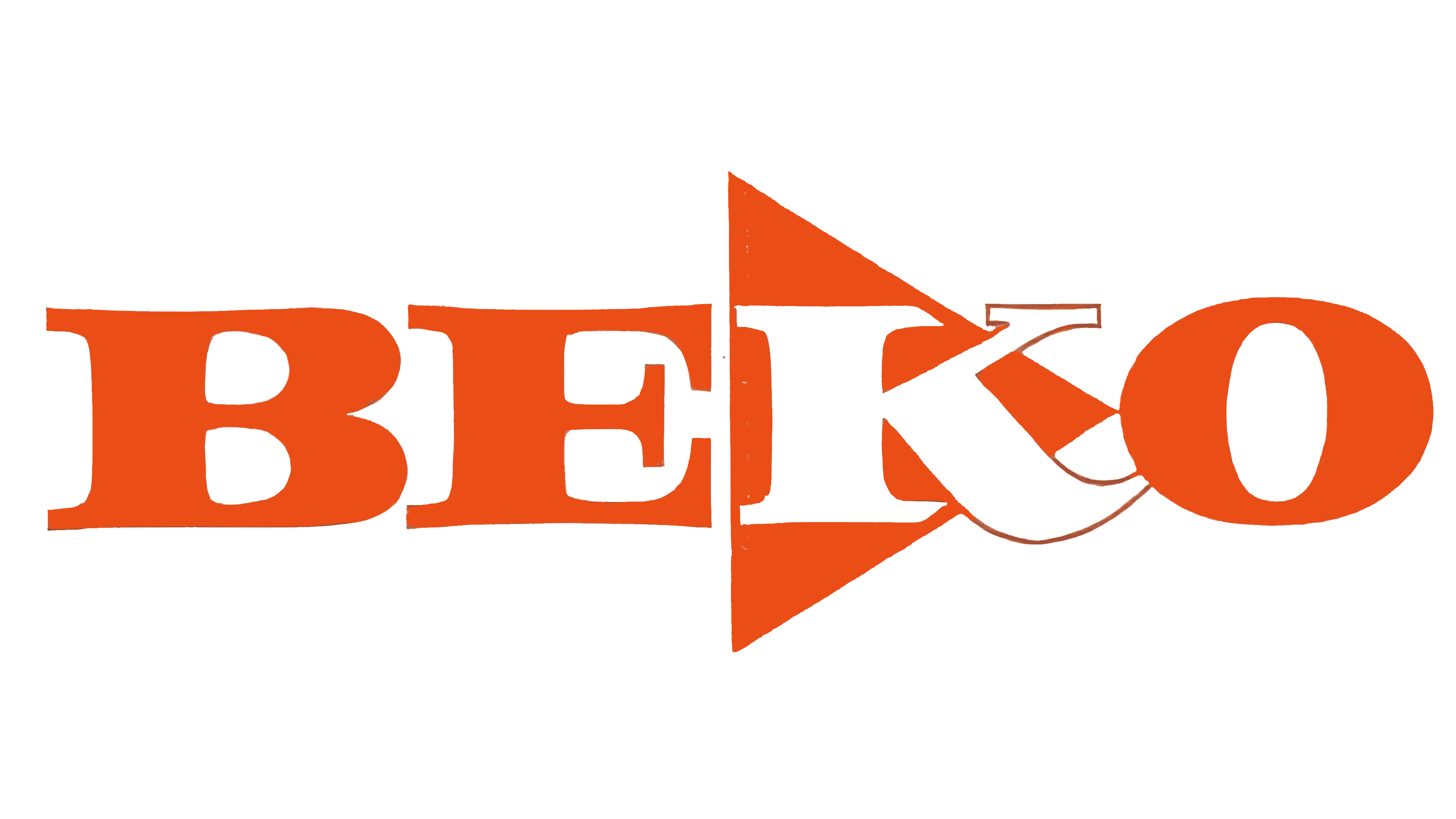
In 1967, Beko adopted the original logo with bold lettering in deep orange. The letters had wide legs and narrow connecting lines. They also had small, elongated serifs and tight spacing between characters. For example, the “K” connected to the “O.” In general, the “K” was a strong graphic element: set against an orange isosceles triangle, it was painted white, unlike other signs.
1986 – 1993
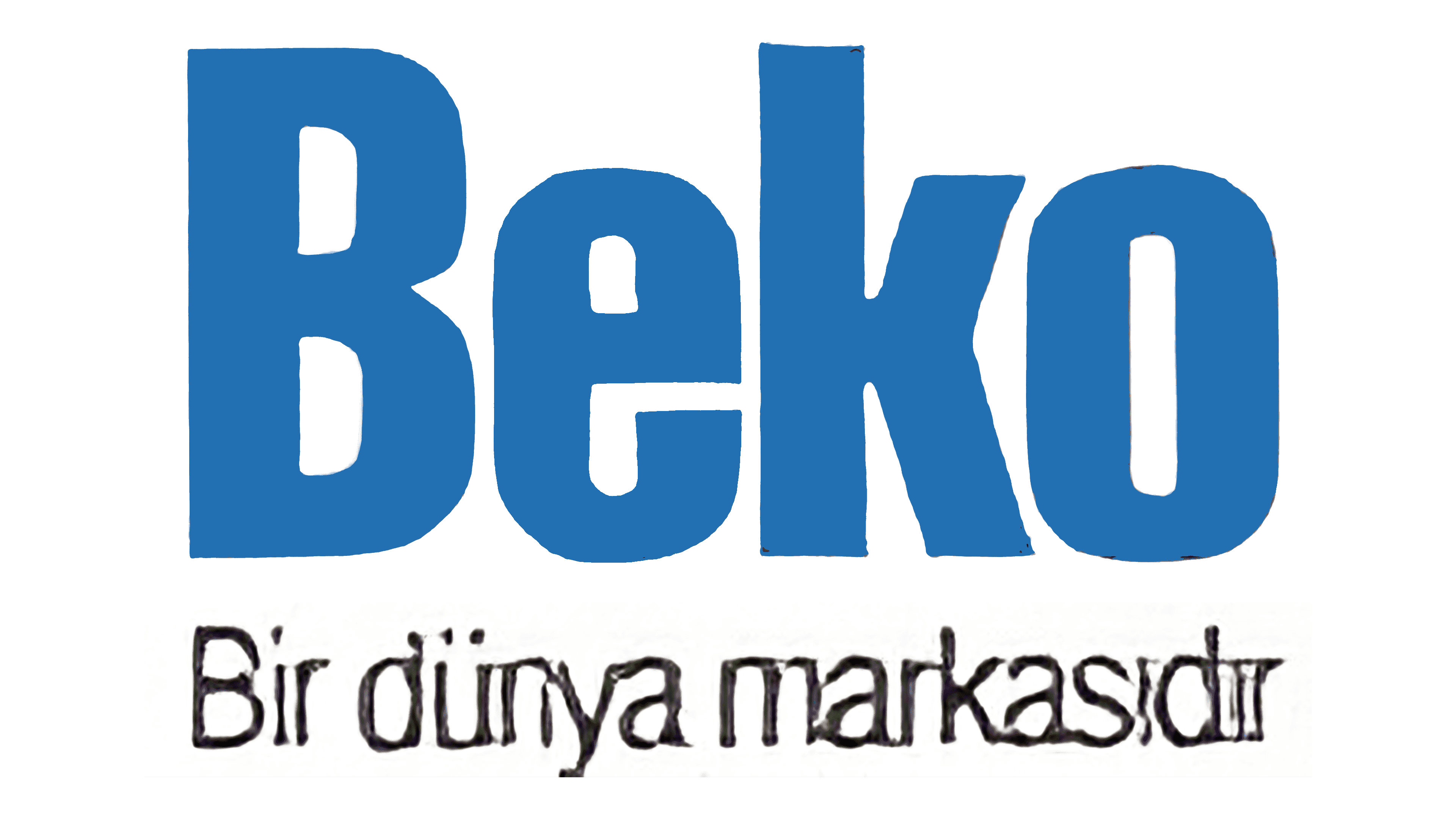
Changes in 1986 introduced a modern logo that ushered in the era of blue in the Beko identity. The company name was in tall, bold type. All letters except the first were in lowercase. The stem of the lowercase “k” matched the height of the capital “B.” Underneath was another inscription: the company motto. It was aligned with the top row on both the right and left. The background was empty white space.
1993 – 2014
The brand name on the debut emblem is written in capital letters. For decoration, they used a square, chopped font. Still, the corners on the “E” and “O” are rounded.
2014 – today
The branding company Chermayeff & Geismar & Haviv developed the current logo. The redesign took four months to prepare. As Sagi Haviv admitted, the specialists faced a difficult task: to make the brand name harmonious. The old version lacked balance because the B and E were closed, while the K and O were open.
To solve this problem, the designers replaced the uppercase letters with lowercase letters. The current typography resembles the Myriad font, but the shapes of the printed characters are slightly different – especially the “b”; the round part looks like an exact copy of the “o.”
The word “Beko” is underlined with a diagonal line. With this, the developers tried to convey the dynamics and energy. The color is also symbolic. The bright shade of dark blue reflects the brand’s focus on consumers between 18 and 35.
Font and Colors
The brand’s visual identity mark has always consisted of only short text. The title sits on a light background and is not accompanied by any figurative elements. Therefore, the Chermayeff & Geismar & Haviv studio designers emphasized the inscription from the outset, giving it graphic expressiveness. The only detail is the wide oblique stripe at the bottom. It coincides with the lines of the letters, so it appears as a diagonal rectangle pointing upward at a slight angle.
The inscription in the new logo version uses a custom typeface. The characters are in lowercase. They are sleek and streamlined, except for the “k,” which has three sharp corners. The legs of “b” and “k” are the same height, so the first letter appears shorter than it is. The inscription uses a chopped, grotesque sans-serif font.
The emblem’s color depends on where it is placed. On official labels, promotional materials, and documents, the letters are blue; on the equipment label, they are black or three-dimensional, with a chrome effect.