 Bentley Logo PNG
The company’s machines outperform competitors’ in many respects. The Bentley logo shows pride in its achievements, confidence in the future, and the technical characteristics that let the brand’s cars “fly” on the roads.
As he moved from two wheels to four, Walter Owen Bentley dreamed of designing and producing his own cars. In 1913, he noticed an ordinary aluminum paperweight at the DFP factory. He decided this metal was an ideal replacement for the cast iron used to make pistons. He correctly thought this would reduce the machines’ weight and increase their speed. And he did it. Initial versions were used on aircraft engines during the First World War, increasing aircraft maneuverability.
Then, in the summer of 1919, the entrepreneur formalized the rights to Bentley Motors Ltd. and, a few months later, presented a car chassis of his design made from an innovative material at the time. This laid the foundation for the famous brand, whose technique has repeatedly won rallies. Today, the most famous racing cars are believed to descend from the legendary Bentley Speed Six and Bentley 4½ Liter, which gave rise to the Sprint brand.
Bentley cars earned a strong motorsport reputation, winning the prestigious Le Mans race five times during the 1920s. A significant factor in this success was the arrival in 1925 of Woolf Barnato, a wealthy investor and talented racing driver. Barnato famously defeated the high-speed train “Le Train Bleu” in 1930 while driving a Bentley Speed Six.
In a series of mergers, sales, and acquisitions, Bentley merged with Rolls-Royce. In 1971, the British government nationalized the largest automobile manufacturer and split it into two firms. The first company was Rolls-Royce Plc (aerospace), and the second was Rolls-Royce Motors Limited (automobiles), which included the Bentley division. Vickers, an engineering conglomerate, then took over the second firm. In 1998, Bentley became part of the Volkswagen Group and received significant investment in technology and manufacturing. Following the restructuring, the historic EXP 2 model was restored and resumed its role as the corporate demonstrator. In 2019, the company celebrated its centenary, remaining faithful to the founding principles established by its founder.
However, an unpleasant incident involving the intellectual property rights to Bentley’s identity occurred. With the sale of Rolls-Royce Motors Limited and Rolls-Royce Plc, the aerospace company retained the rights to the logo and names. The automaker was forced to buy a license to use elements of its visual identity. But this barely affected Bentley: the Volkswagen Group has owned the trademark rights since 2003.
Meaning and History
What is Bentley?
It is a British luxury automobile manufacturer specializing in high-performance sports sedans, coupes, and premium SUVs. The brand is renowned for expertly blending traditional British craftsmanship with advanced technology, utilizing natural leather, rare woods, and handcrafted interiors. The company is well-known for its W12 and V8 engines, delivering outstanding power without sacrificing the comfort typical of luxury sedans. Its vehicles have an impressive motorsport heritage, highlighted by numerous victories at Le Mans, and belong to the Volkswagen Group, combining the exclusivity of hand-built production with the reliability of modern manufacturing. The brand is positioned as a sporty alternative to Rolls-Royce, appealing to customers who value both luxury and dynamic driving performance.
1919 – 1931
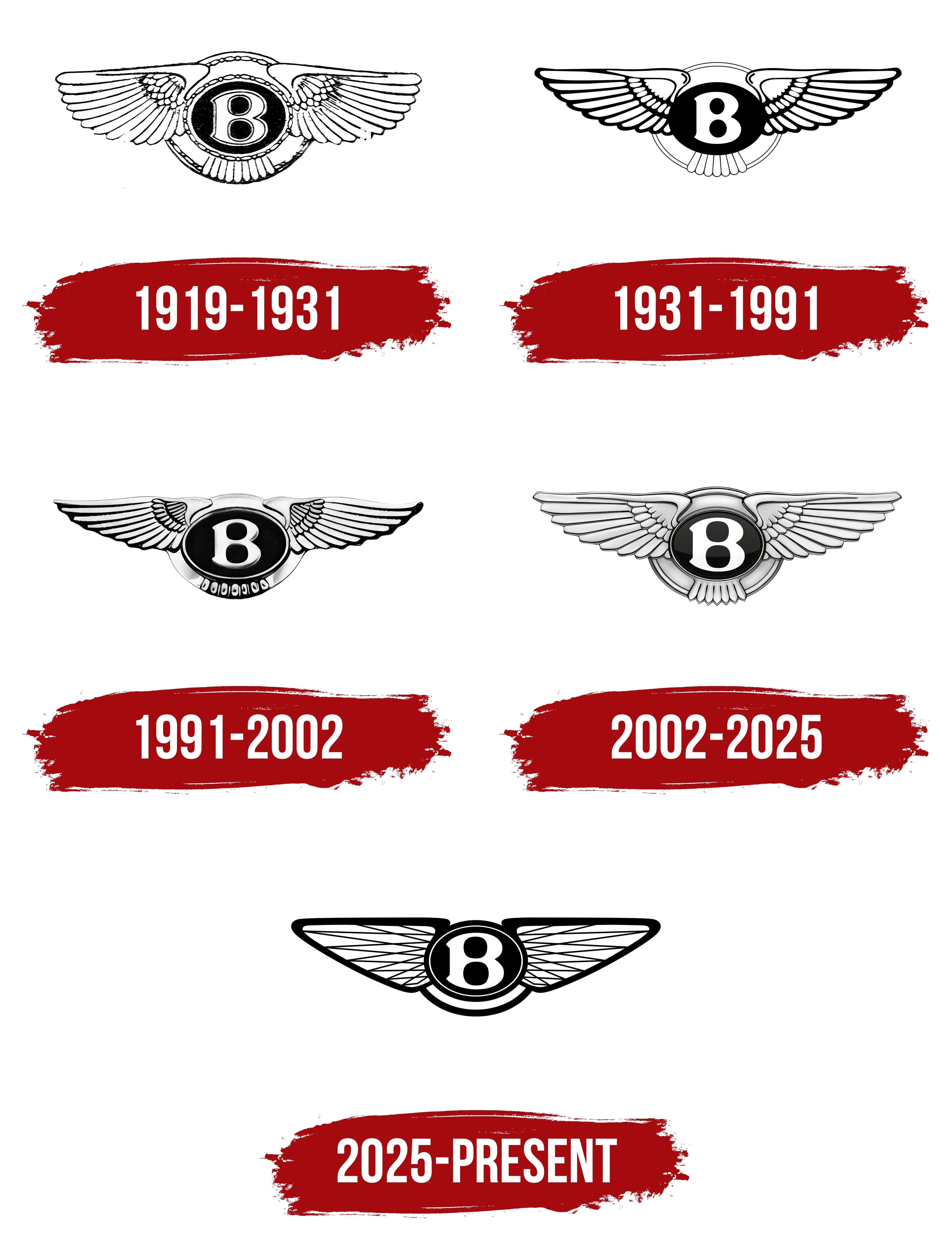
The Bentley emblem, created in 1919 by British illustrator Frederick Gordon Crosby at the request of company founder Walter Owen Bentley, is a hand-drawn stylization of the letter “B” accompanied by spread wings on both sides. The composition was entirely hand-crafted, without using standard typographic sets, emphasizing its unique character and artistic value. The letter “B” is depicted as a large, expressive glyph with moderate stroke contrast and small internal serifs, conveying classic elegance and solidity, reflecting British tradition and the brand’s exclusivity.
The wings, a key element of the emblem, are drawn asymmetrically, intentionally differing in the number of feathers on the left and right sides to deter copying and underscore the company’s individuality. Each feather is detailed, gradually tapering and rounded at the edges, creating a realistic impression of fluidity and motion. This visual concept symbolically relates to Bentley’s aviation past, as the company developed engines for military aircraft during World War I. Metaphorically, the wings represent speed, freedom, and the outstanding performance of Bentley automobiles.
The original color palette of the emblem was monochrome, strictly black and white, highlighting technical seriousness, an engineering approach, and the premium status of the brand. The absence of additional colors emphasized details and line contrast, while also simplifying the emblem’s application to metal and other vehicle surfaces.
The emblem became historically associated with Bentley as a symbol of innovation and technical reliability. Gordon Crosby’s artistic creation, produced without involvement from design agencies or typographic solutions, embodied the brand’s philosophy, its engagement in the process, and its impeccable reputation in the early-20th-century automotive industry.
1931 – 1991

After Rolls-Royce acquired Bentley in 1931, the design of the famous “Winged B” logo was reinterpreted while retaining its key visual elements. Rolls-Royce artists and designers modernized it, basing their work on Frederick Gordon Crosby’s original sketch but aiming for a more elegant, smoother treatment of its forms.
The updated emblem retained the letter “B” within a central oval medallion, where the glyph became more precise and balanced. The typeface preserved expressive details such as small serifs and contrasting strokes, emphasizing the brand’s British refinement and conservative luxury. The contours of the letter “B” became slightly softer, avoiding sharp edges and aggressive angles, reflecting the Art Deco influence predominant in 1930s design.
The wings in the new version also changed: the number and shape of feathers were adjusted and refined, with smoother, more graceful, consistent lines. The feathers became thinner as they extended away from the central medallion, creating an effect of lightness and aerodynamic streamlining associated with speed, dynamics, and forward motion. Adjusting the feather arrangement also effectively protected the emblem from copying, maintaining brand exclusivity.
British sculptor and illustrator Charles Sykes, the renowned creator of the Rolls-Royce “Spirit of Ecstasy” hood ornament, played an important role in refining the logo. He proposed a slightly forward-leaning letter “B,” adding extra momentum and dynamism to the emblem. However, he initially considered a single-winged version before returning to the more traditional two-winged silhouette.
The color palette remained monochrome, reflecting the brand’s premium style and ensuring high-contrast, precise logo reproduction across various surfaces and materials.
Bentley’s redesigned composition embodied a new phase in its history: elegant, refined, and infused with the spirit of the Art Deco era.
1991 – 2002

Following Bentley’s acquisition by Vickers and its subsequent transfer to Volkswagen Group in the early 1990s, the iconic “Winged B” emblem underwent an evolutionary modernization. This redesign, the first since 1931, marked a key milestone, highlighting the brand’s independence and its new positioning in the premium automotive segment.
The logo’s shape was reworked. The wings gained additional lightness through thinner lines and enhanced feather detailing. The wing contours became more graceful and refined, with uniform, elegant proportions that create visual harmony and balance throughout the composition.
The letter “B,” situated in the central oval, took on a stricter, more restrained character: the glyph became slimmer, retaining traditional small serifs at the tips, while the lines adopted a cleaner, more modern appearance. The oval surrounding the letter shifted slightly downward, giving the logo a more stable, complete visual presence.
The symbolism of the updated “Winged B” remained unchanged: the pair of open wings symbolizes speed, prestige, and the uncompromising quality of the automobiles. The wings’ dynamism, appearing as if in flight, serves as a metaphor for engineering excellence and technological sophistication.
This refined emblem became integral to Bentley’s brand identity and was used prominently on key models during the 1990s and early 2000s, including the Continental R, Turbo R, Arnage, and Brooklands. The visual concept of this period emphasized Bentley’s commitment to classic British traditions while expressing the brand’s intention to meet the era’s new stylistic standards and tastes.
2002 – 2025

In 2002, under Volkswagen Group’s ownership, Bentley introduced a new interpretation of its iconic “Winged B” emblem. Bentley’s internal design team created this redesign to blend the brand’s heritage with contemporary automotive aesthetics. The emblem became part of a new visual identity and debuted simultaneously on the first-generation Continental GT, defining the appearance of all the brand’s vehicles until mid-2025.
Important changes primarily affected the wings’ shape: the contours gained sharpness and clarity, featuring decorative “winglets,” small auxiliary elements positioned near the central letter “B.” The wing structure included symmetrically arranged feathers, numbering between five and ten on each side. This gave the overall composition a strict yet dynamic appearance, reminiscent of a predatory bird’s wing captured in flight.
The key element of the logo remained the letter “B,” placed within a central circular feature called the “center jewel” by designers. It received thicker strokes and a sharply defined circular contour, adding solidity and improving visibility on vehicle bodies and digital formats. This approach made the emblem three-dimensional, expressive, and easily recognizable even from a distance.
The choice of these forms and proportions was deliberate: the sharp wing lines symbolically represented Bentley’s drive toward leadership and superior performance, while the larger “B” emphasized prestige and brand exclusivity. The color palette stayed classically monochrome, focusing on silver-chrome finishes.
This version of the “Winged B” became an essential part of the visual identity of all significant Bentley models in the 21st century, including the Continental GT, Flying Spur, Arnage, Brooklands, and Bentayga, symbolizing forward motion, handcrafted tradition, and the British brand’s modern engineering.
2025 – today
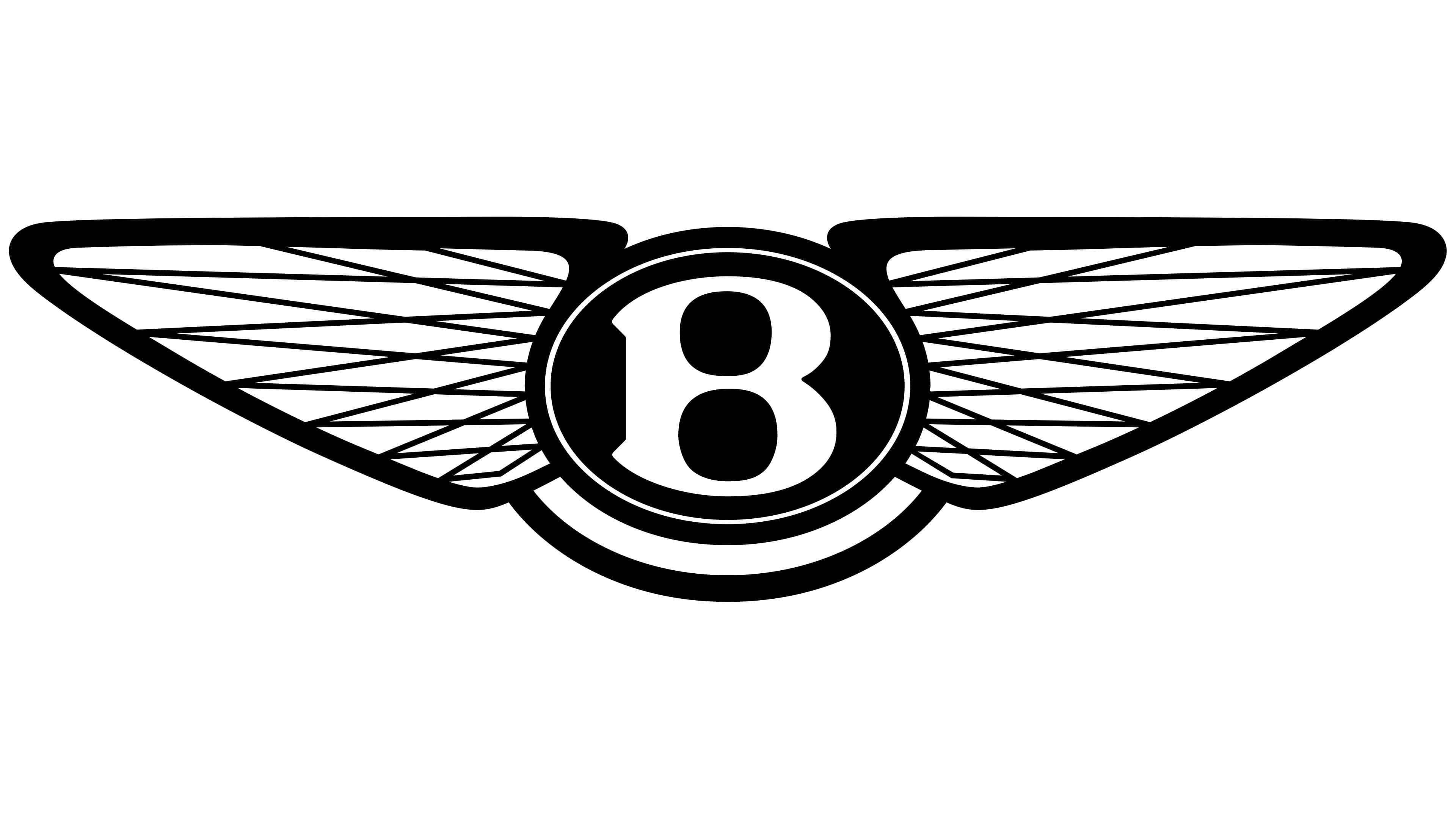
In July 2025, the brand unveiled an updated version of the Bentley emblem, timed to coincide with the announcement of the futuristic EXP 15 concept and the opening of the Design Studio in Crewe, England.
Bentley’s internal team created the new design under Design Director Robin Page. Designer Young Nam developed the final design, which won an internal competition. The logo premiered on July 1, with its full unveiling taking place on July 8 at the Goodwood Festival of Speed.
The redesigned emblem gained a completely different visual character: the wings lost their traditional rounded shapes and adopted an aggressive, geometric form with sharply defined edges, inspired by a peregrine falcon’s wings. The decorative feather structure now appears as a diamond-shaped pattern, symbolically expressing speed and technological sophistication, completely replacing the previous feather detailing. The lower feather group, previously positioned beneath the logo’s central section, was removed entirely for minimalism and clarity.
The central letter “B” was also redesigned as an autonomous symbol, independent of the wings. Its shape draws on watchmaking aesthetics, now featuring a metallic border, beveled edges, and a three-dimensional effect that emphasizes depth, reminiscent of a glass lens cover on a premium watch face.
The new Bentley emblem blends tradition with innovation: it maintains the brand’s recognizability and heritage while adapting to modern digital environments and to Bentley’s electrified future. The updated design highlights Bentley’s ambitions as a manufacturer of next-generation automobiles, including electric vehicles from the Bentayga family and other future models, providing visual harmony and premium appeal within the luxury segment.
Font and Colors
The caption is used separately from the icon. It contains a single text symbol “B.” The capital letter, derived from the word “Bentley,” stands alone and is framed with miniature, sharp serifs. They appear on the left side, above and below. All other elements are rounded.
The logo palette is monochrome, typically black and white. The first is an image, and the second serves as a background; in the center, however, it’s reversed: a white symbol on a black oval. However, this option is primarily used for advertising, business offices, and other tasks, as cars are marked with a colored logo. The space between the wings can be colored green or red. The first color is for racing cars; the second is for luxury models.