


 Bing Logo PNG
With sharp turns, bends, nooks, and crannies, the search engine will overcome obstacles to find the information users need. The Bing logo conveys this meaning through intricate, cubic lines. At the same time, the emblem’s open space always leaves room for discovery.
Bing traces its origins to August 1998, when Microsoft launched MSN Search, which used external indexes such as Inktomi. Despite strong distribution through Internet Explorer, the service failed to gain traction as Google rapidly expanded.
In March 2006, Microsoft relaunched the product as Windows Live Search and renamed it Live Search in 2007. Interface updates and new features did not change its position, with global share staying below 3 percent. In 2008, Microsoft shifted strategy and acquired Powerset, introducing semantic search technology that interprets user intent rather than keywords. This marked the foundation for a new standalone product.
On May 28, 2009, Steve Ballmer presented Bing at All Things Digital. The public launch followed on June 3, supported by a large advertising campaign. The service emphasized structured answers, related queries, and a redesigned homepage. On July 29, 2009, Microsoft and Yahoo! signed a ten-year deal. Yahoo moved its search infrastructure to Bing, completing the full migration by 2012 and increasing its combined scale relative to Google.
In 2011, the Tiger indexing system improved speed and relevance. In 2014, Cortana launched using Bing data. With the release of Windows 10 in 2015, Bing became integrated into system search and the Edge browser.
In 2016, Microsoft open-sourced the BitFunnel indexing algorithm. The next major shift came in February 2023, when Bing integrated OpenAI’s GPT-4 and added conversational search through Bing Chat. The new interface enabled dialogue-based queries and source-linked responses. Early adoption reached tens of millions of interactions, with daily usage exceeding 100 million users. Bing also integrated image generation using DALL · E models. By fiscal 2022, the advertising platform generated about $11.6 billion in revenue.
Meaning and History
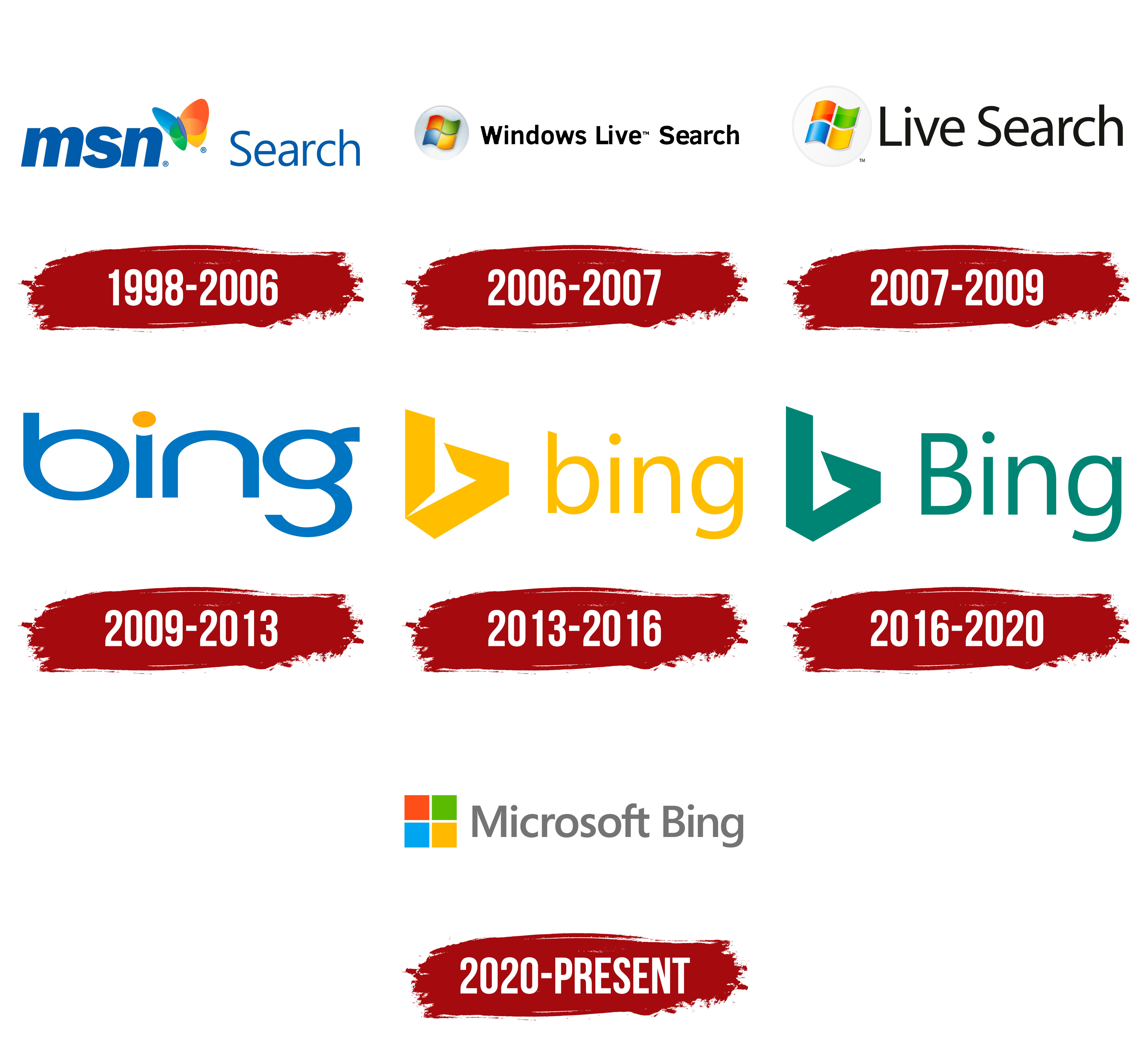
The search engine received the logo well before its 1998 release, when the prototype launched. During this time, the visual identification icon became well recognized among users. In total, it went through six modifications. To indicate its place in the Microsoft product family, the authors left the logo on four multicolored elements (mostly rectangular).
What is Bing?
Bing is a Microsoft search engine available in many languages. Its use does not require registration.
1998 – 2006
The logo debuted with the search startup MSN Search. The sign consisted of three main elements: two words and one graphic symbol. The first part was the service name, while the second was a Microsoft butterfly icon with four-colored wings: blue, green, red, and yellow. The abbreviation “MSN” was in lowercase, although it was in large print. The word “Search” had a classic spelling and included both uppercase and lowercase letters.
2006 – 2007

When Windows Live Search replaced MSN Search, the developers redesigned the logo. It became much simpler: a name with the familiar Microsoft logo. The text was on the right, the icon on the left. The breakdown between words was wide.
2007 – 2009

After testing the beta version, the designers simplified the text part, leaving only the phrase “Live Search.” They made the letters thinner and more graceful than in the opening version.
2009 – 2013
2009 was a turning point in the Bing logo’s history: the authors first used the search engine’s new name. As before, they emphasized the verbal designation. The emblem consisted of “bing” in lowercase, with large, rounded letters of the same height. An orange dot sat above the “I,” and the rest of the elements were blue. For “g,” the designers chose a curly crochet tail.
2013 – 2016

The new logo is a bold geometric emblem with straight edges and sharp corners, reminiscent of a boomerang. The icon sat to the left of the label and looked innovative thanks to its sharpness. The lowercase letters became elongated and thin, and the spacing between characters widened. A single color united both parts of the logo (graphics and text): sandy yellow.
2016 – 2020

The next redesign of the personal sign marked the service’s transition to the next level. It turned green and got a capital letter at the beginning of the word “Bing.”
2020 – today
When the company’s management officially announced the service’s renaming to Microsoft Bing, the rebranding took effect immediately. The logo now features a recognizable icon of the owner: a large square divided into four identical sections of different colors. The developers have expanded the text by adding the corporation’s name. Both words are now in medium-width letters and are grayed out.
Font and Colors
A search engine’s visual identity has always evolved alongside the search engine itself. Renaming, testing, and revision – each transition to a higher level was reflected in the logo. The result is a corporate identity that is easily recognizable among other search engines. Essentially, Microsoft Bing’s symbology has evolved from multi-piece to minimalist. This shift had a tangible effect: after the service launched in a new form (in 2009), the current emblem is radically different from the previous one.
To emphasize that the search engine belongs to Microsoft, the designers chose a single spelling for the logo. As a result, both words use the Segoe proprietary typeface. The letters “n” and “i” match the Windows logo. The top “b” element matches the “t” form from Microsoft’s primary symbology.
The search engine’s color scheme matches the parent company’s logo colors. Both versions have blue, red, yellow, green (in the square icon), and gray (in the font).
FAQ
What color is the Bing logo?
The logo is now a calm and intense green, replacing the previous yellow. This new color gives the logo a fresh, modern look and adds a professional feel, enhancing its image as a reliable and confident search engine.
The wordmark’s first letter is capitalized, emphasizing the brand’s professionalism. The green color conveys trust and stability, aligning with Bing’s goal to be a dependable search engine.
What is Bing’s logo?
The logo has a simple and recognizable design. On the left are four multicolored squares in red, green, blue, and yellow, linking Bing to the Microsoft brand.
On the right, the text “Microsoft Bing” appears in gray, set in two sans-serif fonts with different weights. This gives the logo a modern, clean look.
Why is the Bing logo bad?
The logo was voted the worst because of its unattractive typography and color scheme. Critics felt the design lacked visual appeal and didn’t communicate the brand’s identity.
The typography was seen as uninviting and unengaging, which matters for a brand trying to stand out in the competitive search engine market. The color scheme didn’t resonate with users, making the logo feel dull and uninspired.
These design issues created a negative perception of the brand, underscoring the importance of a well-crafted logo in building a positive, memorable brand image.
What is Microsoft’s search engine?
Bing is Microsoft’s search engine. Microsoft Search in Bing combines Microsoft Search and Bing web search to provide a seamless experience. This integration helps users find relevant results from their organization and the web.
Using Bing, users can search the web and access internal information, such as documents, contacts, and other resources within their organization. This unified search approach boosts productivity and efficiency, making it easy to find the information you need quickly. Bing’s familiar interface and powerful search capabilities make it a valuable tool for personal and professional use.
What happened to Bing?
Nothing significant happened to the company. It still exists but is now called Microsoft Bing. This rebranding reflects a closer integration with the broader Microsoft ecosystem, highlighting its connection to other Microsoft products and services. The name change unifies the brand and leverages Microsoft’s strong reputation in the tech industry. Despite the new name, the search engine still offers the same features users rely on.