


 Blockbuster Logo PNG
The Blockbuster logo directly communicates that it is a ticket into the world of spectacular entertainment, and without it, it is virtually impossible to get there. The emblem is considered timeless because it has a universal form and is highly sought after by those who love spending time in front of a screen watching an interesting movie.
Blockbuster began on 19 October 1985 in Dallas, Texas, when David Cook opened the first Blockbuster Video store. His background in software for the oil and gas sector shaped the format: about 8,000 VHS tapes on open shelves rather than in locked cabinets. Each cassette carried a magnetic strip, while barcode scanners and in-store computers tracked inventory in real time, an uncommon retail system for 1985.
In 1986, the company expanded with additional locations and went public. In 1987, Cook sold his stake to investors led by Wayne Huizenga of Waste Management. Expansion accelerated through acquisitions and rapid store openings. By 1988, Blockbuster had over 400 stores. In 1989, it entered international markets, including the United Kingdom and Canada. In 1992, it acquired Sound Warehouse and Music Plus, forming Blockbuster Music.
In 1994, Viacom acquired Blockbuster for $ 8.4 billion. At its peak in 2004, the chain operated 9,094 stores, employed 84,300 people, and generated 5.9 billion dollars in revenue. Late fees reached around 800 million dollars annually. In 1997, Reed Hastings faced a 40 dollar fee and later co-founded Netflix, which offered DVD-by-mail and later streaming. In 2000, a 50 million acquisition offer from Netflix was rejected. Redbox expanded kiosk rentals in retail locations.
In 2004, Viacom spun off Blockbuster as a public company with 905 million dollars in debt. Attempts to build Blockbuster Online competed with Netflix, while internal dependence on late fees for revenue created tension. On 23 September 2010, the company filed for Chapter 11 bankruptcy protection with over $ 1 billion in debt. In 2011, Dish Network acquired it for $ 228 million. By 2014, corporate stores closed, leaving a single franchise location in Bend, Oregon.
Meaning and History
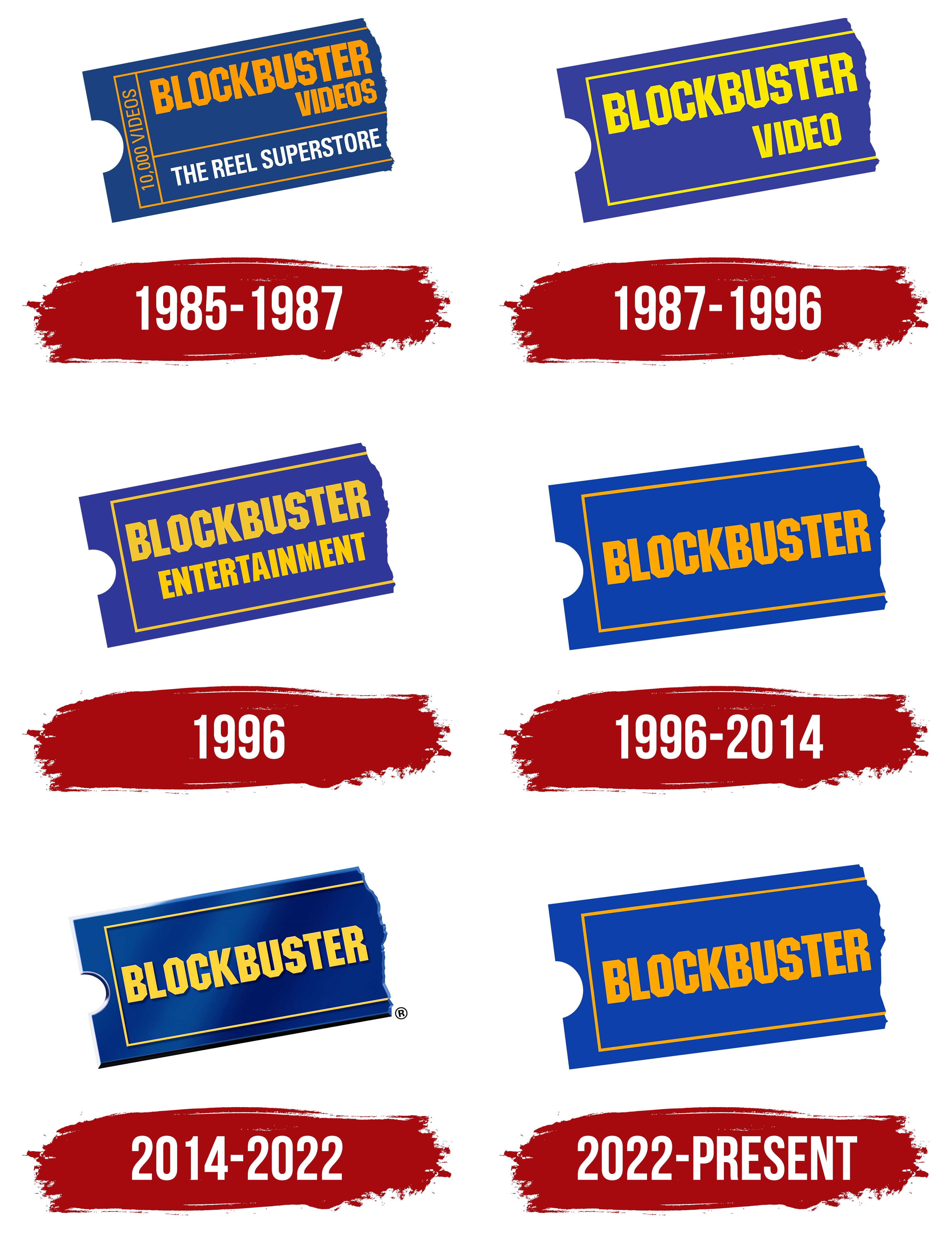
David Cooke, who already had experience running an individual business, opened a video rental store in Dallas, Texas, in 1985. To obtain a suitable corporate style, he began collaborating with art director Lee Dean from Rominger Advertising. As a result of their joint efforts, a unique design was created, which became the basis of the logo for many years. The brand has never strayed from its individuality, adhering to it for several decades.
According to some experts, this emblem could be considered the most successful application of Carnase and Bonder’s font, as it is central to the visual identity. Blockbuster chose the ITC Machine typeface, complementing it with a fitting background that accurately conveys the atmosphere and the company’s line of work. However, oblivion followed due to bankruptcy. Afterward, the service could not recover and closed its entire network of rental points, leaving only one store in Bend, Oregon.
What is Blockbuster?
Blockbuster is an American video-rental service that offers movies and games. It was once a large network, but now consists of just one store located in Bend, Oregon. In addition, the company has evolved into a franchise and a website with the same name.
1985 – 1987

The company’s name is set against a classic movie theater ticket. It is depicted sideways because the diagonal placement adds dynamics as if the ticket controller is returning the torn ticket to the viewer who wants to enter the theater. On the blue background, the yellow-and-white lines and inscriptions stand out effectively: “Blockbuster Videos” aligned to the right, “The Reel Superstore,” and “10,000 videos.” They are set in a simple sans-serif font, with no serifs, complex structures, or smooth strokes. All sides of the glyphs are even, sharp, and precise. The right edge of the ticket is torn, while the left has a notch in the middle.
1987 – 1996

Blockbuster’s new visual identity did not undergo significant changes. However, at first glance, the logo’s main feature, the typography, has changed. Moreover, numerous inscriptions have disappeared, leaving only one with the brand name arranged on two levels. The right-aligned text was disrupted, so the word “Video” in the second line seems to hang uncertainly in space. This happened due to the removal of the final letter “S.” The designer also replaced the bright yellow color with lemon.
1996

The rebranding resulted in a modernized logo. The word “Entertainment” appeared in the bottom row, set in the same font as “Blockbuster.” This time, the alignment is visible: it is centered. The pale yellow letters and lines have taken on an intense, sunny shade, while the neutral blue has turned dark purple.
1996 – 2014

The word “Entertainment” disappeared from the inscription. Only the short name remained, centered. To avoid the space around it seeming too empty, the designers moved the borderlines slightly closer. They are now a bit farther from the edge. The color underwent a significant transformation: the purple shade was left behind, replaced by a neutral blue.
2014 – 2022

The visual identity was adapted to the realities of the time: this Blockbuster logo appeared in-store and on the website. It looks like a traditional ticket with a torn edge, but with blue gradient transitions. Shadows and highlights give the logo a three-dimensional effect. The inscription’s color has softened to a soft yellow.
2022 – today

This emblem is a replica of the logo adopted in 1996. After the brand’s revival, management decided to use the old, two-dimensional, flat version with a yellow-orange inscription.
Font and Colors

The Blockbuster logo has always maintained its original typography, created in collaboration with Lee Dean. The smooth, bold, and straight glyphs look strict, supporting the company’s business atmosphere. For several decades, the visual identity has been built on the simple Carnase and Bonders font family. This typeface is called ITC Machine.
The color palette has also not undergone significant changes, except for some shading. The main color of the video rental service has always been and remains blue. At different times, it has varied from purple to neutral hues.