


 Booking Logo PNG
“Ask us. We know everything about rented rooms,” says the Booking.com logo. The emblem indicates a business approach and the ability to find honest, verified information. It hosts many offers across the network.
Booking.com began in Amsterdam in 1996, after Geert-Jan Bruinsma noticed that US hotels could be booked online through Hilton.com, while Amsterdam had no comparable service. On November 12, 1996, he launched “Bookings.nl” from a server under his desk. He knew little about the hotel business, set a 5 percent commission, and let hotels control their own room prices.
The early years were difficult. In 1997, a newspaper refused his ad because it listed a website instead of a phone number. Competing Amsterdam hotel sites had traffic but lacked a real booking function, so Bruinsma offered them a 50-50 commission split. By late 1998, he had hired his first employee. In 2000, Booking.com merged with Booking.com and appointed Stef Noorden as CEO.
A planned sale to Expedia collapsed in 2002 after months of talks. In 2003, Google AdWords became the main growth engine, with campaigns expanding so fast that Google asked the company to slow down. In July 2005, Priceline Group bought Booking.com for $133 million and combined it with Active Hotels, a UK platform focused on independent hotels.
With Priceline’s marketing budget, Booking.com expanded across Europe and overtook Expedia there by 2010. In the 2010s, the platform expanded beyond hotels to include apartments, vacation homes, and private rentals. In 2018, Priceline Group changed its name to Booking Holdings. By 2024, gross bookings through the platform exceeded $165 billion.
Meaning and History
This travel platform grew from a merger of several online services. One of them was bookings.nl, founded by Geert-Jan Bruinsma in 1996. The second is Bookings Online, which operated on the .org domain (created by Bas Lemmens, Marijn Muyser, Sicco, and Alec Behrens). Since then, the name, logo, and URL have been changed to Booking.com.
It all started when Bruinsma had to place an ad in a local Dutch newspaper, but the paper rejected it. The reason was the lack of a phone number because ads linked to websites had not yet been accepted. Then he had the idea of creating his own resource, where he could advertise in a tourist-oriented way.
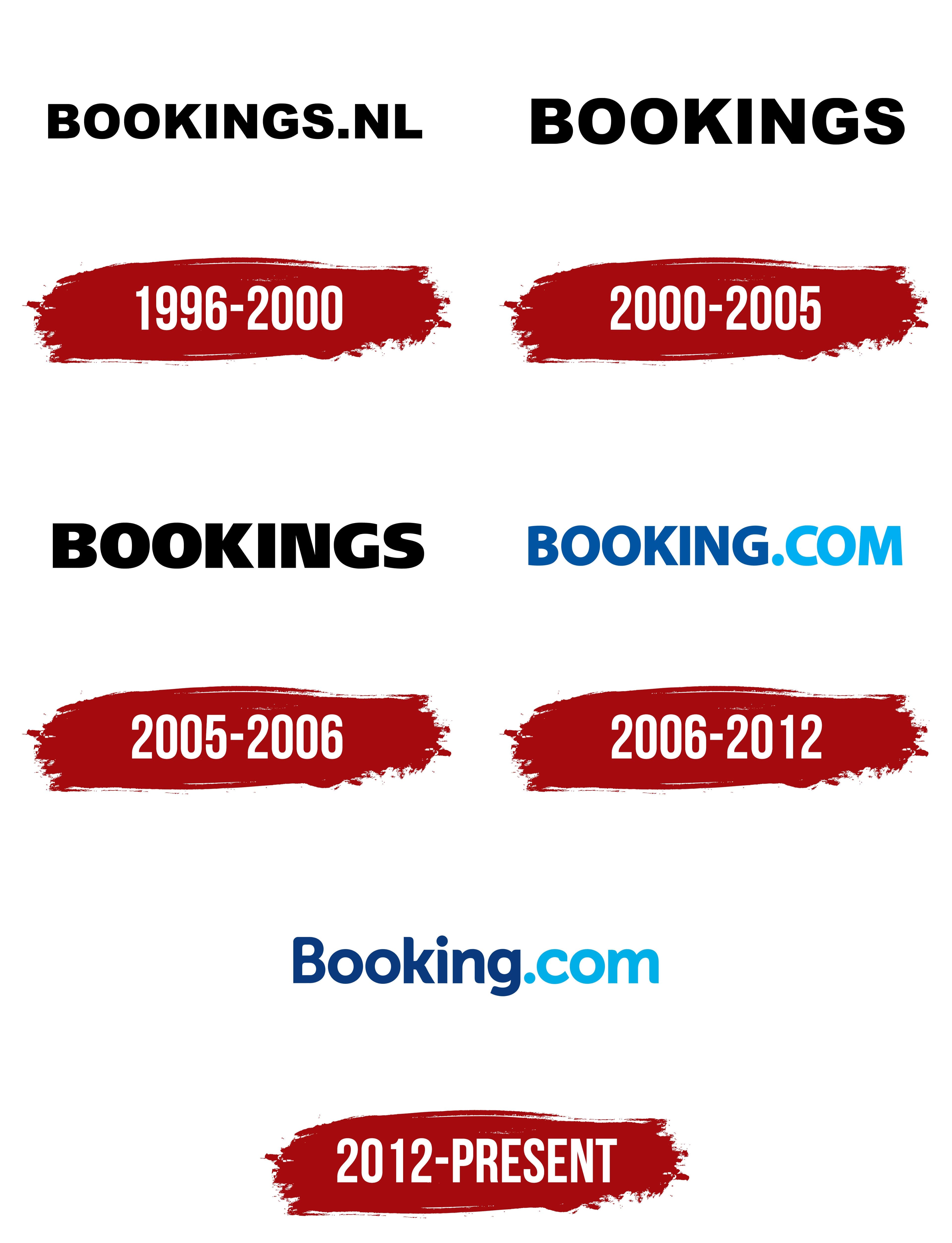
In 2005, Priceline Group bought the Internet platform, which later changed its name to Booking Holdings. She later partnered with the European online booking firm ActiveHotels.com. This integration enabled the service to resolve financial issues, shifting from losses to profits. As a result, Active Hotels became Booking.com, and this purchase was named the best in the world – so profitable was the combination of the two services in the digital tourism market. As the parent company merged and acquired competing services, its logo changed too. But not drastically: the updates required minimal intervention because the name stayed the same. There were six emblems in total.
What is Booking.com?
Booking.com is an Amsterdam-based online platform where users can find accommodations, rent cars, book flights, or other modes of transportation. It is a full-fledged travel agency that offers travelers a vast selection of hostels, villas, hotels, apartments, and resorts in more than 220 countries. The brand has existed since 1996 and is owned by the American company Booking Holdings.
1996 – the 2000s

As an ad-related Internet platform, it also adopted a matching logo and text. It is simple, and it conveys the service’s name and web address. The letters in “bookings.nl” are bold, wide, dark black, and all uppercase.
the 2000s – 2005

During this period, the designers removed the domain zone designation, leaving only the inscription “bookings.”
2005 – 2006

In 2005, a different writing style appeared for the first time. The developers removed the inward-curved stroke from the “G,” smoothed the curves on the “S,” and moved the lower leg of the “K.” The letters were made even bolder and black.
2006 – 2012

With the move to the .com domain, a new logo was approved without the “S.” It differs in color, unlike all other versions. It uses a predominant blue palette with gradient transitions. The platform’s web address was highlighted in neon blue.
2012 – today

The main change the designers made was streamlining the letters. As a result, the logo looks friendlier. They also changed uppercase letters to lowercase, leaving only “B” unchanged. The developers removed the gradient in the first part of the title and softened the neon color in the second half of the inscription.
Font and Colors
The evolution of the Booking.com visual identity mark is a gradual change in font and color, with no other elements. Moreover, the logo never had a permanent background; it depended on the environment and was mostly a neutral white, so the black letters were visible.
The typeface in the logo is special – individual, paying tribute to our common home, planet Earth. The angles at the beveled edges of the letters incline 23.5 degrees, corresponding to the natural inclination of Earth’s axis. Wieden + Kennedy Amsterdam created the custom font Booking Sans to symbolize travel, a variety of options, and the huge reach of goals. It is very similar to Domestos Sans-Black and Conflict. All letters are sans-serif, rounded with miniature cut edges and a 23.5-degree slant in natural curves.
Now the website’s corporate colors are shades of blue and sky. Previously, only black was used.