


 Braun Logo PNG
The Braun logo is concise and smooth. It demonstrates a combination of progressive ideas and perfect design, highlighting the devices’ impeccable performance thanks to a well-thought-out structure.
Braun began in February 1921, when Max Braun opened a small workshop in Frankfurt am Main. Trained as an engineer, he had worked for AEG and Siemens before starting his own business. His first product shown at the Frankfurt Fair was Trumpf, a small device for fixing, extending, and cutting industrial belts, which was later sold in England by British entrepreneurs.
In 1923, Braun moved into radio components while attending evening classes in radio engineering. By 1929, the company was producing power amplifiers and radio receivers, and Braun became one of the first European manufacturers to combine a radio and a record player in a single unit. During World War II, its Frankfurt factories were almost destroyed by bombing in 1944. The company produced military equipment and Manulux hand-powered portable lamps, which sold in millions.
After 1945, Max Braun rebuilt the business, which now employed 150 employees. In 1950, he launched the S 50 electric shaver, using an oscillating cutter under thin perforated steel foil. The foil allowed a closer shave than rival models from Remington and Schick. Around the same period, Braun expanded into food processors, mixers, and other household appliances.
Max Braun died in 1951, and leadership passed to his sons Artur and Erwin. In 1955, Dieter Rams joined the company, working with Fritz Eichler on Braun’s product style. In 1956, Rams designed the Phonosuper SK55 radio-phonograph, awarded at the 1957 Milan Triennale. Gillette acquired control of Braun in 1967; Braun became its full subsidiary in 1984; it entered epilation in 1988; and it joined Procter & Gamble after the 2005 Gillette takeover.
Meaning and History
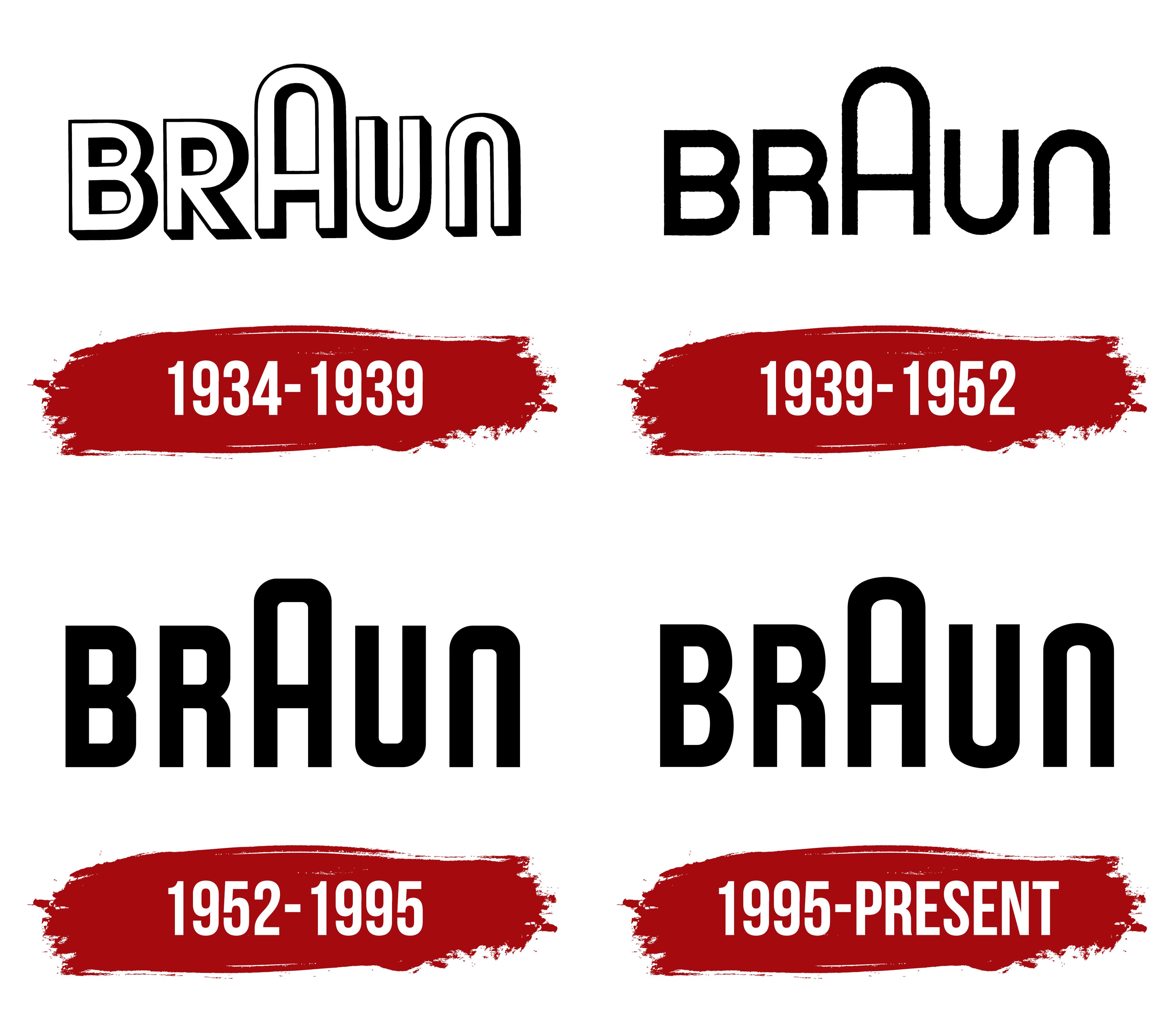
The company was founded in 1921. However, the first logo did not appear for 12 years. Initially, the company produced radio components for other manufacturers. The identity was needed when the team started producing their radio receivers combined with record players. The emblem and brand name were developed for them in 1934. The founder’s sign changed slightly over time, with only minor additions. Therefore, the image of the first logo became the company’s calling card for 100 years.
What is Braun?
A German conglomerate with 9,000 employees, valued at $7 billion. It specializes in producing electrical appliances: electric shavers, epilators, toothbrushes, juicers, kettles, meat grinders, and blenders.
1934 – 1939

The manufacturer’s logo is a voluminous Braun inscription with the central letter A highlighted. The main purpose of the visual sign is to reflect the brand’s advanced ideas and distinctive design.
The brand is named after the engineer and founder, Max Braun. Until 1962, the company was owned by its descendants, who had significantly contributed to its establishment and development. Therefore, the Braun surname is the main focus of the logo.
The emphasis on the letter A:
- Creates harmony. The element is central in the inscription and divides the word in half.
- Reflects the products’ distinctive form and unique ergonomic design. The round curve of A resembles 1) the speaker on radio receivers, which was located on top as a protruding bump, and 2) the round knob for tuning stations. Later, shavers with round frames, oval cameras, and slide projectors appeared.
- Indicates the double A in the center of the founder’s first and last name.
- Reminds me of the first product receivers. The bend in the name is similar to sound waves.
The capital element signifies growth and development. The company gradually climbed the “mountain” from a workshop, achieving prosperity. In the 1960s, Braun became a well-known international brand. Ironically, the logo’s ascent followed a descent, which predicted a further reduction in production and a decline in the manufacturer’s popularity. The peak of the brand’s history falls right in the middle: the 1950s-1980s.
1939 – 1952
The inscription gained elegance and smoothness. This change resulted from the refinement of the glyphs, which are now rendered with semi-thin lines. Designers turned shadows into full-fledged elements and removed the white part of the letters, making them appear more compact. The emphasis on the large “A” remains, as does the similarity between “u” and “n,” which seem like mirror reflections of each other.
1952 – 1995

The inscription’s font was changed to an extra-bold, less smooth style during this period. The letters acquired clipped and slightly rounded corners. Designers stretched the glyphs upward, making them thinner and taller.
1995 – today
The Braun logo, introduced in 1995, continued the tradition of minimalism and user-friendliness in the company’s products, complemented by new details. The letterforms are straightforward and precise, with soft curves that subtly suggest the comfort and ergonomics of Braun’s household appliances. The letter “A” stands out with its closed upper section, adding a sense of lightness and dynamism to the image while maintaining a balance between external simplicity and the products’ internal comfort.
The black text color symbolizes durability and high quality, emphasizing the brand’s reputation and its focus on reliability and practical convenience. This design reflects Braun’s aim to create products suitable for everyday use and long-term application.
The company name originates from the surname of its founder, who is associated with innovations in household technology. The simplicity of the text’s visual form complements the company’s image, combining clean, functional design elements that are traditional for Braun.
Despite changes in individual details, the overall style preserved continuity and became a harmonious continuation of the brand’s long-standing history. The absence of sharp lines and the use of rounded forms reflect Braun’s approach to developing products with intuitive controls and ease of use, consistently maintaining the reputation of a reliable manufacturer.
Font and Colors
Braun logos have been associated with black-and-white shades for 100 years. After various experiments and combinations, the owners finally settled on charcoal-black.
- White demonstrated innovation. The founder implemented leading industry developments in production. The color indicates the principle of radio operation: radio waves spread through the air.
- Black expresses strength, stability, and the color of plastic products.
The transition from white to dark shades signals the brand’s power and maturity, making it a giant that has defeated its competitors.
The font resembles Neubau Grotesque Bold. Bold glyphs speak of expansion to other continents, a wide assortment, and large sales volumes. The use of capital letters reinforces the impression.