


 Budget Rent a Car Logo PNG
The Budget Rent a Car logo is high-design and built for large-scale marketing. This strong association offers many benefits for the car rental brand. First, the logo advertises the company’s services; second, it makes the brand instantly memorable. The color palette conveys reliability and convenience, and the font signals the service’s wide availability.
Budget Rent-A-Car began on June 15, 1958, when Morris “Morrie” Mirkin opened a small rental office on Wilshire Boulevard in Beverly Hills. He started with $10,000 borrowed from his mother-in-law and about 15 used cars. Rentals cost $4 a day plus four cents per mile, roughly half the price charged by airport-based rivals Hertz and Avis. The name Budget came from a dictionary and matched the low-price model Mirkin wanted to sell.
In 1959, Jules Lederer joined the business. A distant relative of Mirkin and husband of columnist Ann Landers, he helped turn the idea into a scalable company. In 1960, Budget Rent-A-Car Corporation was registered in Chicago, which became the new headquarters. Lederer traveled across the country recruiting franchisees, making franchising central to Budget’s growth.
The chain expanded quickly, mainly targeting tourists and family travelers. By January 1968, Budget had more than 500 locations and over 15,000 cars across the United States, Canada, Mexico, the Caribbean, and parts of Europe, including the United Kingdom, Ireland, Switzerland, and Belgium. Annual revenue reached about $100 million. That year, Transamerica Corporation acquired “Budget” and invested capital to expand further.
In 1986, Gibbons, Green, van Amerongen, and the company’s management bought Budget from Transamerica in a leveraged buyout. “Budget” went public in 1987. In 1997, Team Rental acquired it and renamed the holding company Budget Group, but heavy expansion led to bankruptcy in 2002. Cendant bought the assets for $107.5 million, bringing Budget and longtime rival Avis under one owner. In 2006, Cendant split its businesses, and Avis Budget Group became publicly traded on the New York Stock Exchange.
Meaning and History
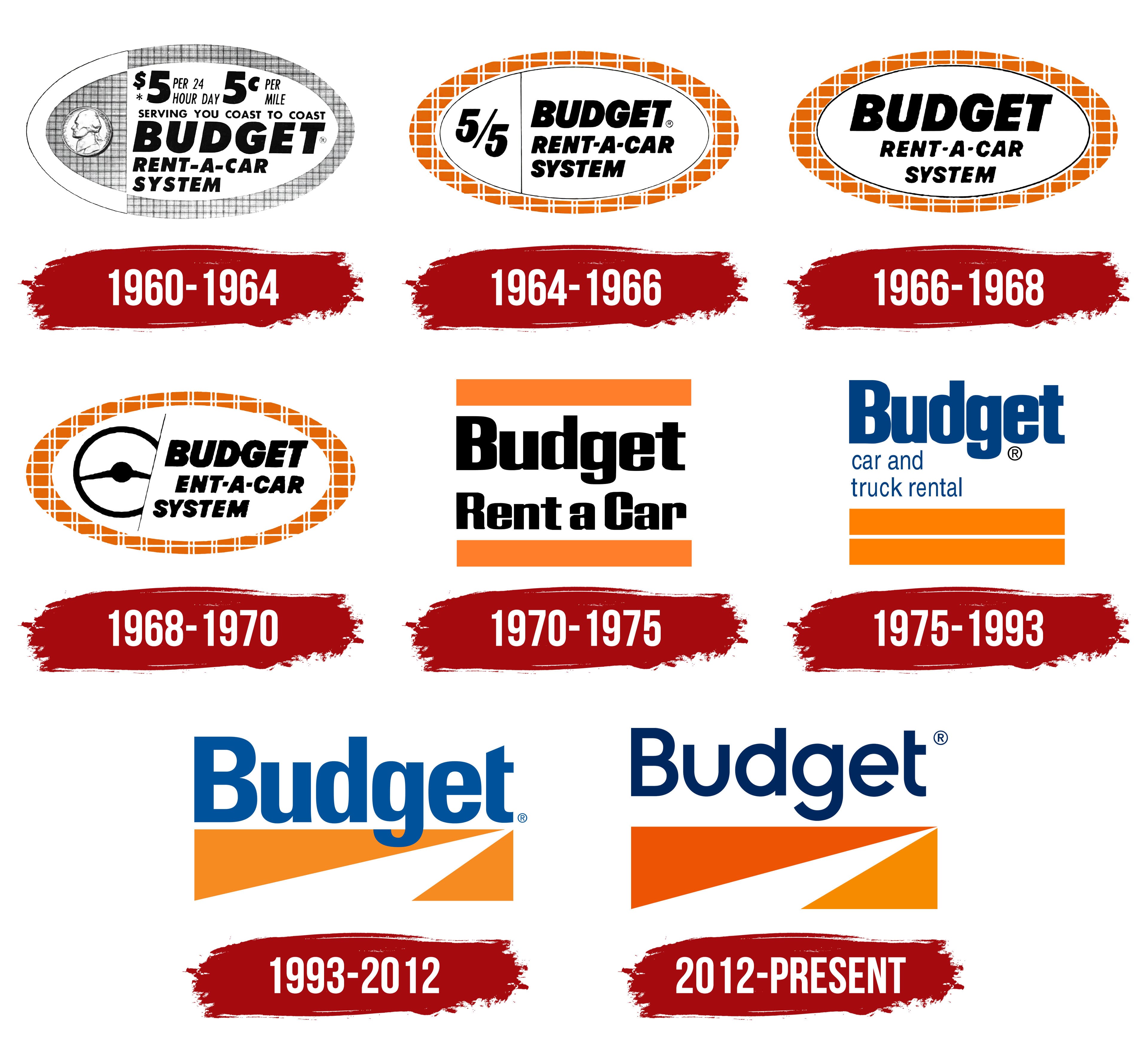
Over the company’s history, eight logo designs were created. The first four versions were almost identical, and it didn’t adopt a major redesign of the main elements until 1970. Today, the logo features only the word “Budget,” so first-time renters may not realize it’s the best option.
What is Budget Rent a Car?
It lets anyone rent a car in major U.S. cities. The company has branches in every state and serves tens of thousands of customers every day.
1960 – 1964

The original logo was presented to the public in black and white. It was an oval containing a large amount of information associated with Budget Rent a Car. For example, the top block contained information about the price per mile driven or an hour rented. Just below that was the slogan of the organization, namely: “SERVING YOU COAST TO COAST.” The letters were small but readable. Next, in three lines, was the company name “BUDGET RENT-A-CAR SYSTEM.” And the word “Budget” was much larger. It was a classic, bold, all-caps sans-serif typeface. To the left of the main elements was an image of a cent. Interestingly, the background was either white or a grid, which visually resembled cloth.
1964 – 1966
The first update occurred four years later. The logo became more modern and attractive, and designers removed elements that made the Budget Rent-A-Car emblem hard to read. It was now an oval with a black outline, set on an orange-and-white grid. The left side of the inner oval contained one element: the inscription “5/5”. This likely refers to the pricing policy. Again, the company name was written on the right in three lines. The font remained identical.
1966 – 1968
At this stage, the logo was further simplified. It focused on a single text block: the company’s name. Again, the font did not change, but the letters grew larger because of the extra space.
1968 – 1970
Again, the logo was divided into two sections. The right part remained unchanged, displaying the company name. The left side featured a black steering wheel. It was large enough to stand out against the background. Interestingly, a diagonal line divided the lower-right corner of the steering wheel, separating the two sections.
1970 – 1975
For the first time, the company abandoned the oval shape. The only element was the lettering, shortened to “Budget Rent a Car.” Removing the word “System” allowed it to fit on two lines. The font style was also changed to a modern serif typeface. No longer were all letters capitalized; only the first letter of each word was. The character lines became more confident. At the top and bottom of the lettering were two thick horizontal orange lines.
1975 – 1993
This logo version lasted almost 18 years. The two orange lines were now at the bottom and visually resembled a road. A new version replaced the wordmark. The word “Budget” appeared in bold on the first line. The letter style was quite unusual. For example, the vertical line in the “d” was shortened at the bottom. Next, on two lines were “car and truck rental.” They used blue for the name. The font was a modern sans serif.
1993 – 2012
The new redesign resulted in a concise logo. Only one word was written at the top: “Budget.” It was superimposed on the road image, which users should associate with vehicle rentals. As a result, the logo looks harmonious and attractive.
2012 – today

The company’s most recent logo redesign repeated the previous version. However, the word “Budget” was no longer superimposed on the road image; it was moved to the right. Moreover, the image became smaller and about the same size as the font. The name’s color has become darker and more elegant. The new version has become as similar as possible to the parent company Avis’s logo.
Font and Colors
The font in the company name looks fresh and harmonious. At each stage, the letter style differed. In the current logo, it stands out for the shortened horizontal line to the left of the letter “t” and the minimalist “u.” It’s a modern, bold serif typeface with a clean, legible style.
The original orange-white-black color scheme has been replaced by orange-white-blue. Now it looks fresher and friendlier, making potential customers more interested in the offer.