


 Busch Logo PNG
The Busch logo communicates a unique cold-cooking technology. The method gives the drink a unique taste and light shade. The emblem conveys completeness and perfection, setting the beer brand apart.
Busch grew out of the wider Anheuser-Busch story, which began in St. Louis in 1852, when Eberhard Anheuser bought a struggling Bavarian brewery. Adolphus Busch later joined the company, married Anheuser’s daughter Lilly in 1861, and helped turn the brewery into a national business. He introduced beer pasteurization in America, built refrigerated rail distribution, and launched Budweiser in 1876.
The Busch name entered beer history under August Busch Jr., who took over after 1946. In 1953, he bought the St. Louis Cardinals and tried to name their home field Budweiser Stadium. Still, MLB commissioner Ford Frick blocked the idea. The arena became Busch Stadium instead. Company historians do not confirm the legend that the beer came from this episode. Still, Busch Bavarian Beer went on sale in 1955.
The brand filled a lower-priced lager segment below Budweiser. In 1979, the name was shortened to Busch, and Anheuser-Busch signed a NASCAR deal with Cale Yarborough’s No. 11 car. In 1984, Busch became the title sponsor of NASCAR’s second-tier series, a role it held until 2007. In the budget beer market, it competed with Coors Light and Miller Lite.
The line expanded with Busch Light Draft in 1989, was renamed Busch Light in 1994, and was later renamed Busch Ice in 1995. In 2008, InBev bought Anheuser-Busch for $52 billion, bringing Busch into AB InBev while keeping the St. Louis base. In 2016, NASCAR sponsorship shifted from Budweiser back to Busch with Kevin Harvick. In 2020, Busch became a premium NASCAR Cup partner and launched Dog Brew by Busch, a broth-based non-alcoholic drink for dogs.
Meaning and History
Busch beer was named in honor of Adolphus Busch, a German immigrant who fell in love with brewing and devoted his life to it. He was the first in America to introduce beer pasteurization, refrigerated wagons for transporting drinks, and coolers. One of the first to use bottling. He produced various products under his beer brands. Busch’s innovations brought prosperity to Anheuser-Busch. Therefore, the businessman’s descendants named the first stamp introduced after Prohibition after him.
What is Busch?
Busch is the second most popular brand of the American company Anheuser-Busch. It sells a light lager made from a blend of premium-class hops. The trademark appeared in the 1950s when it was prohibited to name baseball stadiums after alcoholic beverages. Beer magnate Gussie Busch, who owned the Cardinals, circumvented the ban: he first named the stadium after his surname and then created a beer brand with the same name.
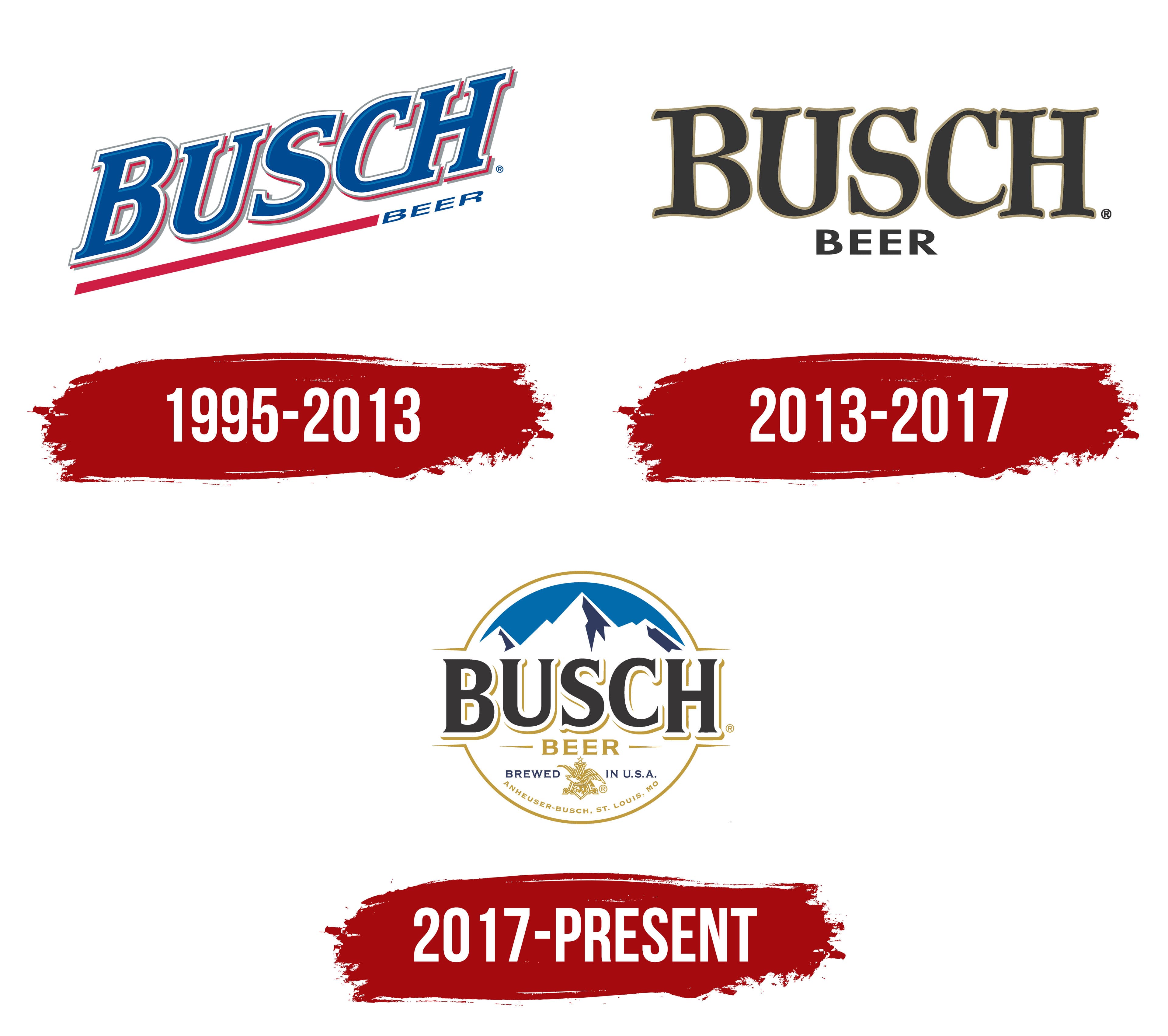
1995 – 2013

The original name, Busch Bavarian Beer, hinted at the Bushes’ Germanic origins and pointed to the Bavarian monks as the first inventors of lager. After the discovery of bottom fermentation, Bavaria became the center of brewing. The product had to be associated with the ancient recipes of those parts. The slogans developed were: “clean and bright as mountain air” and “head to the mountains.”
The logo used Adolf’s surname, written obliquely from bottom to top as a sign of ascent to the heights. The name had a red underline and a red shadow, indicating energy, strength, and love for his work, which helped the company’s founder achieve such success. Blue letters with a white outline symbolized the sky and the snow of the Bavarian mountains. Associated with coolness, they subtly alluded to mechanical cooling, a device that Busch himself had first introduced.
In 1979, the beer adopted its current name, Busch Beer, but the logo change came much later, when Joao Nevis led the company.
2013 – 2017

An unusual handwritten font distinguished the logo of this period. The letters in the word “BUSCH” looked handwritten and very sloppy: they had uneven, trembling edges and disproportionate curves. The “U” stood out the most, lacking the usual symmetry. The word “BEER” sat below in capital glyphs, but it was reduced several times. Its simple sans-serif font resembled Core Sans N 83 Ex Heavy by S-Core. Both parts of the text were painted in an unsaturated shade of black. The letters in the top line also had a thin, dark, beige outline.
2017 – today
The updated Busch logo reflects the brand’s key elements, history, and values. The design has become circular, symbolizing completeness, stability, and tradition. Two outward-facing stripes resemble a championship belt, evoking associations with the brand’s leadership and competitive edge in the beer market. This visual element emphasizes Busch’s prominent position among brewing companies.
At the top of the logo, snow-capped mountain peaks are depicted. This element symbolizes purity and freshness and references the brand’s historical roots. The beer’s original name, Busch Bavarian Beer, directly connects it to Bavaria, known for its Alps and brewing traditions. These mountains serve as a visual metaphor for the beer’s natural essence, lightness, and refreshing taste, reminiscent of cool mountain streams.
The composition’s central feature is the word “BUSCH.” It is rendered in black font with a white outline and golden shadows. The letters are bold, with clean, precise lines that give them visual weight. The font conveys stability and confidence, while golden accents suggest premium quality. Notably, the design avoids aggressive decorative elements; the text stays classic and restrained, underscoring respect for long-standing traditions.
Directly beneath “BUSCH” is the word “BEER,” written in gold. While less prominent, it provides visual balance and draws attention to the product. Gold signifies quality and the brand’s rich history.
At the bottom of the emblem is the phrase “BREWED IN U.S.A.,” a simple yet meaningful detail that affirms the beer’s national origin and pride in its American roots. Below it is the company’s trademark: an eagle embedded in the letter “A,” a long-recognized symbol of the brand that reflects its history and unwavering commitment to quality. Beneath it is the company’s founding location: “ANHEUSER-BUSCH, ST. LOUIS, MO,” a reminder of St. Louis, where the brewery began its journey.
The fonts used in the visual design are simple yet expressive. The main inscription is in a classic sans-serif style with smooth transitions and clean lines, highlighting stability and traditional craftsmanship. The black-and-white contrast makes the name stand out, while the golden hue adds depth and richness. The upper part of the logo, featuring the mountains, incorporates blue to enhance freshness and evoke natural purity.
The brand’s name is tied to the brewery’s founder, whose surname has become a symbol of high-quality American beer. It evokes associations with tradition, craftsmanship, and fidelity to time-tested recipes.
Font and Colors
Lines, contours, and inscriptions related to the manufacturer are made in gold. They suggest that Bush beer is the gold standard of brewing and that it comes from a long-established, legendary company with over 150 years of history.
In addition to gold and blue, the brand uses a lot of white. Blue and white shades symbolize freshness, purity, and coolness, which the beer should convey. In other drinks, the color scheme of the lines, the company logo, and the name change vary by place and release date. However, it uses cool shades (silver, blue, white, cold red).

The black brand name stands out brightly against the background and immediately attracts attention. The first version of the logo used the font Romic Light Italic LET for the inscription. On the modern emblem, the inscription was set in a direct style rather than italics, with the distinctive serifs characteristic of the Columna typeface.