


 Byju’s Logo PNG
“Learning with us is easy and fun,” says Byju’s logo. The logo symbols represent a large body of knowledge that can be accessed remotely. Their use will help develop a harmonious personality.
Byju Raveendran was born in Kerala in 1980 to two schoolteachers. After engineering college, he worked for an international shipping company, but in 2003 began helping friends prepare for India’s CAT exam and scored in the 100th percentile himself. Those lessons grew into Byju’s Classes in 2007, with exam-prep sessions held in large halls. In 2011, Raveendran and Divya Gokulnath founded Think & Learn Pvt. Ltd. in Bangalore, the company behind “BYJU’S”.
In August 2015, BYJU’S launched The Learning App for school students and candidates preparing for IIT-JEE, NEET, CAT, GRE, and GMAT. The app reached over 2 million users in its first three months. In 2016, BYJU’S became the first Asian company funded by the Chan Zuckerberg Initiative. Sequoia Capital and Tencent Holdings later joined. By 2018, the platform had 15 million users, 900,000 paid subscribers, and had become India’s first edtech unicorn.
Growth turned into an acquisition spree: Osmo in 2019, WhiteHat Jr. in 2020, then Aakash Educational Services, Epic!, and Great Learning in 2021. By 2022, BYJU’S was valued at $22 billion, ahead of Indian rivals Unacademy and Vedantu. Then problems surfaced: delayed accounts, no CFO from 2021 to 2023, layoffs, investor exits, Deloitte’s departure, and searches by India’s Enforcement Directorate.
In 2024, its US unit filed for Chapter 11 in Delaware after defaulting on a $1.2 billion debt. India’s tribunal later appointed an insolvency specialist. In October 2024, Raveendran said BYJU’S was worth zero. In May 2025, Google removed the app from Google Play over unpaid AWS bills.
Meaning and History

The brand emerged from the same-name application, launched in 2011 by Think and Learn Pvt Ltd. A married couple founded the service: software developer Byju Raveendran and Divya Gokulnath. He is an engineer who taught students to take exams and prepare them for tests; she is an educational specialist. Together, they built a firm offering online learning products for K-12 and materials for competitive examinations.
In 2012, Think and Learn gained popularity and entered the prestigious Deloitte Technology Fast 50 and Deloitte Technology Fast 500 Asia Pacific rankings, and has remained on them. After four years of work on digital software called Byju’s: The Learning App, she launched it in the summer of 2015. In 2017, the Byju Math utility for children and the Byju Parent Connect program were introduced, enabling parents to track their children’s learning.
This was followed by several major acquisitions as the company entered the international arena. This helped expand the popularity of its educational products, which became not only a series but also an independent brand with its own symbols. In total, Byju’s has two logos. They are essentially similar, differing only in minor details.
What is Byju’s?
Byju’s is an educational technology developer. It was established in India in 2011 and started as a small startup by two entrepreneurs, Divya Gokulnath and Byju Raveendran. They created an app to simplify learning and make education widely accessible. The company now offers a wide range of online courses across various subjects and collaborates with several universities.
2010 – 2017

The debut emblem appeared with the release of the first program. She not only accompanied her but also presented her, since it contained only informational, introductory text. The logo’s base is a lilac square with rounded corners. It had highlights and shadows along the edges, giving it a sense of three-dimensionality, so the sign felt like a button to launch the announced utility. Its name was set in two lines: “Byju’s” in large grotesque type at the top, and “The Learning App” in small letters at the bottom. They were set against light lilac and dark purple backgrounds, with a wave-like gradation of shades.
2017 – today
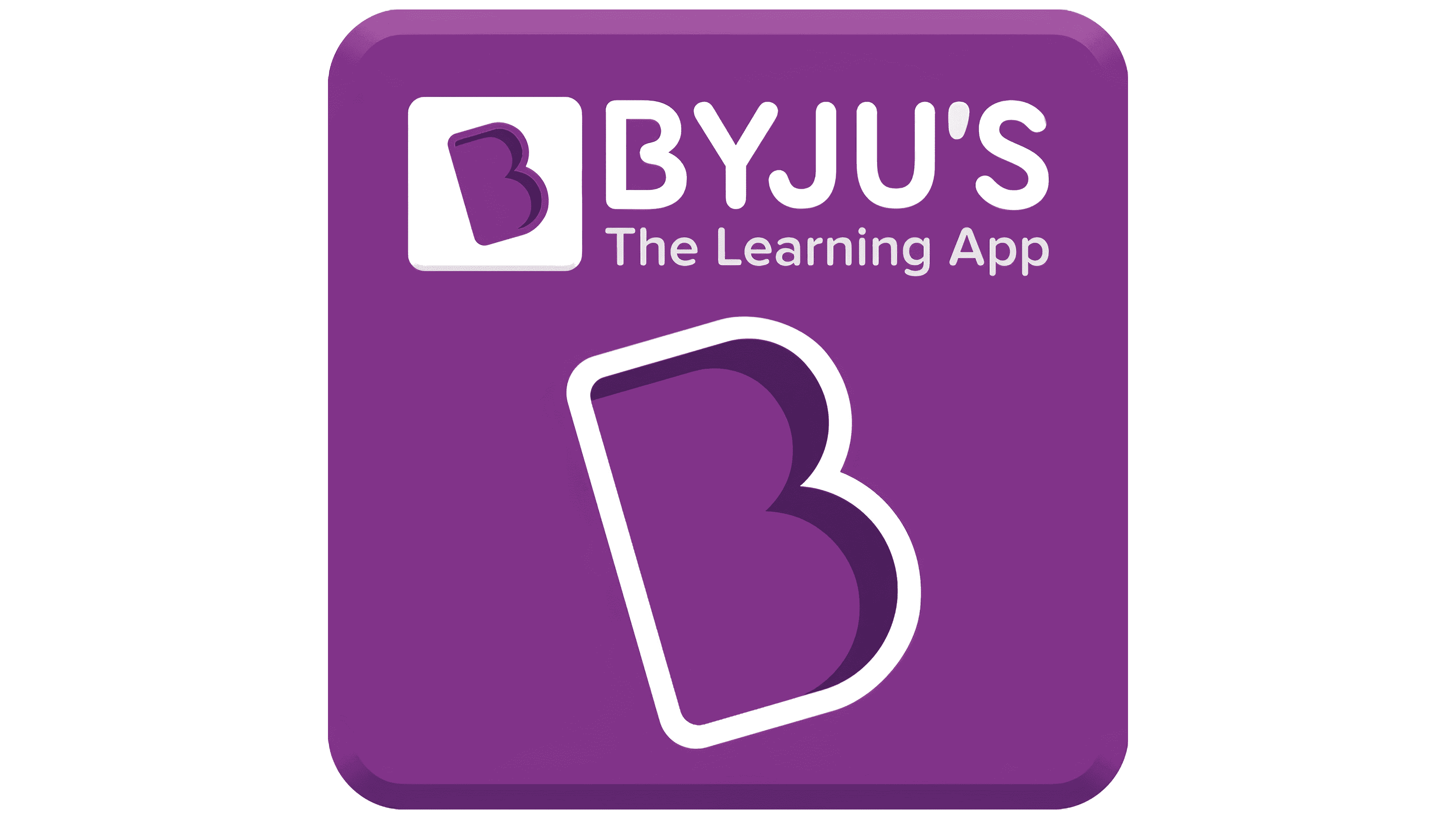
The current logo looks modern and includes both text and graphic elements. It is a diagonal “B”-shaped icon located in the center and the upper-left corner. In the first case, the letter is large, expressive, with a deep shadow on the right and a white border. It looks voluminous, as if it is raised above the surface.
The upper part shows a similar symbol, but smaller, in a miniature white square. The brand name is also placed next to it. The designers changed their style by capitalizing the beginning of each word. The exception is “Byju’s”: it is in uppercase. The developers kept the sign’s roundness but refined the “B” by reducing its center bar. This young Indian company’s identity is readily recognizable because, from the very beginning, it adopted its own “face”: a purple convex square. It serves as a base for the remaining elements, which, thanks to the contrast, look clear and catchy.
Font and Colors
The emblem uses two types of typefaces. The word “Byju’s” is set in a font reminiscent of JCfonts’ Linotte Bold or S-Core’s Core Sans ES 75 Extra Bold, with a slight modification to the “B”. “The Learning App” is executed in a simple grotesque, as close as possible to Museo Sans Rounded 700 or Core Sans AR 55 Medium. The color scheme remains unchanged: purple (square) and white (letters).