


 Cannondale Logo PNG
The brand is quite recognizable thanks to its bright, fresh logo. It consists of a graphic symbol (a stylized first letter of the name) and the inscription Cannondale. The logo evokes only positive associations and conveys the brand’s friendly spirit. The bright green color also symbolizes the trust of hundreds of customers who have had time to evaluate the products’ quality.
Cannondale was founded in 1971 in Wilton, Connecticut, by a small group led by Joe Montgomery. The name came from the Cannondale railroad station in the same town. At first, the company did not make bicycles. Its early products were bike trailers and touring gear for riders who needed practical equipment for travel and outdoor use.
The major turn came in 1983, when Cannondale released its first mass-produced bicycle with an aluminum alloy frame. Most manufacturers still relied on steel, so aluminum seemed unusual. Cannondale built its reputation on lighter, stiffer frames, then kept refining aluminum construction through the CAAD (Cannondale Advanced Aluminum Design) program.
In the 1990s, the company expanded its mountain and road bike lines while manufacturing in Bedford, Pennsylvania. Its American production became part of the brand’s image. During the same period, Cannondale competed with Trek, founded in Wisconsin in 1976, and Specialized, founded in California in 1974. Together, the three brands shaped much of the premium U.S. bicycle market.
In 2000, Cannondale entered the motorcycle business through Cannondale Sports LLC, developing off-road motorcycles with aluminum frames and its own four-stroke engines. The project consumed heavy investment and failed commercially. In 2003, the company filed for Chapter 11 protection, closed the motorcycle division, and continued as a bicycle brand under new ownership. In 2008, Dorel Industries acquired Cannondale, and it joined Cycling Sports Group, which included GT Bicycles, Schwinn, and other brands. In the 2010s, it focused on carbon frames, e-bikes, and professional racing programs.
Meaning and History
Cannondale is a unique company that has changed its focus several times. But the changes have only benefited it. Today, under the specified name (Cannondale Bicycle Corporation), it operates a successful brand that produces high-quality products. It is recognized in most countries and known for its excellent performance.
Bicycles are easy to find among other manufacturers’ models. The brand logo immediately captures buyers’ attention with its expressiveness and brightness. Designers achieved this goal through their visual identity work. They took the first letter as a basis and turned it into a stylish icon that immediately caught the eye.
Beneath it, the company name confirmed that a reliable, well-respected brand created the model. Each element in this concept has a specific meaning and harmonizes with the other parts of the logo. A massive three-dimensional letter is balanced by neat, identical smaller letters.
What is Cannondale?
Cannondale is a successful division of one of the largest Canadian conglomerates. The company has operated under Dorel Industries’ control for many years and, during this time, has created a full line of high-quality bicycle models. The production process used “CAAD” technology and a special material (carbon). Cyclists worldwide have already appreciated the models.
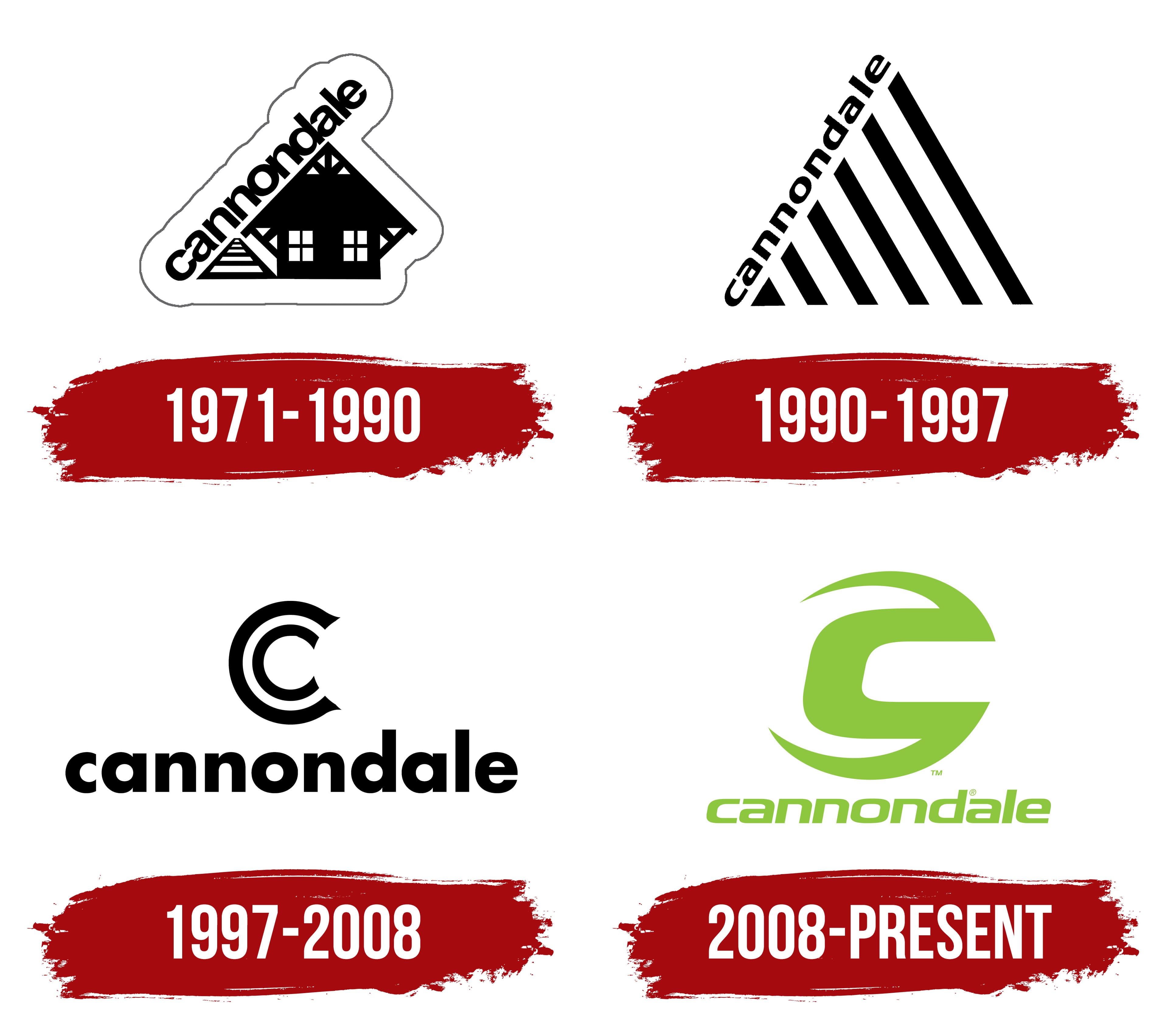
1971 – 1990

The company idea emerged in 1971. Three entrepreneurs (Ron Davis, Jim Catrambone, and Joseph Montgomery) decided to create a company specializing in precast concrete structures. Later, they completely changed direction. The brand launched clothing and backpacks for cyclists. The creators didn’t stop there and soon began developing bicycle trailers for tourism.
Since 1983, the brand has been producing two-wheeled vehicles. During this period, the brand’s visual identity was based on the original logo, which combined several elements. The picture showed a house, a striped triangle, and the company name slanted.
The colors were not varied. Only black and white are visible on the emblem. The company chose these shades to reflect its characteristics. It was a reliable, self-confident brand seeking to strengthen its position. The black-and-white color scheme effectively emphasized the company’s solidity and elitism.
1990 – 1997

In 1990, the company expanded its lineup with functional motorcycle (motocross) and ATV lines. But this decision worsened the situation and prompted a search for solutions to return to its previous level. All this became one of the prerequisites for changing the corporate identity. The new emblem has become simpler and more concise. This signaled the company’s desire for renewal and growth.
An isosceles triangle, divided into stripes, was placed at the center of the image. On one side, the company name appeared in neat, miniature letters. The updated logo solved the “hanging” problem present in the previous version. The inscription did not fit on one side of the triangle, creating a sense of disproportion. Now the inscription was a stylish continuation that didn’t cause dissonance.
1997 – 2008

In 1997, Cannondale introduced a new bike model, the CAAD3. It was a new, more advanced two-wheeled vehicle in the 2.8 category. The model’s success prompted management to rebrand. The result was a new emblem vaguely similar to the modern version.
The double letter C became the central element. It placed special emphasis on the brand name and confirmed its strengthened market position. The company quickly went on to success and developed new, improved models. Another sign of this improved position was the use of a clearer, more expressive font.
The letters are thicker, rounder, and softer. This design evokes associations with comfort and reliability, which the brand wanted to convey to customers. The logo’s colors remain the same. The achromatic palette emphasized the company’s prestige and solid status.
2008 – today
Cannondale also changed its visual identity in 2008, when it introduced a new line of improved bikes (SystemSix). During this period, Cannondale created a logo version it still uses today. It was a stylish concept, radically different from all previous emblems.
The overall design, font, and colors were changed. The updated badge is based on a massive letter C, drawn with thick lines. At the back, the lines don’t connect at the ends, adding originality and freshness. The font became more refined and stretched, and the basic colors shifted to brighter hues. These changes show the company’s progressive approach and its desire to improve.
Font and Colors

The brand’s modern corporate identity is based on a bright, expressive logo. The designers chose bright green for the main elements and white for the background. The latter shade is universal and symbolizes purity. Together, they create a sense of freshness, energy, and lightness.
The updated palette underscores the company’s commitment to introducing progressive technologies that make cycling more comfortable and easier. A stylish font complements the overall concept. The company name is rendered in straight, thin, sans-serif lines, evoking confidence and professionalism.
It also stylistically continues the top symbol. The inscription looks harmonious and energetic alongside the massive letter C. But the logo’s main message is professionalism, evident at every stage of bike production. This is evident in every element of the original emblem: a confident typeface, expressive colors, and a massive graphic symbol at the center.