


 Carefree Logo PNG
Elegance, subtlety, and lightness are the emblem’s main motifs. The Carefree logo is distinctly feminine. Shows that the brand was created specifically for the beautiful half, with their needs and requirements in mind. As a result, brand products are always handy in a handbag.
Carefree’s history reflects a broader shift in women’s hygiene during the 20th century. For decades, pads were held in place with belts and pins, a format dominated by Kotex from Kimberly-Clark. In 1969, Johnson & Johnson changed the category with Stayfree, introducing adhesive-backed pads.
The Carefree name first appeared in 1967 on tampons, but its core identity formed in 1976. On May 27, the trademark was registered for pantyliners, establishing a new product category for everyday hygiene rather than menstrual use.
The format differed from traditional pads. It was thinner, lighter, and designed for daily wear. The campaign “For the fresh-dressed woman,” created by SSC&B, reflected the growing number of working women in the 1970s and a shift toward practical comfort.
Adoption was rapid. By the late 1970s, Carefree controlled more than half of the US pantyliner market. Johnson & Johnson expanded the range with variants for different underwear types, protection levels, and scented or unscented options.
In 2001, Carefree Black addressed a specific consumer need by adapting the product for dark underwear. In 2012, the Acti-Fresh campaign in Australia and New Zealand triggered 149 complaints due to explicit anatomical language, though the company defended it as fact-based.
In 2013, North American rights to Carefree, Stayfree, and o.b. were sold to Energizer Holdings for about $185 million. In 2015, the assets moved to Edgewell Personal Care. In February 2026, Essity acquired the business for $340 million.
Meaning and History
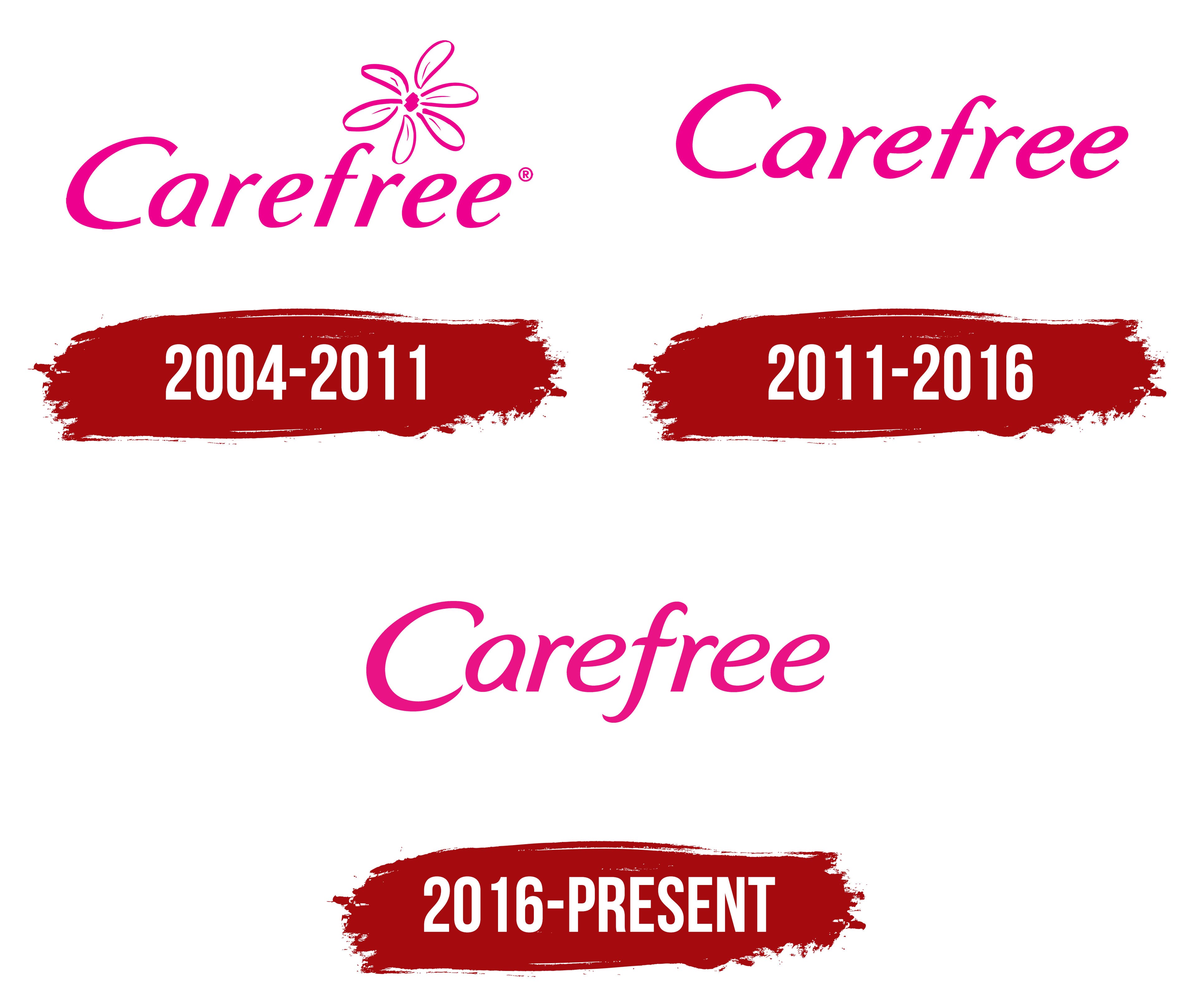
From its inception to the present day, the company has changed its logo five times and now uses its sixth. Across all variants, the main element was the brand name inscription. The word “Carefree” looked different, but it was almost always light and slanted. The graphic designation appeared later. The main countdown in the history of logos dates back to 2004, when the brand was firmly established in the international market. Its structure has shown no noticeable changes.
What is Carefree?
Carefree is a line of feminine hygiene pads previously owned by the American company Johnson & Johnson. The brand is now part of Edgewell Personal Care. The first batch of products was introduced in 1976, when the trademark was registered.
2004 – 2011

This version features an italic inscription and an image of a six-petalled flower. They are shaped like classic pads without wings.
2011 – 2016

Now the company uses a logo without a flower: the designers removed it in 2011. Then they changed the palette to pastel.
2016 – today
The designers chose a more saturated shade of fuchsia for the modern logo. As a result, the inscription is now in neon pink with a slight touch of lilac. The basic font remains the same, but we made a few changes. For example, we corrected the “r” (the top stroke is slightly thinner) and the “f” (the bottom half is finished and bent in the opposite direction).
Font and Colors
The main detail of the Carefree personal badge is the name. The graphic element was present only in the 2004 version. It was a chamomile flower whose petals resembled sanitary pads.

The brand uses italic lettering. The calligraphic letters “c,” “a,” and “e” appear to be handwritten. The emblem is pink: once bright, it has now become subdued.
In the new logo, the developers kept the old typeface and made slight corrections. The original palette has been shifted to a bright nude spectrum, as in the 2004 version, so the logo now uses a rich fuchsia.