 Oriflame Logo PNG
“Oriflame branded cosmetics are a great choice,” the emblem proclaims. A balanced Oriflame logo composition gently emphasizes the dignity of the buyer’s skin and makes the features more expressive and memorable.
In 1967, in Stockholm, Jonas and Robert af Jochnick, together with Bengt Hellsten, founded Oriflame. The company relied on direct sales, avoiding retail and working through independent consultants who earned commissions and benefited from network growth.
From the start, the brand focused on cosmetics made with natural ingredients and of Scandinavian origin. In the 1970s, Oriflame expanded across Western Europe, building a network of consultants and distributing products through printed catalogs used for personal sales.
The segment already included major players. Avon, founded in 1886, held strong positions in Europe, while Mary Kay, launched in 1963, used a similar model and emphasized female entrepreneurship. Oriflame entered this field with a European identity and different product positioning.
In the early 1990s, after the Soviet Union collapsed, the company moved into Russia and other post-Soviet markets. Direct sales gained traction amid economic instability, and the consultant model attracted many participants. Russia became one of the key markets by sales volume.
During the 1990s, Oriflame listed on Nasdaq Stockholm, raising capital to expand into Asia, Latin America, the Middle East, and Africa. By the end of the decade, it operated in dozens of countries with millions of consultants.
In the 2000s, the company expanded beyond cosmetics into skincare, wellness, and health products, while adapting its catalog model to online tools and digital platforms.
In 2019, the af Jochnick family took Oriflame private and delisted it from Nasdaq Stockholm. The headquarters is now in Schaffhausen, Switzerland.
Meaning and History
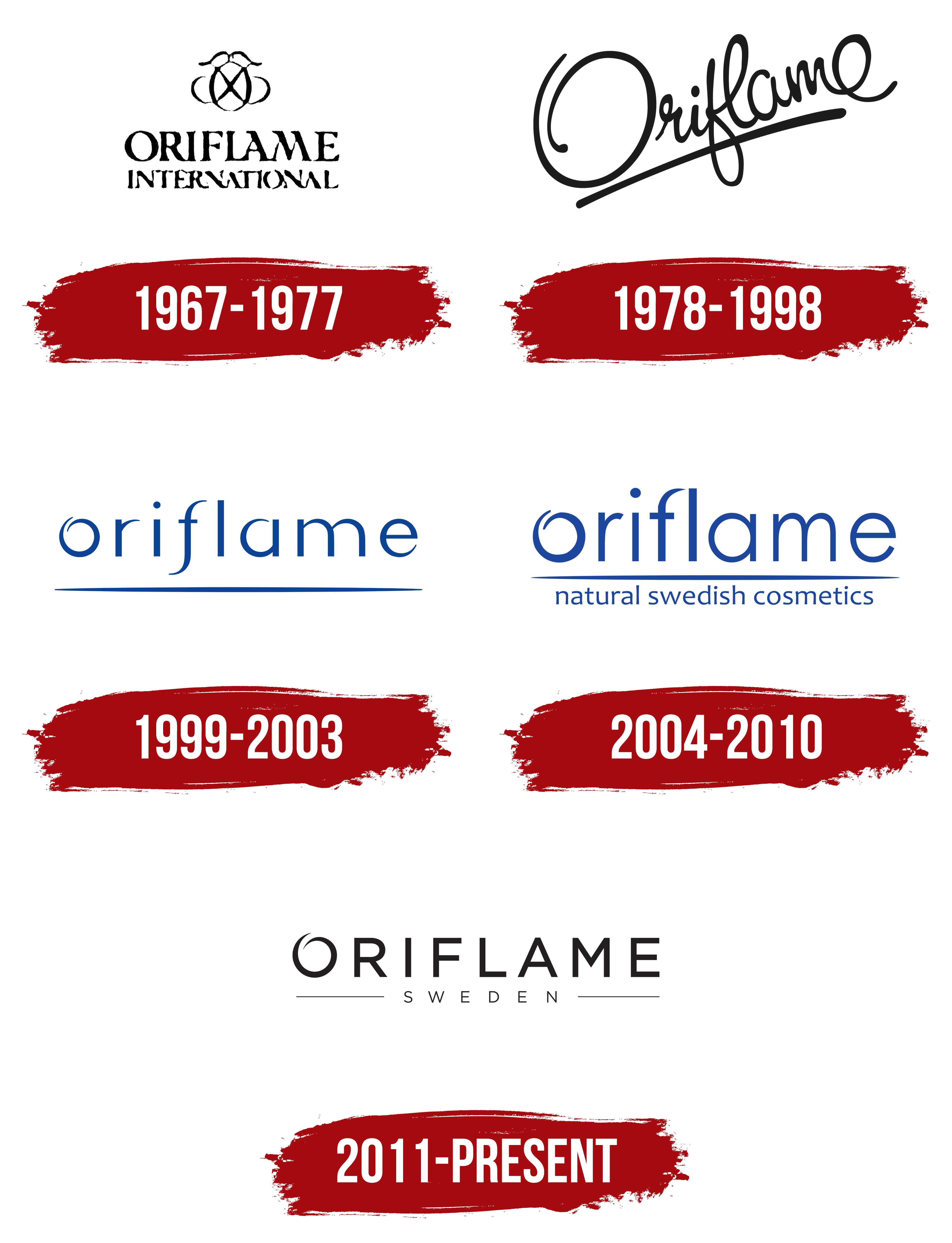
Over its long history, Oriflame Holding AG’s visual identity mark has undergone five stages of change. These changes mainly concern the styling of the word “Oriflame.” Now the minimalistic version is used.
What is Oriflame?
The brand develops its products in research laboratories in Sweden. It covers skincare, makeup, fragrances, and dietary supplements. With diverse lines from the premium NovAge skincare collection to everyday essentials and trendy makeup, the brand offers solutions for all ages and needs. A distinctive feature of the company is its ability to combine Swedish beauty expertise with affordability, providing high-quality care at an attractive price.
1967 – 1977
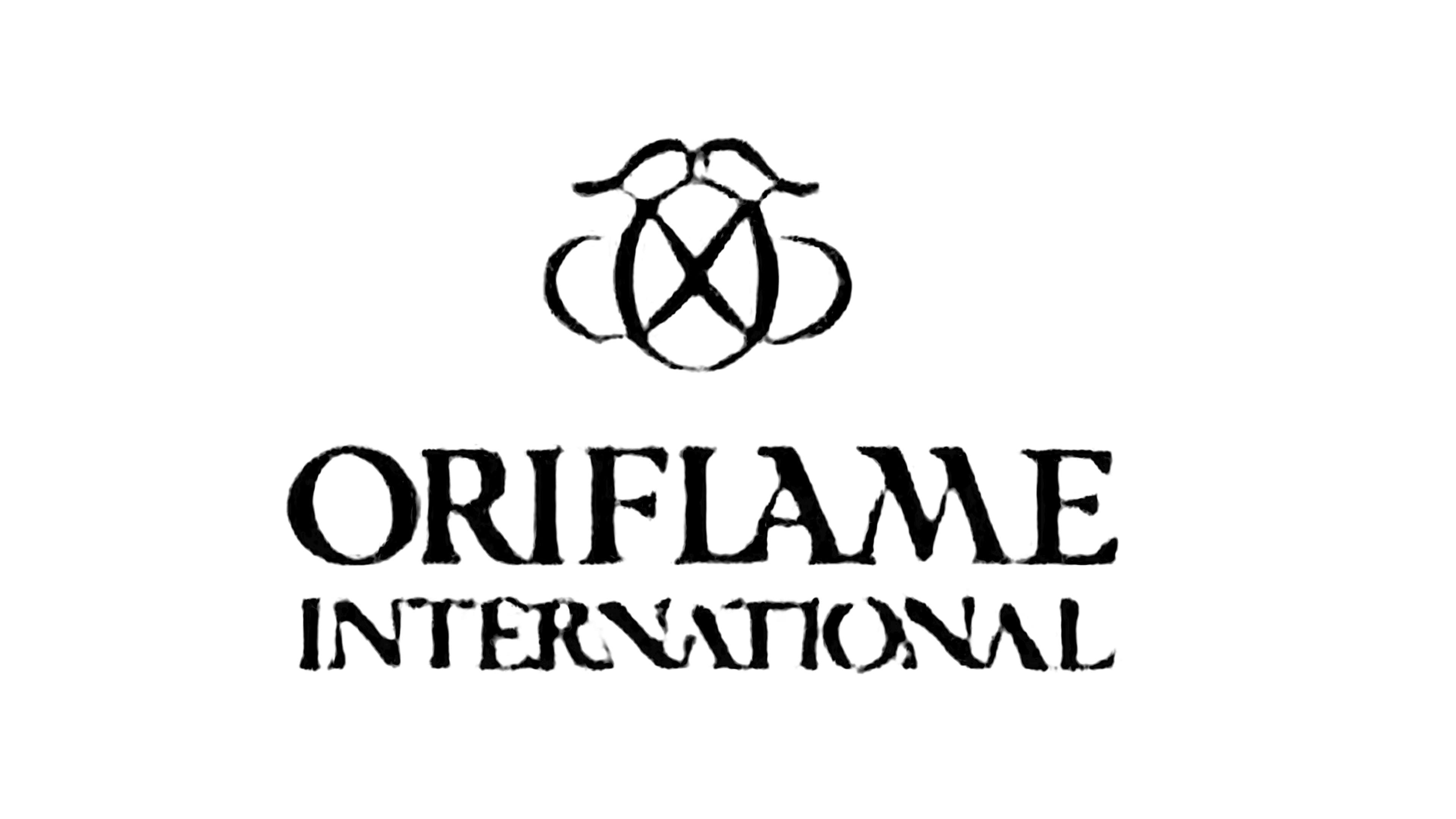
The Swedish cosmetics brand began with a logo featuring both text and graphics. The inscription had two parts: at the top, the word “Oriflame”; below it, “International.” This meant that the company was initially focused on international sales. The letters were printed with the original serifs pointing left. At the top, the designers have placed a monogram, a vignette made up of three symbols. It featured two handcrafted mirrored “Fs” and one “O” as its background.
1978 – 1998
For several decades, the company used the simple italic logo, as if written in careless handwriting. The name rose rapidly along the diagonal. The cursory handwriting suggested a high degree of emotional outburst, as the symbols lacked clear outlines but remained coherent, merging into an inseparable whole. Beneath the caption was a bold line in the same black color as the word “Oriflame.”
1999 – 2003
In 1999, the cosmetic brand switched to printed signs. The designers converted them to lowercase but retained the same features. The letter “o” remained an open circle with overlapping lines; “f” became a smooth vertical bend; the top of “a” no longer converged to the end; and the dot above “i” sat higher than usual. The subscript is also preserved: it has become one long line with a bulge in the center. Instead of black, it became deep blue.
2004 – 2010
The focus shifted to typography, so some symbols changed. So, the developers removed the lower tail from “f,” making it more classic. The sharp edges at the ends disappeared, and a marketing clarification appeared below the line: “natural swedish cosmetics.” It was done in lowercase letters. The only thing that has survived is the trademark “o” as an open ring.
2011 – today
The current logo is rigorous itself. It consists of a title typed in a classic capital sans serif. It has an original design that emphasizes the letter “O.” The sign is shaped as an open circle, as if it were a massage movement along the contours of the face. In this way, the manufacturer emphasized the connection with cosmetic products. The wide spacing between the letters makes the inscription look airy and light despite the bold lines and black color. All symbols are straight, geometric, with even corners. The designers divided the long line into two thin stripes and raised them to the word “Sweden.” They also returned the emblem to black.
Font and Colors

The emblem uses two types of typefaces. The first letter in the word “Oriflame” is set in the printed font of the same name; the rest of the symbols are from the Sans Serif category. Moreover, “O” functions as a standalone sign. The letter spacing in both inscriptions is wide. The corporate palette is monochrome, featuring the classic combination of black (letters) and white (background). Dark gray also appears in the word “SWEDEN” and its surrounding strokes.