


 Sunsilk Logo PNG
The emblem shows shine and purity. The product components work together to heal hair and scalp. As the Sunsilk logo shows, a high concentration of beneficial ingredients makes this effect possible.
In 1954, Unilever introduced Sunsilk in the UK through D & W Gibbs. Its liquid formula enabled effective cleansing in one wash, replacing the two-step routine common at the time.
In 1955, the brand entered television advertising, focusing on specific hair issues. In 1956, it introduced a cream version for dry hair. By 1959, Sunsilk operated in 18 countries, expanding across Europe, Brazil, and Asia, with local names such as Elidor, Seda, and Sedal.
In 1962, the product line shifted toward segmentation by hair type. In 1964, hairspray was added. In 1966, an olive oil shampoo appeared, competing with brands such as Procter & Gamble and Pantene. In 1968, packaging changed to larger PVC bottles without a price increase.
In 1969, the brand promoted Sunsilk Herb through radio campaigns featuring Derek Nimmo. In 1971, the brand introduced conditioners in three variants, reflecting growing demand for multi-step hair care. In 1973, the brand introduced an aerosol styling lotion. By 1975, weekly sales reached one million units.
In 1980, the company relaunched the range with updated formulas and packaging. In 1985, the company introduced styling foam in response to changing trends. In 1993, the Elida Hair Institute developed new products based on consumer research.
In 2001, Sunsilk entered the hair color segment in Asian markets. In 2008, the global campaign “Life Can’t Wait” launched. In 2009, the brand was relaunched as Sunsilk Co-Creations, developed with international stylists.
Meaning and History
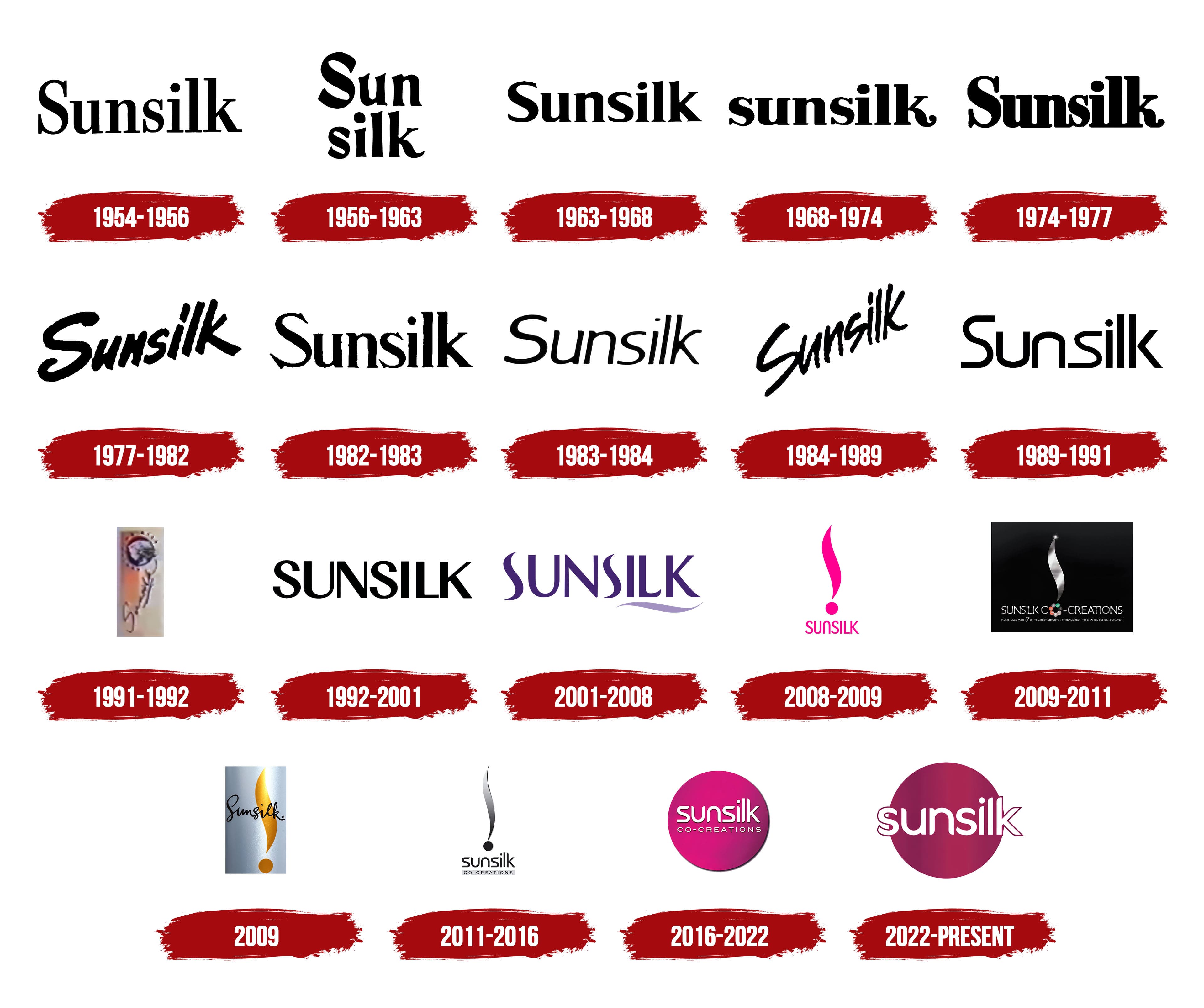
The British manufacturer’s progressive approach helped it gain popularity quickly. It entered the international market within five years and gained fame in 18 countries. Over the brand’s existence, the number of its emblems has increased to several dozen. The main ones are six modifications.
What is Sunsilk?
This is a major Unilever haircare brand, particularly popular in Asia, Latin America, and the Middle East. Each product in the range is developed in collaboration with hair specialists and offers targeted solutions for different hair types and needs, from volumizing formulas to products that ensure smoothness and manageability. The brand stands out for its deep understanding of diverse haircare needs across cultures and climates. It creates products that address specific concerns such as damage repair, humidity resistance, and maintaining the natural hair condition.
1954 – 1956
In 1954, the hair care brand was introduced, and its first logo featured black “Sunsilk” lettering in a typeface similar to SoftMaker’s Thames Serial Bold. The first letter was capitalized, and all the rest were in lowercase. Long serifs and strong contrast between the main and secondary strokes created a dynamic feel.
1956 – 1963

In 1956, the brand name was split into two parts: “Sun” and “silk.” They appeared on separate, centered lines. The inscription was still black, but it used a bold custom font.
1963 – 1968

In this version, the design includes both text and a graphic element. The designers simplified the characters by removing a few serifs and adding a vertical oval shaped like a yellow “S.” It divides the space into two halves: the upper side is white with a miniature brand name, and the lower is blue in the form of a drop.
1968 – 1974
After the redesign, all letters became lowercase. The typeface, with long, thin serifs, was roughly similar to DSType’s Prumo Deck Extra Bold; only the “k” at the bottom had a graceful spiral with a dot at the end.
1974 – 1977

The first “S” in “Sunsilk” has been changed to uppercase. At the same time, all letters were elongated vertically, and their strokes widened, causing them to merge.
1977 – 1982
In the second half of the 1970s, the logo changed again. The inscription remained black, but the designers completely redesigned the font. This version’s brand name was written in jagged glyphs with custom styling. The word sat diagonally, rising slightly to the right.
1982 – 1983
In the early 1980s, the inscription was aligned. Both “S” acquired long diagonal serifs, while all other letters had short, triangular, and horizontal serifs.
1983 – 1984

After the redesign, the serifs disappeared, and the letters became thin and slanted. The logo used an individual set of glyphs, but in a new design.
1984 – 1989
The wordmark has become a handwritten inscription set at a high angle. The letters were not connected; only two “S” s accidentally touched the next “u” and “i” because of their curved shapes.
1989 – 1991
In 1989, the developers realigned the Sunsilk logo inscription. Both the capital and lowercase “S” were twisted and disproportionate. At the same time, “u” and “n” looked like mirror images of each other.
1991 – 1992
In the early 1990s, the designers used a handwritten font for the brand name and placed it vertically at a large angle. They drew a black stripe under the word, with a round element at the top.
1992 – 2001

Until 2001, the Sunsilk logo used a bold, contrasting sans-serif similar to FontSite Inc.’s Regalis ExtraBold. The lettering was black and aligned horizontally.
2001 – 2008
In 2001, the letters became thinner and took on an unusual shape. For example, the “L” had a sharp, claw-like curve at the end, and both “S”s looked like vertical waves or upside-down tildes. The inscription was repainted in dark purple. In the lower-right corner was a wavy line of a light purple hue.
2008 – 2009
The logo uses a long, vertical wavy stroke. A large dot sits beneath it. Visually, this modification resembles an exclamation mark. It is a stylized letter “S.” At the very bottom, the company name was added with the same “u” and “n.”
2009 – 2011
In 2009, the brand was relaunched as Sunsilk Co-Creations, which was reflected in its symbolism. The management retained the undulating element and approved two modifications: advertising and labels.
2011 – 2016
The developers made the vertical wave, symbolizing a lock of hair, thin and elongated. The point was left large. An updated inscription appeared under it in two lines: at the top, the single word “Sunsilk”; at the bottom, “Co-Creations” in a gray rectangle.
2016 – 2022
In 2016, the company name was inside a fuchsia circle with a dark gradient and gray-to-black shadows. The word “Sunsilk” was the largest and was at the top. But it used only lowercase letters, in contrast to the inscription “CO-CREATIONS,” set in small capital glyphs. The font remains the same as in the previous version.
2022 – today
The current Sunsilk logo differs from the previous one by lacking gray shading along the edges of the circle and the letters. The purple has darkened, and the gradient has become more pronounced and linear. The bottom lettering has been removed, allowing the designers to enlarge the word “Sunsilk.” Moreover, it is now so large that the first “s” and the last “k” go beyond the round base.
Font and Colors
In 2022, the Sunsilk logo’s font changed slightly, although the brand name still uses bold geometric sans serifs. The letters have become more rounded, with many corners cut off and smoothed. The left-hand cuts at the tops of the vertical strokes “i,” “l,” and “k” look symmetrical.
The color scheme has also been modified. It is now dominated by purple, ranging from dark to light pink, with a gradient. The white inscription stands out against this background.
Despite the many versions, Sunsilk’s symbols are tied to its name, which appears in all versions. Since 1963, a vertical oval graphic has appeared in the logo, evolving from the letter “S” into an elongated curl.
The emblem uses several typefaces. The first versions used serifs; the rest did not. The current logo uses a sleek, grotesque font. The color palette also ranged from black-and-white classics to a bright purple neon spectrum.
FAQ
What does the Sunsilk logo mean?
The logo has a clear, meaningful message that reflects the brand’s uniqueness and its consumers. The fuchsia-and-white palette represents femininity, style, and beauty. Fuchsia, a bright and bold color, reflects the brand’s passion, energy, and dedication to providing effective hair-care solutions. This color choice conveys luxury and care, suggesting that using the brand’s products leads to a pampering, indulgent experience.
The white elements in the logo add simplicity and purity, enhancing feelings of trust and reliability. This color mix makes the logo visually appealing and strengthens the brand’s image as a beauty and hair care leader.
The logo’s design appeals to its target audience, primarily women, by resonating with their desire for stylish, high-quality hair care products.
Is Sunsilk an Israeli brand?
The brand is not Israeli. It is a British hair care brand produced by Unilever. The brand was introduced in the UK and is available in most countries worldwide. Unilever owns the brand and oversees its production and distribution.
The company started in the UK and has grown in popularity globally. It offers a wide range of hair care products, including shampoos, conditioners, and styling treatments for different hair types and needs.
The brand’s global presence and extensive product line have made it a trusted name in hair care. The company continues to innovate, creating new formulations to meet the changing needs of its diverse customer base.
What is the vision of Sunsilk?
Sunsilk’s vision is to empower and equip girls with the support, skills, and confidence they need to explore their possibilities. The brand aims to expand what girls believe they can achieve and become. The company inspires young women to pursue their dreams and reach their full potential through empowerment.
The brand’s products and marketing efforts align with this vision. The company provides high-quality hair care products and fosters an environment where young women feel empowered and supported.
What is the logo of Sunsilk?
The logo is a purple-pink circle with the brand name and the word “CO-CREATIONS” written in white letters. This design showcases the brand’s vibrant, modern identity. The purple-pink color represents energy, passion, and a youthful spirit, matching the brand’s focus on providing high-quality hair care solutions.
The white letters for the brand name and “CO-CREATIONS” ensure clear readability and a clean look. “CO-CREATIONS” highlights the brand’s collaborative approach with hair care experts and stylists to develop products and effective hair care tailored to various needs.
This simple yet impactful design makes the logo recognizable and memorable, strengthening the brand’s presence in the competitive hair care market.
Do they still make Sunsilk?
Although the brand is no longer made or sold in the United States, it is still available in many other countries, including Canada. It remains popular in regions like Europe, Asia, and Latin America.
Unilever, the company behind Sunsilk, continues to support the brand and innovate with new products to meet global customers’ needs. The brand’s product line includes shampoos, conditioners, and styling treatments for different hair types and concerns.
Which company owns Sunsilk?
Unilever owns Sunsilk. The brand is part of Unilever’s portfolio, which includes other well-known names like Dove, Axe, and Tresemmé.
Unilever’s ownership gives the brand access to vast resources and expertise in research, development, and marketing. This helps the brand innovate and introduce new products to meet consumers’ needs worldwide.
Through Unilever’s efforts, the brand continues to thrive and expand its offerings, reinforcing its commitment to effective and reliable hair care solutions.