


 Carex Logo PNG
The Carex logo resembles a voluminous soap bubble, promising safety and the destruction of harmful microbes. The emblem represents the tool as reliable protection. Hands will shine with cleanliness thanks to an effective recipe.
Carex’s roots go back to 1884, when George Paterson and George Zochonis founded Paterson Zochonis in Sierra Leone. The company traded goods between West Africa and the UK, later expanded into Nigeria, and acquired a soap factory in 1948, shifting the business toward consumer products.
In 1975, Paterson Zochonis acquired Cussons Group Ltd., bringing in established brands such as Imperial Leather. The merger combined distribution networks with a strong product base. Expansion continued with the addition of production sites in Thailand in 1986 and in Indonesia in 1988.
By 1994, under what would become PZ Cussons plc, Carex was launched in the UK as the first commercially sold liquid antibacterial hand soap. At the time, bar soap dominated the category. Carex introduced pump dispensers and a hygiene-focused positioning that changed everyday usage.
In 1998, Carex introduced hand sanitizing gel to the UK market, entering a segment later dominated by Dettol and Lifebuoy. This move established the brand in both soap and sanitizer categories.
During the 2000s, the parent company expanded its portfolio through acquisitions such as Charles Worthington in 2004, Sanctuary Spa in 2008, and St. Tropez in 2010, while also adding Original Source, which competes with Dove and Radox.
Carex production remained based in Manchester. The product line expanded to include aloe vera, variant moisturizers, and children’s formats. Over time, the brand maintained a leading share in the UK hand hygiene segment.
Meaning and History
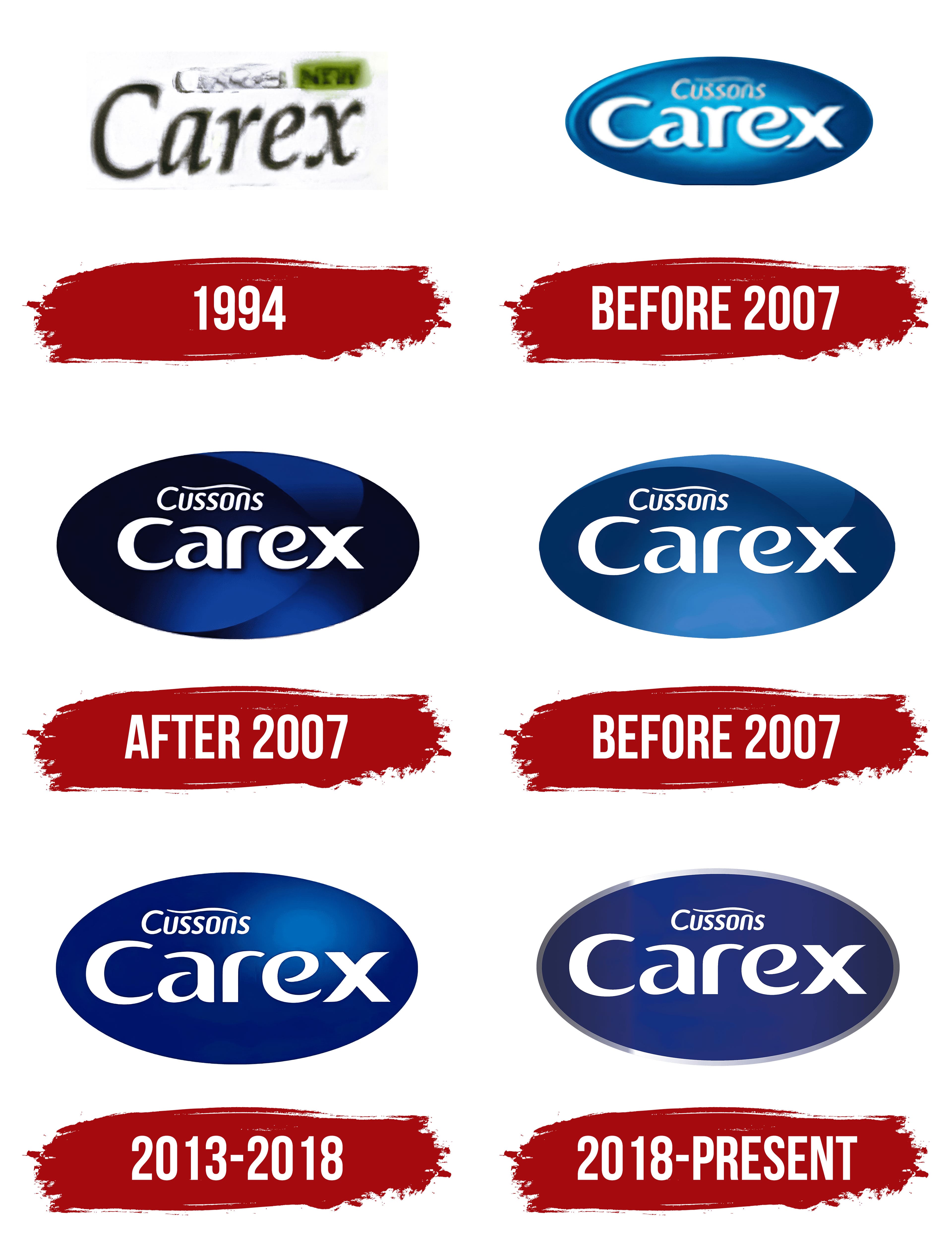
The brand emblem contains its name in a dark blue ellipse. The evening sky inspires its rich color. Throughout its history, it has had two logos: the original and the current one, which appeared after the transition to a British corporate structure.
The oval is the first thing that catches the eye in this brand’s branding. The geometric shape is regular and has a light gray border. The silver is metallic, with subtle reflections. In the center, against a blue velvet background, is the large word “Carex.” “Cussons” is written above it in small letters, which denotes brand ownership. Above it is a thin, winding strip.
What is Carex?
This is a reputable hand hygiene brand from PZ Cussons, well known in the British personal care industry for its extensive range of handwashing and sanitizing products. Their offerings include fast-acting gels and moisturizing hand care with distinctive scents, combining skin-friendly ingredients with effective cleansing. The brand aims to balance thorough cleansing with gentle hand care by providing solutions for sensitive skin, from moisturizing formulas to kitchen products that remove food odors.
1994

The logo consisted of inscriptions arranged in two rows. The brand name was in the second. It was in black italics. The letters were curved and lowercase, except for the first, which remained capitalized.
before 2007

During this period, the logo underwent a complete redesign. So, it featured a blue oval with an internal gradient. It served as a background for the white lettering, which was vertical, bold, and smooth, with miniature curves at the ends. Above the company name was “Cussons,” written in italics. This word used thin, right-handed glyphs. At the top was a wavy line.
after 2007

The logo from that time had a large dark blue ellipse. It had several light zones. In the center was the word “Carex.” It used the same style as before, but with a truncated stroke on the “r” (upper left). The designers moved the first line a little, placing it above the first three letters of the brand name.
before 2013

Compared to the previous logo, the text and background oval changed significantly. To improve readability, the designers enlarged the text, so it now occupies most of the space. The developers replaced the dark blue with a lighter shade and added a bright highlight at the bottom.
2013 – 2018
In the logo, which debuted in 2013, the designers moved the white highlight to the upper-right corner and removed the lines that divided the blue background into light and dark sections. They also removed the gloss from the emblem’s surface and added a matte finish. Everything else remained the same as in the previous version.
2018 – today
The current logo improves on the previous symbolism. The ellipse has a thin silver frame with bright reflections. But the top highlight has disappeared, causing a slight blur in the background. The developers aligned the word “Cussons” in the center, leaving it above the company name.
Font and Colors

The emblem uses two types of typefaces. The central inscription is set in a rounded, mixed-print-and-handwritten font. The upper word is set in an oblique style and uses chopped letters, where “n” and “u” without legs repeat each other upside down. The color palette consists of blue, gray, and white.