


 Carhartt Logo PNG
The company’s emblem is original and unusual. The Carhartt logo looks like artisan work, with handmade stitching and color overlays. The image suggests clothing for hardworking, creative people, with distinctive cuts and materials.
Hamilton Carhartt was born in New York in 1855 and grew up in southern Michigan. After working in furniture, he founded Hamilton Carhartt & Company in Detroit in 1889 with two sewing machines and a small electric motor. Early sales failed, so Carhartt spoke directly with railroad workers and designed a bib overall to meet their needs. Heavy duck canvas and denim formed the basis of the brand’s workwear identity.
By 1910, the company had mills and factories across the U.S., Canada, Liverpool, Paris, and New York. Its Chore Coat appeared in ads by 1917 and stayed close to its original form for decades. World War I brought military production, but the 1929 crash and the Great Depression nearly destroyed the business. Carhartt was reduced to plants in Atlanta, Detroit, and Dallas, while Dickies gained ground in the South.
In 1931, Carhartt bought the Big Bill Overall Company in Kentucky. Hamilton Carhartt died in a car accident in 1937, and his son, Wylie, took over. During World War II, Carhartt produced uniforms, Marine Corps gear, and women’s workwear for factories. Later, Robert Valade modernized production and supplied Sears and J.C. Penney. In 1962, Carhartt acquired Crown Overall and W.M. Finck, briefly using the Carhartt-Headlight-Finck name before returning to a cleaner brand mark.
From the late 1980s onward, Carhartt expanded into Japan, New York fashion shows, and hip-hop culture. In 1994, Carhartt Work in Progress launched in Europe as a streetwear line. After 1998, under Mark Valade, the company expanded into retail, e-commerce, women’s clothing, and flame-resistant workwear. Linda Hubbard became president in 2013, while the Carhartt-Valade family kept ownership.
Meaning and History
At first, the sewing studio had only two sewing machines and its owner. At first, I researched the consumer market by directly asking railway workers what work clothes they should wear. The result was Carhartt’s signature jumpsuit, quickly becoming the standard for quality workwear.
In 1910, the company expanded significantly, opening two factories in South Carolina and Georgia, as well as many sewing workshops in other cities across the United States. Gradually, the company expanded internationally, establishing its ateliers and warehouses in Walkerville (Ontario), Toronto, Vancouver, Liverpool, Paris, and New York.

The company’s management was inherited, and each representative contributed to the garment industry: some introduced innovations, others strengthened the technical base, and others launched a global e-commerce business. For example, in 1975, Carhartt introduced a heavy-duty hooded jacket called the Active Jac, which remains the world’s best-selling jacket. As a result, the Carhartt emblem is highly recognizable to the general public. Moreover, its products are in demand not only among workers but also among young people.
What is Carhartt?
This American workwear manufacturer began by creating functional clothing for farmers and construction workers and later became widely recognized in streetwear and professional spheres. The product range includes jackets, overalls, work pants, and accessories, known for their durability and practicality. The WIP (Work In Progress) line enabled the brand to enter the streetwear market while retaining its signature features: quality materials, practical design, and a distinctive style. Its popularity among hip-hop and skateboarding enthusiasts has led to collaborations with well-known brands and limited-edition collections that blend traditional workwear with contemporary design ideas.
1920s – 1940s
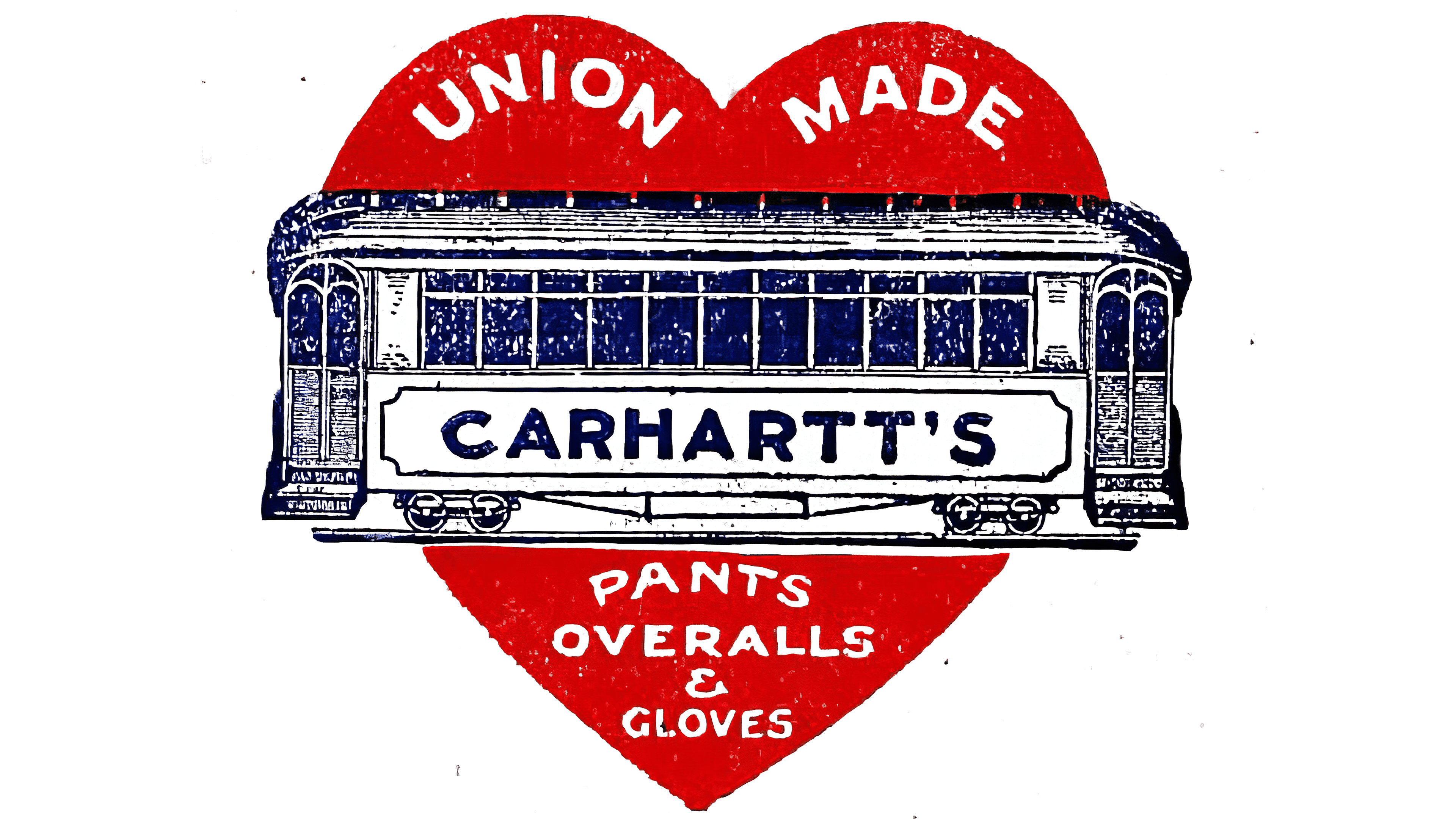
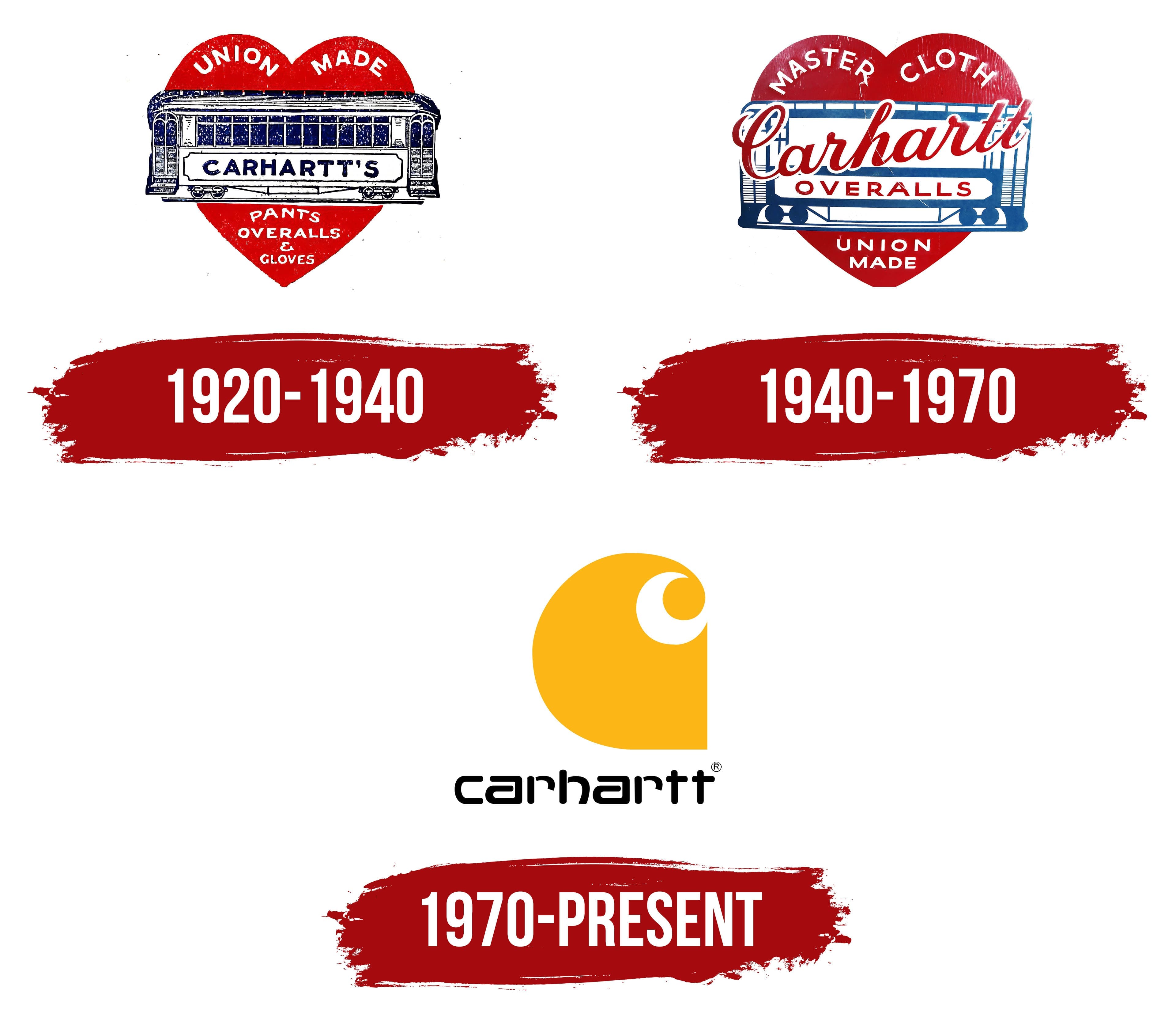
The debut emblem depicts a railway carriage with double-sided doors and hinged steps. It is painted realistically, with wheels, fasteners, windows, and a massive, sloping roof. The car is in the background of a large red heart. Several informational inscriptions appear: at the top, “Union Made” on each half of the heart; at the bottom, “Pants Overalls & Cloves” at its tip. The company’s name takes center stage along the carriage wall, under the windows. It is written in chopped type. The logo’s main colors are dark blue, red, and white.
1940s – 1970s
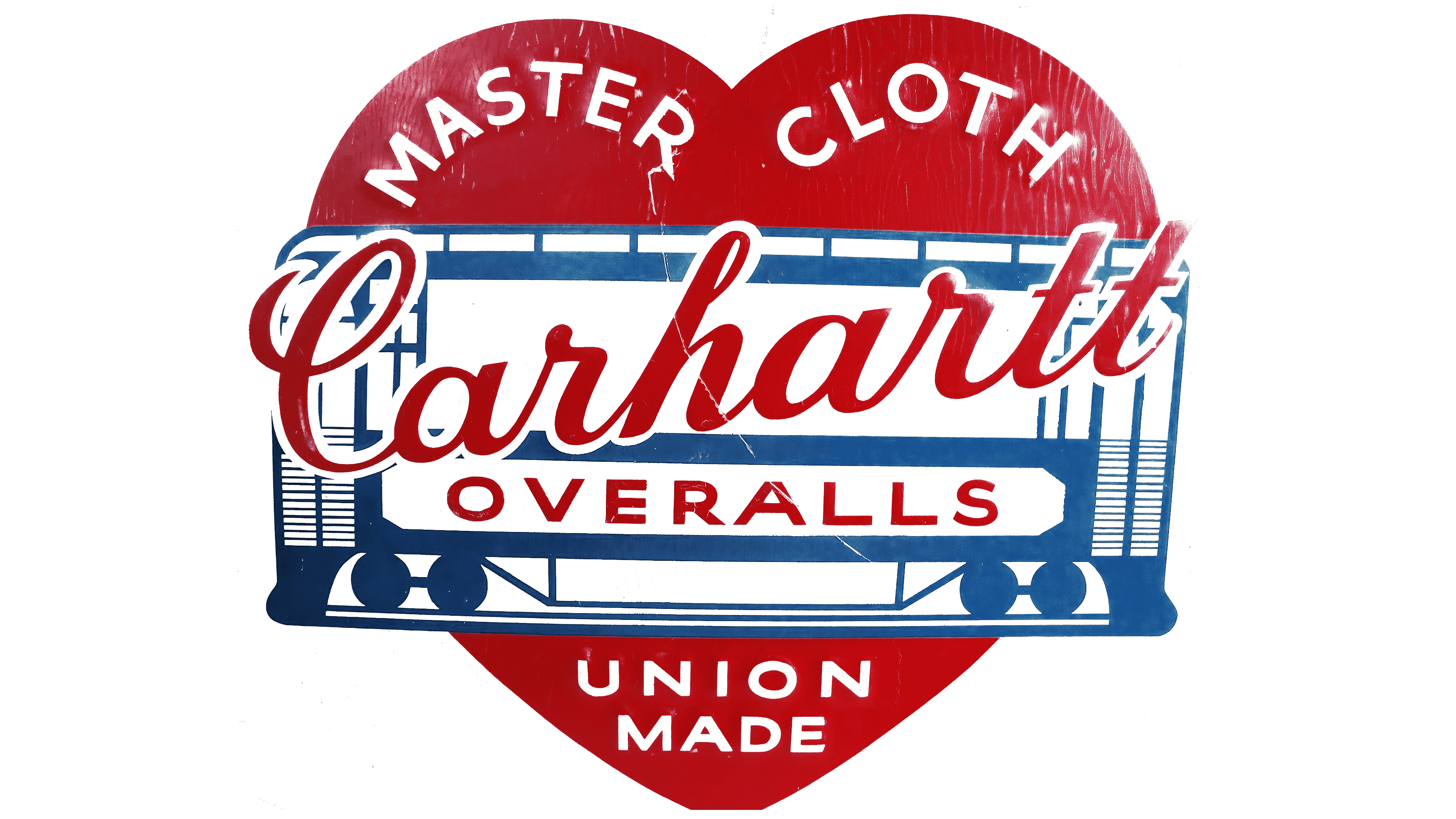
During the redesign, the text part was rearranged. Above, the phrase “Master Cloth” appeared in the center; below, “Carhartt Overalls”; below that, “Union Made.” The developers highlighted the trademark name in a consistent italic font and set it on a diagonal. They also changed the color palette: the logo authors lightened the blue by several tones and, conversely, darkened the red, adding a purple tint. They also corrected the car and gave it a contour of horizontal and vertical strips of different lengths. The wheels have become schematic, appearing as large blue circles (two on each side).
the 1970s – today

The trademark logo consists of an icon and a wordmark beneath it. The brand name is in unique lowercase letters with small curves and short strokes. The text elements reflect the company’s work direction, resembling tools or parts of various mechanisms.
Both “t” and ” r ” look like a welding electrode holder with an electrode, and “c” looks like straight and bent pipes, and “h” looks like a cab of special equipment – a high-rise crane or heavy-duty transport. In some versions, the vertical stripes are separated from the horizontal segments, emphasizing torque mechanisms and building materials.
The graphic emblem consists of a single piece in a rounded, wave-like shape. This design creates movement, even though the dynamics are hidden in the image. The beginning of the “wave” is wide, and the end is narrow, with a large dot at the top. A white crescent in the negative space is visible on the right, forming this point. To remain recognizable, Carhartt does not change or adjust its logo.
Font and Colors

The lowercase word uses an original, modern, innovative, geometric font without sharp corners or protrusions. Almost all the letters are smoothed and streamlined to resemble a Conradi or Controller Four typeface with minor tweaks. The Carhartt brand emblem color scheme is consistent, typically using black (lettering), yellow (wave), and white (background).
FAQ
What does the Carhartt heart logo mean?
The heart-shaped logo, known as the “Car in the Heart,” embodies the brand’s core values and philosophy. It is a visual identifier that reflects the company’s commitment to its employees and consumers, as well as the innovative spirit of its founder, Hamilton Carhartt.
Hamilton Carhartt strongly advocated for workers’ rights and dedicated himself to improving their lives. This emblem represents Hamilton Carhartt’s values and heritage, ensuring the brand remains true to its founding principles as it continues to grow and evolve.
Is Carhartt a luxury brand?
It is not a luxury brand, but its influence and recognition in the luxury fashion industry are significant. The brand’s genuine appeal and high-quality products have allowed it to expand beyond its workwear roots and become a modern fashion staple. It is known for durable, practical, high-quality workwear. Over time, its image has evolved, creating a unique place that combines functional workwear with stylish clothing. The brand’s ability to inspire luxury fashion while staying true to its roots shows its strong positioning in the industry.
What does the Carhartt symbol mean?
The symbol has a distinctive wave-like design that reflects the brand’s values. Inspired by the cornucopia, an ancient symbol of prosperity and nature’s bounty, the logo aligns with the brand’s commitment to providing high-quality, reliable workwear.
The wave in the logo is visually striking and suggests a continuous flow of benefits and positive results that the company provides to its users. It forms the letter “C” to represent the brand name. This design choice ensures the logo is meaningful and functional, making it easily recognizable and directly associated with the brand. Its simplicity and elegance make it stand out, resonating with longtime customers and new generations alike. Customers recognize the wave logo as a sign of quality, knowing it represents a brand with over a century of experience producing durable, reliable workwear. This trust is crucial to maintaining customer loyalty and expanding the brand’s reach.
What is the slogan of Carhartt?
Founded by Hamilton Carhartt, this family-owned company is based in Dearborn, Michigan. The brand’s slogan, “Recycle ’em All,” demonstrates its commitment to creating durable, reliable workwear for hardworking people. Known for its quality and functionality, the brand has earned a strong reputation for clothing that withstands harsh conditions. This commitment has made it a trusted name across many industries.
What is Carhartt known for?
The brand is known for its workwear, including practical overalls, fire-resistant suits, and durable jackets. It offers vests, jeans, and shirts, and designs clothing for anglers and hunters. The brand’s reputation is built on the durability and functionality of its products, making it a popular choice for reliable performance and outdoor gear.