


 Changan Logo PNG
The Changan logo’s symbols represent large machines with optimal performance and ease of operation. The emblem shows the assembly’s precision, with every part fitted perfectly to form a reliable mechanism.
Changan’s history began far from the car industry. In December 1862, Li Hongzhang founded the Shanghai Foreign Gun Bureau. This Qing-era arms plant later moved to Suzhou and then Nanjing, becoming the Jinling Arsenal. By 1899, it had about 1,700 workers and nearly 1,000 machines. After the Japanese invasion threat in 1937, the arsenal was evacuated to Chongqing and renamed the 21st Arsenal.
In 1951, it became State Factory No. 456. For almost a century, it produced weapons and ammunition before moving into vehicle production. In 1959, the factory built the Changjiang Type 46 jeep, the first mass-produced vehicle in the People’s Republic of China. Its production was limited to about 1,400 units, but it helped pave the way for the later BJ212 in Beijing.
The real civilian shift came in 1984, when Changan signed a technology agreement with Suzuki. On November 15, 1984, the SC112 microvan and SC110 microtruck became the first civilian vehicles under the Changan name. In 1996, the company was reorganized as Chongqing Changan Automobile Co., Ltd., and in 1997, it was listed on the Shenzhen Stock Exchange.
Changan Ford was formed in 2001, followed by Changan Ford Mazda in 2004, giving the company access to foreign engineering while China’s auto market expanded. Changan then built its own lineup. The Eado sedan debuted at the Frankfurt Motor Show in 2011, followed by the CS35 SUV in 2012, and later by the CS75. In 2009, Changan absorbed Hafei and Changhe. While SAIC worked with Volkswagen and GM, and Geely bought Volvo Cars, Changan relied on joint ventures and state-backed domestic brands. In December 2025, Changan produced its 30 millionth self-branded vehicle.
Meaning and History

Changan’s roots date to the mid-19th century when Li Hongzhang opened a military-grade factory, the Shanghai Foreign Armaments Bureau. It was originally located in Shanghai but was relocated to Chongqing during the Sino-Japanese War. This happened in 1937.
Car production started in 1959, when Chongqing Chang’an Arsenal, under an agreement with the government, developed and assembled the Changjiang Type 46. It became the PRC’s first production car, produced under license from Suzuki. In 2009, the company bought two small specialized firms, Hafei and Changhe. The Jiangxi provincial administration later took over the second and restructured it, eventually making it a subsidiary.
In 2010, the brand experienced two major events. First, it rose to fourth place in the country’s car production rankings. Second, the company updated its consumer-product logo, while commercial production retained the same logo: a red arched structure.
In 2012, the company was split into two new structures, Changan Ford and Changan Mazda, which cooperate with foreign car manufacturers. During this period, 72 percent of its production was passenger cars. In 2017, the company announced that it would completely reorient its sites to produce electric vehicles by 2025. Although the automobile brand dates back to 1862, its logos date back to 1957. To date, it has four emblems.
To determine the style, the logo’s creators experimented with several options. The trial ended when they turned the double arch over and shaped it into a wide “V.” As you know, this letter symbolizes victory, but here it also looks like a bird’s wings raised for flight.
What is Changan?
Changan is a brand of Chang’an Automobile Co., Ltd., China’s oldest automaker. Its history dates back to 1862, when it produced only weapons. The company now specializes in commercial transportation, passenger vehicles, electric vehicles, and SUVs. It sells them under different brands, such as Kaicene, Oshan, and Changan. The China Ordnance Equipment Group Corporation owns the company.
1957 – 1998

The debut logo was a double-arched curve that curved upwards. It was in a red oval and connected at its ends to the base figure’s bottom line. At the same time, the arch overlapped the top, making it seem as if the strip were open. As a result, four white hollow parts appeared, separated by red strokes in different configurations. An inscription was placed to the right of the graphic emblem. It was the brand name in Chinese or English, in all caps. Although all the symbols were sloping and elongated, with rounded corners, some had individual designs. For example, “A” was depicted as an isosceles triangle with a lower bar.
1998 – 2010

After tweaking, the emblem achieved volume through the correct combination of shadows and highlights on the gray. The developers retained the arch’s shape but widened the lines. They worked the same way with the oval. The letters have been changed the most. Thanks to the oblique cuts, they have become stylish and curly. Tips appeared at the ends of the “C.” The triangular “A” had its lower half shortened (improvised crossbar). The right side of “G” is now diagonal. The designers replaced the black lettering with blue.
2010 – 2020
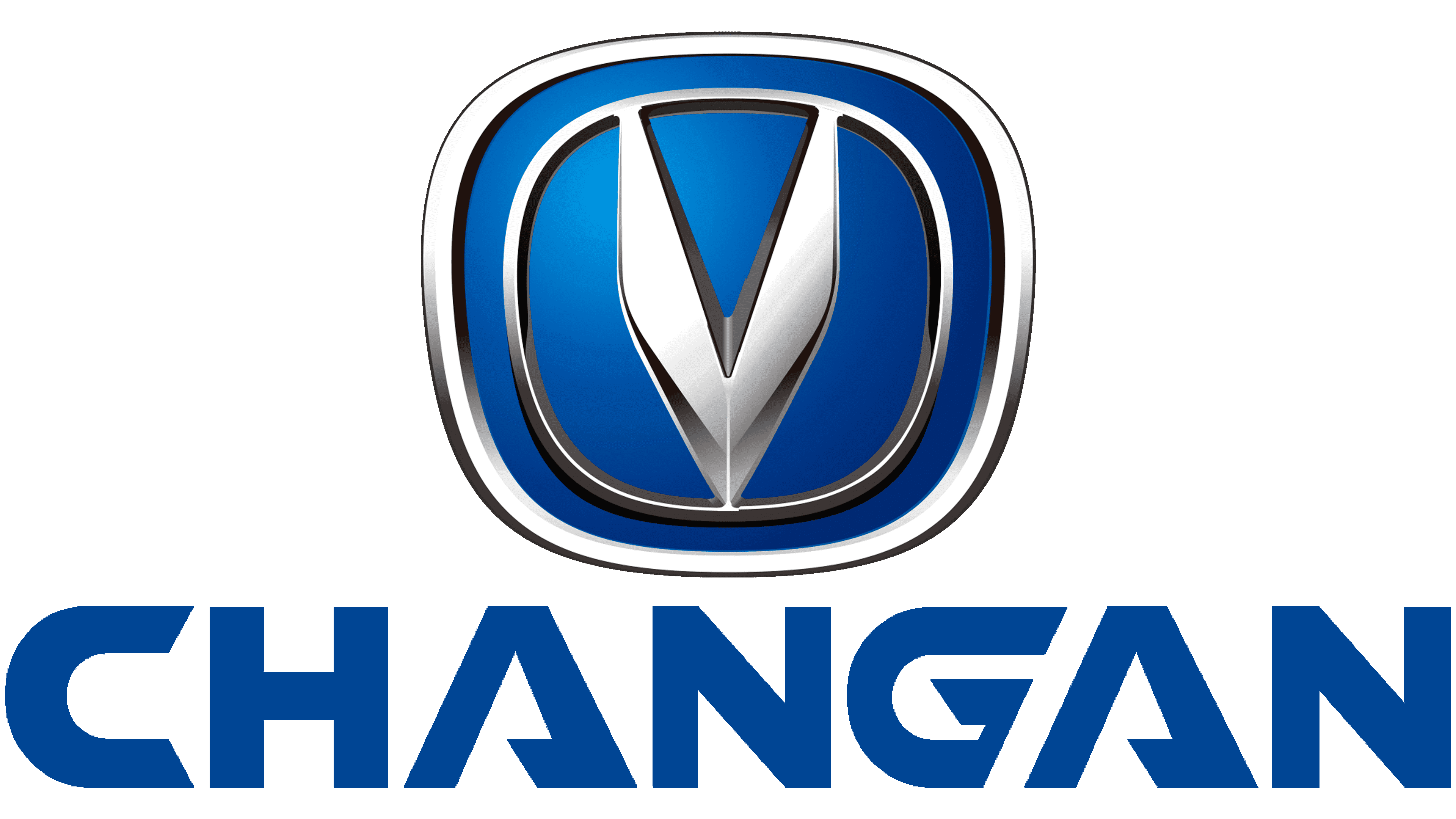
The graphics have been completely redesigned. The designers turned the emblem over, placing the arch upside down. They made a wide “V” from it, resembling two wings in flight. The oval also became elongated: it took the shape of a ring, slightly narrowed at the bottom. Behind it was a trapezoidal frame. All elements were three-dimensional and set against a blue background with gradient transitions. The inscription has remained the same.
2020 – today

The current emblem aligns with current trends in 2D-style logos, so it is flat and simple. The designers removed various special effects, visually unloading them. But at the same time, they retained the basic components: the letter “V,” a trapezoidal frame, and double edging.
Font and Colors
The inscription is set in an individual typeface in which the “A” takes the form of a triangle, with its crossbar lowered to form an edge. The letter “G” has the right side cut diagonally.
The logo’s color scheme is simple and currently consists of deep blue and white. Previously, it used black, red, and several shades of gray.