


 Coles Logo PNG
The emblem’s main motto is “Goods necessary for everyday life at affordable prices.” The Coles logo conveys vitality and a tireless desire to help customers. The sign speaks of the popularity and prevalence of chain stores.
George James Coles opened the first Coles store on April 9, 1914, at 288 Smith Street in Collingwood, Melbourne. He had worked in his father’s store in rural Victoria. He had studied the American “five-and-ten-cent” model, based on low fixed prices and high turnover. On opening day, the store promised “nothing over one shilling,” and the stock sold out.
His brothers Jim and Arthur soon joined the business. In 1921, it was registered as G.J. Coles & Coy Proprietary Limited. By 1924, Coles had nine stores in Victoria and a turnover of £840,000. That year, its central Melbourne store opened Australia’s first self-service cafeteria. On October 31, 1927, Coles was listed on the stock exchange.
By the mid-1950s, Coles stores were moving toward self-service retail. In 1960, the company opened Australia’s first freestanding supermarket in Balwyn, with parking, groceries, and household goods under one roof. In 1969, Coles partnered with S.S. Kresge to launch Australia’s first Kmart. In 1971, it cut prices on 7,000 items and introduced the Farmland private label. By 1973, Coles operated in every Australian capital city.
In 1985, Coles acquired Myer Emporium Limited for about A$918 million, forming Coles Myer Ltd., with Myer, Target, and Kmart. Myer was sold in 2006, and the group became Coles Group. Wesfarmers bought Coles in 2007 for A$22 billion, then separated it again in 2018. On November 21, 2018, Coles Group returned to the ASX under the ticker COL.
Meaning and History
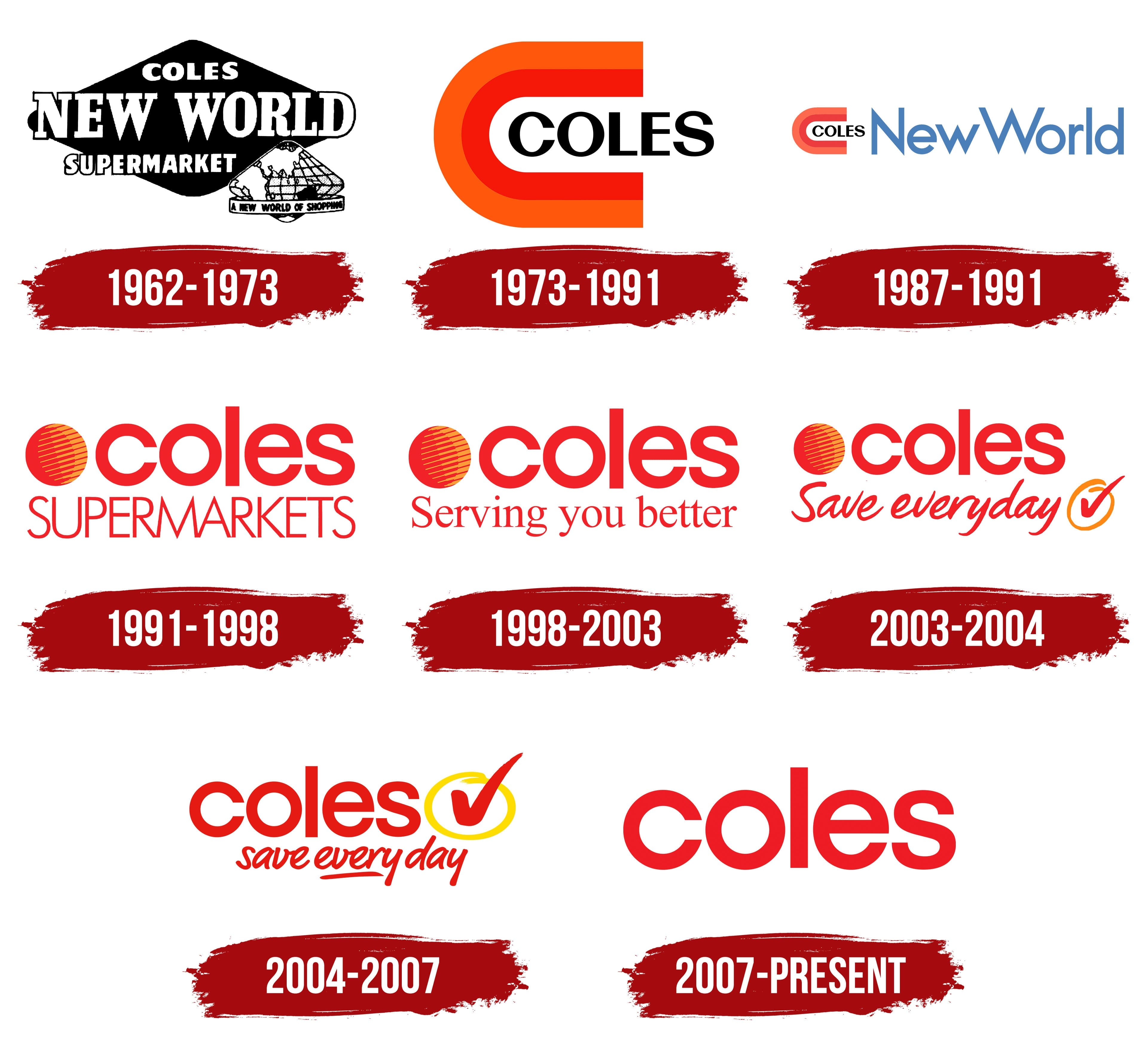
Coles Supermarkets’ visual identity is supported by a team of specialists who work across all aspects, including in-store graphics. Initially, the retailer’s marketing engine relied on slogans that emphasized low prices. They changed their logos as often as they changed their slogans because the company tried to stay relevant, regardless of the era.
George James Coles, who opened the Coles Variety Store in 1914, laid the foundation for the retailer’s growth. As the business expanded, dozens of other stores joined the first outlet. The assortment also changed constantly: it started with ready-made food, then shelves filled with electrical appliances and cosmetics. In the 1950s, supermarkets began to operate on the principle of self-service. But the history of Coles’ logos dates back to the 1960s, when the retail chain changed course and shifted its focus to food products.
What is Coles?
Coles Group Limited is an Australian company that runs retail chains. It owns major brands such as Coles Express (fuel sales), Coles Online (home delivery), Coles Liquor (liquor sales), and Coles Supermarkets (several hundred retail stores).
1962 – 1973

As part of the “tomorrow’s shops, today” program, the supermarkets were renamed Coles New World and received a new logo: two rounded rhombuses. One geometric figure was large and black. It was in the center and contained a white inscription divided into three parts: “COLES,” “NEW WORLD,” and “SUPERMARKETS.” Notably, the middle word was set in bold type with rectangular serifs, while the designers used a rounded grotesque for the outer words.
The second rhombus was shown in the lower right corner. It contained part of a map with two oceans (the Pacific and Indian), Africa, Asia, Antarctica, and Australia itself, highlighted in black for some reason. The irregularly shaped globe was encircled by a white ribbon titled “A NEW WORLD OF SHOPPING.” This slogan reflected Coles’ new concept of opening freestanding stores with a parking lot. At the time, the identity was tied to the space age, as space was seen as synonymous with innovation.
1973 – 1991
In the 1970s, the company changed its marketing approach again, emphasizing innovation and lower costs. Its logo, designed in 1973, was meant to attract even more customers, as the figure shaped like the letter “C” symbolized a magnet attracting success, affordable prices, and, of course, new customers. This “C” looked very bright because it was made of two connected orange-and-red strips. In the free space between the two horizontal strokes was the black word “COLES”; the initial letters sat inside, while the last “E” and “S” looked out. They used a high-contrast, sans-serif font. The logo change coincided with the opening of Coles stores in all Australian capitals.
1987 – 1991

Because the supermarkets were still called Coles New World, the designers reflected this in a new graphic sign. They kept the two-color “C” with the black word and added the blue word “New World” on the right in a pointed sans-serif font. The elements were very different in size: one half of the logo was disproportionately small, and the other half was too large.
1991 – 1998

In the early 1990s, the retail chain was renamed Coles Supermarkets and began to actively introduce Internet technology. At the same time, the color red became the basis of its visual identity. It was in everything, even in the logo, which now consisted of two words. At the top was the first part of the brand name, written in lowercase letters and complemented on the left side by a red-orange circle. Its slanted axis suggested a globe, so the reference to the New World space theme remained. The word “SUPERMARKETS” at the bottom was in capital letters and tightly spaced. The designers used radically different fonts so that the two lines were the same length for visual balance.
1998 – 2003
In 1998, the supermarket chain became known simply as Coles, and the logo changed slightly. The designers made the color palette less bright than before and placed the slogan “Serving you better” under the company name. They wrote it in a standard serif font similar to Times New Roman. They used this advertising slogan until 2003.
2003 – 2004
In 2003, they replaced the old slogan with a new one: “Save everyday.” The designers moved it to the bottom, changed the typeface to a handwritten style, and added a red checkmark to the right of the phrase, encircled by an orange ring. This checkmark symbolized the availability of a full assortment of everything customers might need.
2004 – 2007
After another redesign, the red-orange ball was removed, though it remained on supermarket signs until 2010. The logo’s creators made the checkmark bolder and moved it to the top, placing it to the right of the word “coles.” The ring around it became bright yellow. The slogan was slightly reduced in size, and the first “s” was changed to lowercase. At the same time, the designers emphasized the “ever” part in “everyday” to increase the semantic emphasis.
2007 – today
After 93 years, the company has a current logo, adopted after the Australian conglomerate Wesfarmers took over the chain of stores. It consists of one word, “coles,” written in the red circular font. All other elements were removed, perhaps to follow fashionable minimalism. This allowed the supermarket chain to focus only on its name.
Font and Colors
Cards, C-magnets, balloons, and checkmarks are a thing of the past – now, the Coles trademark is incredibly simple. Since its adoption in 2007, the company has had time to leave Wesfarmers and become independent again, but such large-scale changes have not affected its logo. Customers remember the trading network’s name exactly as it is today: minimalist, red, and in large letters.
The bold geometric grotesque used in the Coles wordmark has several counterparts. First, it resembles Avant-Garde Gothic Demi Bold, created by Herb Lubalin & Tom Carnase. It also resembles Touche Medium by Indian Type Foundry, Sonny Gothic Regular by W Foundry, and (to a lesser extent) Qanelas Soft Semi Bold by Radomir Tinkov.
The red color (shade PANTONE 485 C) was not chosen by chance. Its brightness attracts customers’ attention, and it is also associated with discounts, as most promotional activities traditionally use red palettes.