 Compaq Logo PNG
Based on the visual, the company continually improves its software and computer components and embraces new technologies. The Compaq logo represents a company focused on customer needs.
Compaq began in February 1982, when former Texas Instruments employees Rod Canion, Jim Harris, and Bill Murto met at House of Pies in Houston. They considered several business ideas before Canion sketched a portable IBM-compatible computer on a placemat. The name combined “Compatibility” and “Quality.” Sevin Rosen Partners backed the plan with $2.5 million, and Ben Rosen became chairman.
Compaq introduced the Compaq Portable in November 1982 and put it on sale in March 1983 for $2,995. It weighed about 11 kilograms, ran IBM PC software, and could be moved outside the office. In its first full year, Compaq sold 53,000 units for more than $111 million, an unmatched first-year result in American business at the time.
Compaq went public in 1983 and, in 1986, challenged IBM directly by launching the first PC based on Intel’s 386 processor before IBM did. In 1987, it reached $1 billion in revenue faster than any previous US company. After a downturn in 1991, Ben Rosen replaced Canion with Eckhard Pfeiffer, who cut 1,700 jobs, lowered prices, and pushed desktops, servers, and printers. By 1993, Compaq had passed IBM as the world’s largest PC maker and later expanded with Armada laptops and Presario consumer computers.
In 1998, Compaq bought Digital Equipment Corporation for $9.6 billion, but the integration proved difficult as Dell and IBM grew stronger. Pfeiffer left in 1999, and Michael Capellas took over. In 2001, Hewlett-Packard proposed a merger despite internal resistance. The deal closed in May 2002 for about $25 billion in stock. Compaq ceased to exist as an independent company, though HP kept the brand for lower-priced business and consumer computers.
Meaning and History
Nowadays, it isn’t easy to imagine life without our electronic assistants, phones, laptops, and computers, but few people know and remember how it all began. The first giants of the international market for personal computers and, later, laptops are now losing market share, replaced by more fashionable models, more aggressive marketing from newcomers, and, in general, more sophisticated ways to compete in their market segment. And yet, there is one company that has not yet lost its chips, and accordingly, the buyer: this is the world-famous PC manufacturer Compaq.
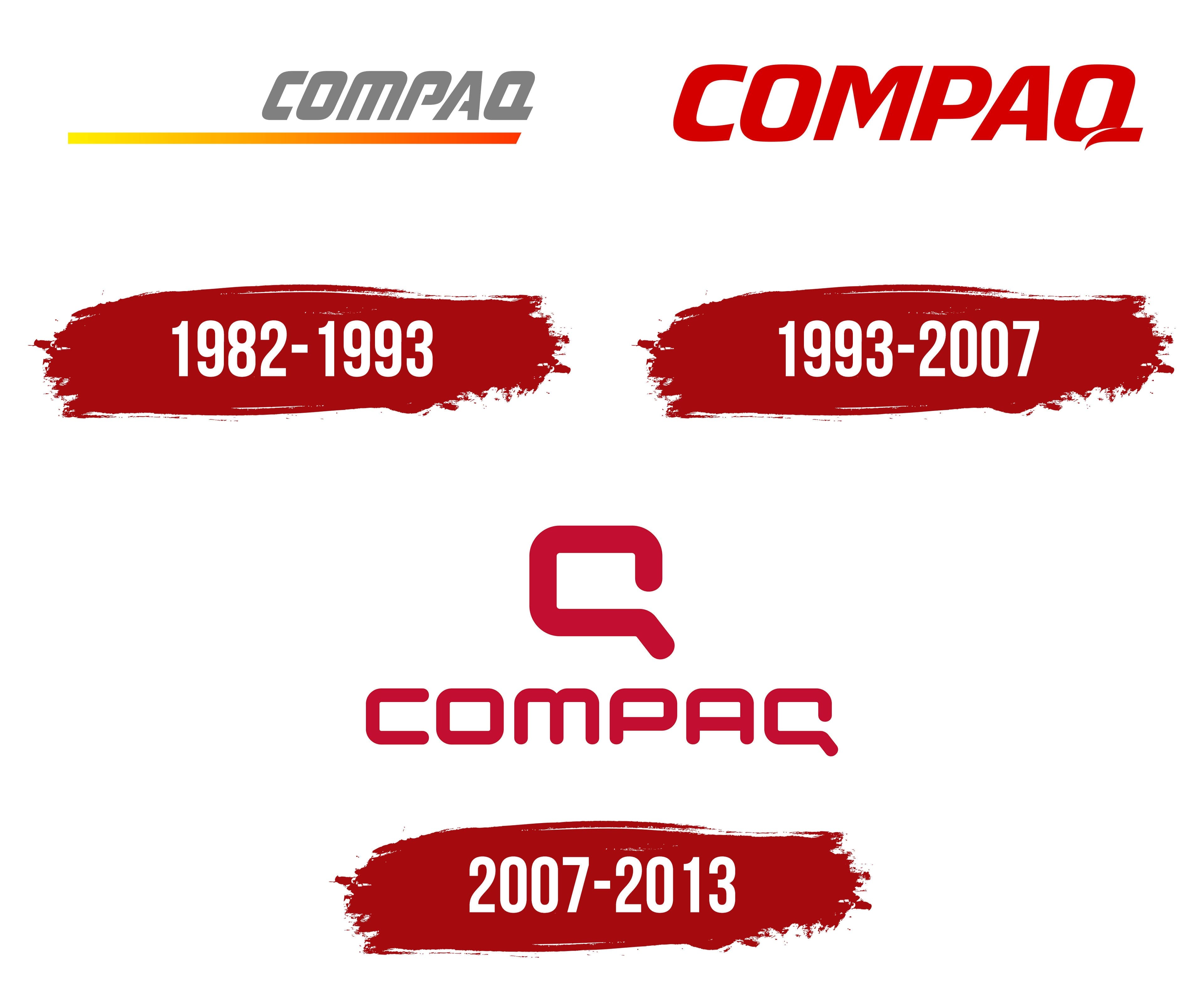
1982 – 1993

Since its founding, the company has maintained a minimalist logo style, keeping it in dark gray, simple and clear, with only the company’s name. It personifies the laconic acronym “Compatibility and quality” (in translation, compatibility and quality). The letters were presented in a slightly rounded font, tilted slightly to the right, with a yellow-to-red gradient stroke under the overall logo to add color.
1993 – 2007

Since 1993, the company’s logo has changed from gray to red, with sharper corners on the letter “M,” and the letter “Q” at the end of the tail has received a small slit. At the same time, “P” and “A” were lost. Despite the color change, the symbolism has not changed; the word Compaq has remained the company’s main logo.
Since the takeover, most of Compaq’s products have been named after the parent company, the HP 2000 series, while the company’s logo has been preserved. In 2013, it received its current look. With minor changes, it is used in the Brazilian, Indian, and Middle Eastern markets, as well as in several Southeast Asian countries.
2007 – 2013
In 2013, an updated, now-final logo was presented to the public, changing the color to scarlet and rounding the letters again; the logo did not change the recognizable word. Most importantly, the design of the last letter of the word “Q” has changed; the cut at the tail (lower right side) has expanded, resembling the Latin letter “C” – the first letter of the name, as well as the last “Q,” thereby making it possible to shorten the famous logo and make a reference, in fact, to the full name of the company. Since then, the latest models have adopted a single “Q” on their caps without risking the loss of their identity.
Font and Colors
Today’s Compaq logo resonates with a longstanding minimalist agenda. At first glance, it is monotonous and uncomplicated. But it has the same rich meaning as color if you look closely. Red-orange contrasts well against a white background; it looks energetic and draws attention. The rounded edges of the letters, the very word “Compaq” on the logo without slopes, and the “Q” and “C” combined into one semantic field, as if they say to the consumer: “We are reliable and up-to-date.”