


 Correos Logo PNG
The Correos logo demonstrates a deep connection to the historical roots of Spanish mail. That’s why it’s included among the national treasures. Its simple design balances straight and curved lines, creating a recognizable symbol.
Correos traces its origins to a private system run by the Tassis family, who held exclusive rights to postal services in Spain for two centuries. Couriers delivered royal decrees on horseback, publicly announcing arrivals and verifying recipients’ identities with witnesses.
On July 8, 1716, King Philip V transferred control to the state by appointing Juan Tomás de Goyeneche as superintendent. This marked the start of a centralized postal system, with the crown managing tariffs and operations.
Expansion followed. In 1756, the crown introduced trained postal workers, and in 1760, the first mailboxes appeared. On January 1, 1850, Spain issued its first stamps with Queen Isabella II, shifting payment to the sender and increasing mail volume.
Telegraph services developed in parallel. The first line opened in 1854 between Madrid and Irún, and by 1865 the network had grown to over 11,000 km. In 1889, the Cuerpo de Correos formalized a national postal workforce, and in 1900, maritime routes were integrated from the Compañía Transatlántica Española.
In the early 20th century, new services emerged. Express mail began in 1905, postal savings in 1916, and airmail in 1919, with routes such as Barcelona-Alicante. Rail remained the dominant delivery method until 1993.
In 1909, postal and telegraph services merged to form the Servicio de Correos y Telégrafos. Postal codes were introduced in 1981. In 2001, the system became Sociedad Estatal de Correos y Telégrafos, S.A., under SEPI.
Facing competition from DHL and FedEx, Correos launched Correos Express in 2019 and expanded into Portugal, entering the cross-border parcel market.
Meaning and History
The Spanish postal service dates back a long time. It was established in the early 18th century as a private courier service owned by the Italian Tasso family. These representatives of the Italian aristocracy took it upon themselves to develop the postal service in Europe, starting in Italy, Spain, France, Switzerland, and other countries.
Correos messengers distributed royal decrees and other correspondence throughout the country. They arrived in towns and villages, blew a horn to summon the population to the central square, read the decree, and handed out letters if three witnesses confirmed the person’s identity.
The organization of such a service was so successful that, on July 8, 1716, King Felipe V issued a decree nationalizing courier delivery. The founders were compensated and also granted high titles.
From 1756, the state postal service employed only specially trained postmen, who, under royal protection, delivered shipments throughout the country and to neighboring France and Andorra.
In 1760, Spain saw its first mailboxes; from 1850, postage stamps featured an image of Queen Isabella and the words Correos (mail) and Franco (paid).
From the end of the 19th century, the post office was allowed to provide banking services. Today, the state mail has over 12,000 branches, employs 55,000 people, and handles almost 6 billion shipments annually.
The Correos logo holds significant historical importance for Spaniards and has artistic value, as it was created over 300 years ago.
What is Correos?
Correos is the trade name for Sociedad Estatal de Correos y Telégrafos. This Spanish company transports goods, delivers parcels, and handles correspondence. It is one of the oldest postal services, with over 300 years of history. Over time, it has expanded its network to 10,000 branches.
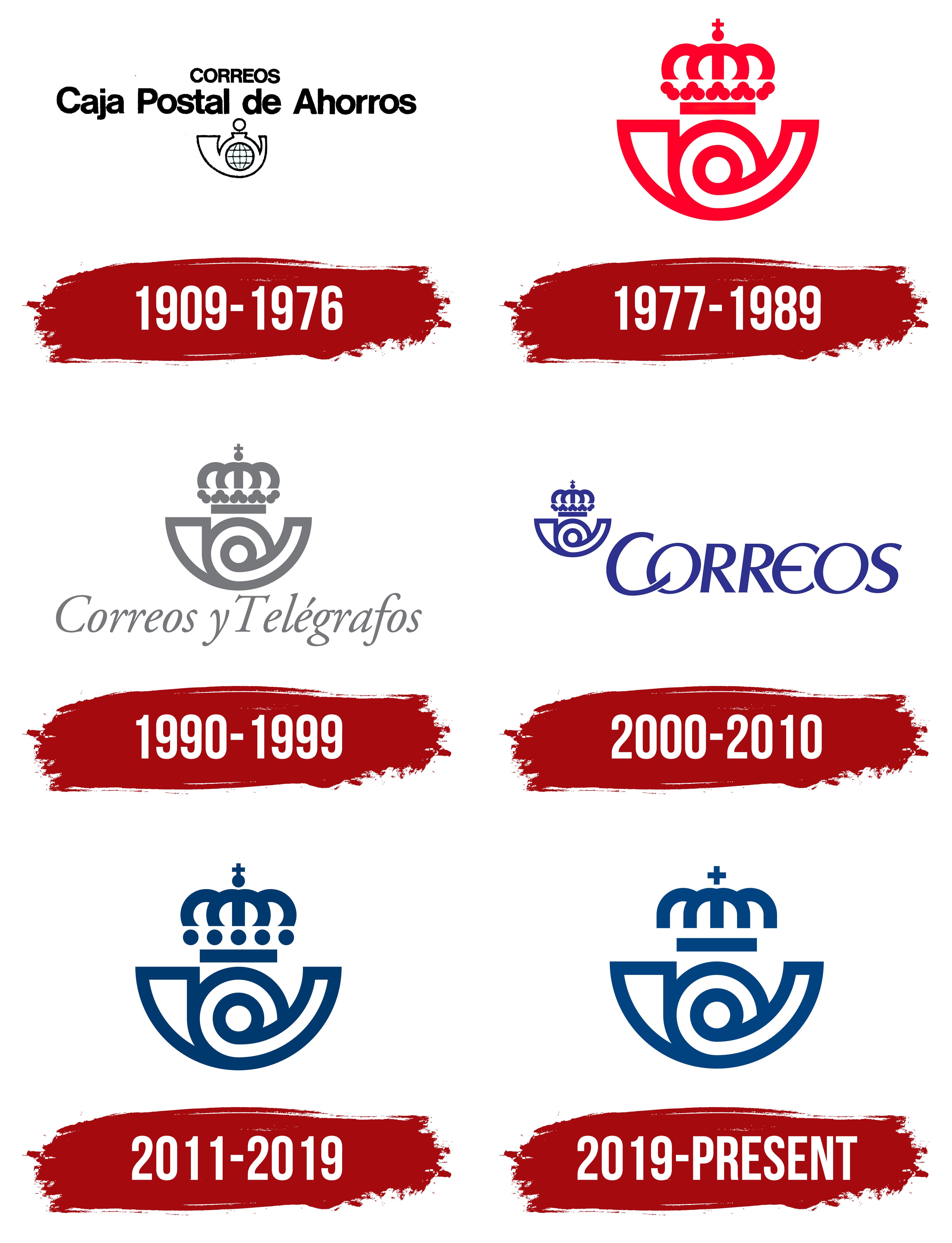
1909 – 1976

Initially, the courier service’s uniforms and carriages featured the family crest of its founders, the aristocratic Tasso family, and the universally accepted postal symbols of the time: a horn and a cross. The color scheme was blue, yellow, and white. When the enterprise became state-owned, the emblem was removed and replaced with the royal crown; yellow was replaced with gold, and white with royal red. Thus, the Correos coat of arms, in addition to the dark blue used by European postal services, adopted the colors of the Spanish flag.
1977 – 1989

The previous emblem lasted until 1977, when management decided to refine it and modernize it. The horn and crown were stylized, and a thick stripe was added beneath them, with the English word “Post” written on it. Below the postal service name, Correos, the letter “e” was specially written as “ë.”
A unique Monotype-based font was developed specifically for this. It was named Postman in honor of all mail carriers worldwide. The color scheme remained unchanged: blue, yellow, and red.
1990 – 1999
In the early 90s of the last century, the logo changed somewhat, and the inscription at the bottom was expanded to include the words Correos y Telégrafos (Mail and Telegraph). The royal red color, which signified that Spain was a republic even though the king was still in power, was removed from the logo. It was replaced by dark gray, almost black (it was called “gray” at the presentation), and the logo now looked like this: on a dark rectangle, a yellow circle with the postal emblem inside, and at the bottom, the inscription “Correos y Telégrafos”.
2000 – 2010

Another change to the logo: the words “and Telegraphs” were removed, and the black background was replaced with dark blue.
2011 – 2019
Along with this variant, only the round yellow part with the emblem has been used in recent years, without the inscription. In 2010, a pan-European study concluded that the smaller and more minimalist the logo, the better for the environment, as it uses less ink and fewer chemicals. As part of this eco-branding, Correos significantly lightened its emblem: removed the dark blue background, made the yellow uncolored and saturated, simplified the crown and the adjacent elements above it, and reduced its base to dots.
But the logo remained recognizable, and the Spaniards were very proud of it. The Correos logo is a thread that connects people worldwide, past and present. It is called the national heritage of the country and its people.
2019 – today
In this version of the Correos logo, the dots near the base of the crown were removed. All other elements remained in place.
Font and Colors
The modern Correos logo embodies the postal service’s historical values. It consists of two elements: a crown with a cross and a swirling horn, which have become the brand’s main identifiers. The crown is not just a symbol of royal authority. It also signals that the company once belonged to the titled Count family. The horn is an ancient musical instrument used by mail carriers to gather people in the main square.
Inscriptions appeared on the logo from 1909 to 1976, 1990 to 1999, and 2000 to 2010. Initially, it read “CORREOS Caja Postal de Ahorros” in a sans-serif font. In the 1990s, the words “Correos y Telégrafos” appeared, highlighted in italics. In the early 2000s, “CORREOS” was written in stylized italics, with the letters “CO” connected and a rounded “E.”
The palette has also changed several times. The emblem was originally black, red, gray, and purple, but later adopted its current shade of blue. But only the outlines are colored; the rest of the image is white.