


 Costa Logo PNG
The Costa logo signals comfort, convenience, and friendliness. The tourist emblem represents first-class service, excellent cabins, a pleasant atmosphere, and responsible staff. To present itself in a favorable light, the company drew on simple yet elegant symbolism and classic design.
Costa Cruises began in 1854 in Genoa, when Giacomo Costa founded a trading company that imported olive oil. For decades, the family business operated via Mediterranean trade routes and had no connection to passenger travel. In the early 20th century, Costa bought cargo ships to control its own logistics, moving olive oil, textiles, and other goods between European and African ports.
Costa entered passenger service after World War II. In 1948, Costa converted the cargo ship Anna C into a passenger ship and carried mostly Italian emigrants from Genoa to South America. Routes to Argentina, Brazil, and Venezuela became the company’s first regular passenger business during postwar Italy’s economic hardship.
In the 1950s, Costa began treating sea travel as leisure rather than just transport. Its first cruise routes covered the Mediterranean and the Caribbean. From the 1960s to the 1980s, the company expanded its fleet and audience as Italy’s middle class grew. Costa built its image around Italian service, food, and onboard style. In 1986, Costa Crociere listed shares on the Italian stock exchange to fund further growth.
In 1997, Carnival Corporation bought a 50% stake in Costa Crociere, then took full ownership in 2000. Costa kept its Italian brand inside the world’s largest cruise group while competing in Europe with MSC Cruises and Royal Caribbean. On January 13, 2012, Costa Concordia capsized near Giglio Island off Tuscany, killing 32 people. Captain Francesco Schettino was later convicted of manslaughter and abandoning ship.
Meaning and History
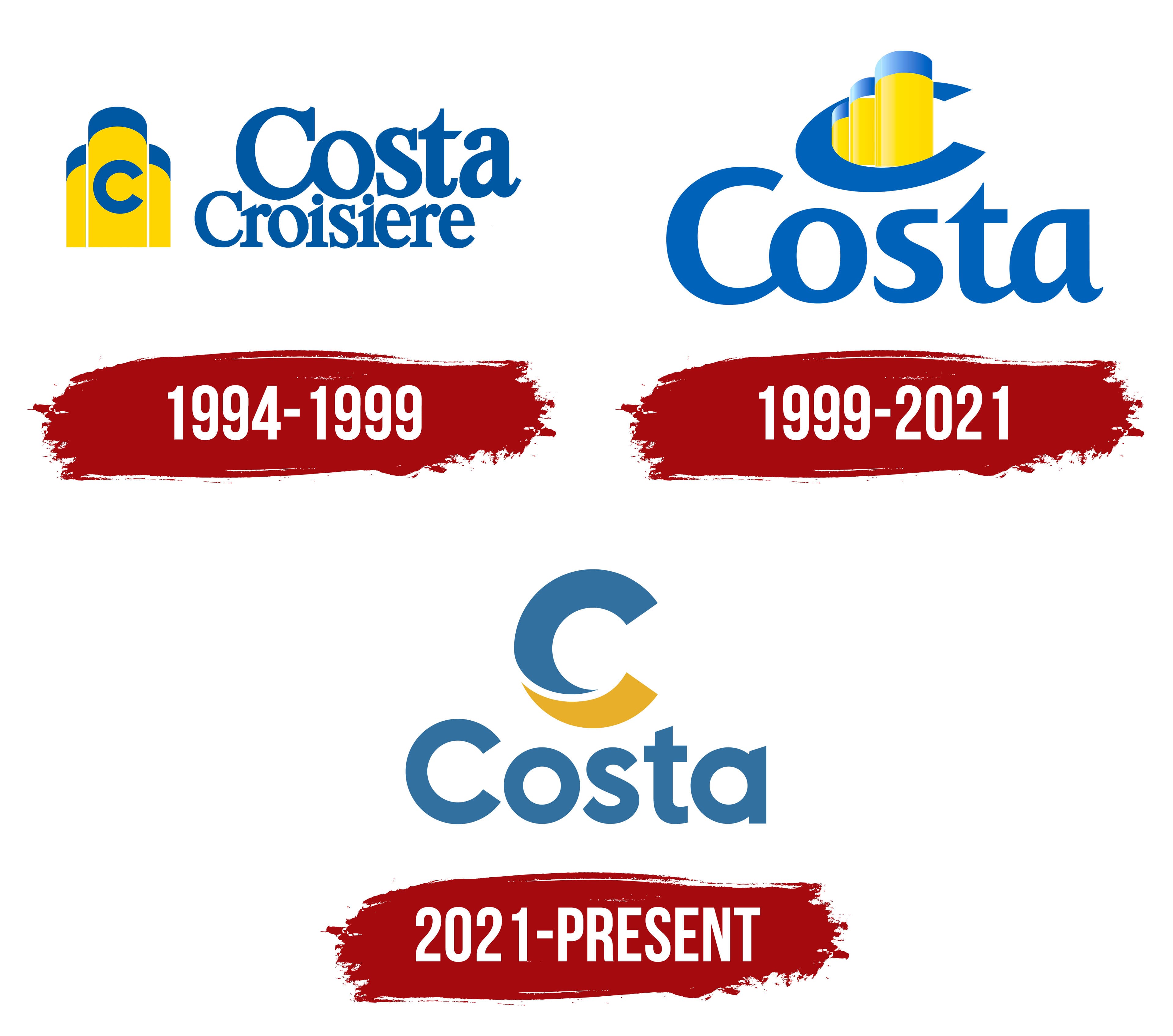
Brand recognition is high among sea travel enthusiasts. Three variants of the Costa Cruises logo have been used throughout the company’s existence. With similar styling and a yellow-and-blue color palette, they all look almost identical.
Costa Cruises focuses on three main areas: cruises, food, and sustainability. Therefore, the brand’s future development will be worth watching, given the project’s ambitions.
What is Costa?
This is one of the most famous brands associated with sea cruises. Every year, up to 10 million people use Costa Cruises, bringing the company billions of dollars in revenue.
1994 – 1999

The first version of the logo was introduced in 1994. It was a verbal inscription and an emblem depicted on the left. More specifically, it shows three steamship pipes pressed together. Most are painted yellow, with only the tops in blue. The middle pipe shows the first letter of the name, “C.” It’s an uppercase blue letter in a classic bold sans-serif.
On the right, the company’s name is presented in two lines, namely “Costa Crociere.” It also uses a classic bold sans-serif with rounded ends. Because some letters have connecting lines, we can also discuss italics. All letters were dark blue. The first word is slightly larger than the second.
1999 – 2021

The first redesign brought two new logo variations. One was used for the international market, and the second was Costa’s Italian version.
The main logo also served as the emblem, with the company name at the bottom. The pipe layout has changed; they now run diagonally, and the first one seems much closer to the user than the last. The letter “C” now wraps around the pipes instead of sitting on them. The font for the “Costa” wordmark remains the same, but it now features a blue gradient, making the logo even more eye-catching.
The Italian version of the Costa Crociere logo is as close as possible to the generally accepted one, but an additional line reading “Crociere” has been added.
2021 – today

The latest redesign to date took place in 2021. As a result, the logo has become simpler and more concise. Costa removed the pipes, which means the image references the cruise theme less. The emblem was a wave-shaped letter “C,” with the top painted blue and the bottom yellow. A white horizontal line separated these colors. The emblem looks three-dimensional and modern, and arouses genuine interest in the target audience.
The font for the word inscription was also simplified. The letters had no elongated lines and looked more natural. The blue color remained unchanged, but the gradient was removed.
Font and Colors

The logo was based on a classic bold sans-serif font. The first versions also used italic elements, which made the inscription feel more handwritten and interesting. However, later simplification gave it a more confident look.
A pleasant yellow-and-blue color palette was chosen for the Costa logo. Yellow can represent the sun, while blue can represent the sky and the sea. Moreover, bright shades evoke positive emotions and encourage people to change their lives and take a trip on a luxury liner from a world-famous company.