


 Cotton Bowl Classic Logo PNG
The Cotton Bowl Classic logo highlights the sporting prestige and historical significance of the popular American football bowl game. Its clear design reflects the event’s tradition, competitive character, and national recognition.
The Cotton Bowl Classic began with Texas oilman J. Curtis Sanford, who watched SMU face Stanford at the Rose Bowl in January 1936 and decided Dallas needed a comparable event. He formed a committee, rented Fair Park Stadium, and financed the venture himself. On January 1, 1937, TCU beat Marquette 16-6 before 17,000 spectators, but Sanford lost $6,000 on the game and about $100,000 over the next three years.
A 1940 agreement guaranteed the Southwest Conference champion a place in the bowl. Texas A&M and Fordham filled the stadium in 1941, giving the event a permanent conference base. In 1948, the meeting with Penn State became the first interracial football game played in Texas. In 1960, Syracuse defeated Texas 23-14 and completed an undefeated national championship season.
The match first aired nationwide in 1953, expanding its audience and attracting national sponsors. The 1966 LSU-Arkansas contest was the first edition with Black players on both teams. In January 1979, Notre Dame trailed Houston 34-12 in severe cold. Joe Montana, treated for hypothermia with chicken soup, returned and directed a 35-34 comeback in the final seconds, creating the game’s enduring nickname, the Chicken Soup Game.
After the Southwest Conference dissolved in 1996, organizers developed new ties with the Big 12 and SEC. In 2010, the game moved from its historic Dallas stadium to AT&T Stadium in Arlington. It entered the College Football Playoff rotation in 2014 as one of the New Year’s Six bowls.
Meaning and History

What is Cotton Bowl Classic?
It is one of the most famous college football bowl games, held annually in Texas. Its name reflects the region’s history with cotton farming. The game traditionally takes place around New Year’s and is considered one of the elite college football events. It often determines semifinalists for the national college championship. The event features a large fair, a parade, and a festive atmosphere, attracting tens of thousands of spectators.
1937 – 1988

In the late 1930s, when the game had already established itself as an annual sporting event, it received a distinctive emblem. This logo lasted over half a century, accompanying every edition of the Cotton Bowl Classic through 1988. At the time, the tournament lacked a title sponsor, and all communications were unified under the “Cotton Bowl” name.
The visual composition featured an oval shape with a yellow border resembling an American football outline. The interior was green, and at the center was a minimalist, stylized depiction of an open cotton boll. Dark outlines around the ball provided a subtle sense of depth.
Black segments with white uppercase lettering appeared along the top and bottom arcs of the oval. The top text read “COTTON BOWL,” and the bottom said “CLASSIC.” The typeface had bold, straight lines with tight letter spacing, ensuring compactness and readability against the vivid background.
The palette relied on the contrast between three dominant colors: green, yellow, and black, with white accents in the typography and central emblem.
The primary symbolism directly referenced the tournament’s name. The cotton boll represented the region’s agricultural heritage. At the same time, the oval frame echoed the shape of a football, combining rural and sporting themes into one visual concept.
1989 – 1995

Beginning in 1989, the tournament introduced a new partnership format. Mobil Oil became the event’s first title sponsor, officially renaming the tournament the “Mobil Cotton Bowl Classic.” This prompted a comprehensive redesign of the visual identity used through 1995.
The new composition vertically arranged the sponsor’s name and tournament title into a unified text block. “Mobil” stood out: the letter “o” was in vivid red, while the remaining letters were dark blue. Below, in matching dark blue, were the words “Cotton Bowl” and “Classic,” set in large type and neatly aligned.
To the right was a square-shaped emblem with rounded corners, featuring an abstract silhouette of a cotton boll. The simplified, geometric lines lent a modern, streamlined appearance.
The sans-serif typography featured uniform strokes and clear proportions. Letter spacing was designed to visually interlock characters, forming a solid text block.
The palette utilized high-contrast blue and bright red. The occasional white background intensified the visual accents and maintained the composition’s clarity.
The emblem continued to reference the region’s agricultural heritage, albeit through simplified iconography, which facilitated reproduction in print and broadcast media. Integrating Mobil’s branding made the logo part of the sponsor’s broader advertising strategy.
1996 – 1999

September 1996 marked the beginning of a long-term partnership. Southwestern Bell became the tournament’s title sponsor, securing a contract through 2006. A new logo, introduced that year, was used for four seasons. Beyond its visual function, the logo became integral to a broader range of events. Southwestern Bell organized a Corporate Hall of Fame, children’s art competitions, and a parade during the State Fair of Texas, connecting the brand to regional culture and community engagement.
The design featured a three-level structure. At the top was the inscription “SOUTHWESTERN BELL,” in a narrow, sans-serif typeface rendered in blue. Between the two words appeared a small emblem depicting a simplified cotton boll enclosed within a red square frame. The symbol’s proportions ensured it did not dominate the composition.
Below, a thin horizontal yellow line separated the top portion from the central text block. The middle prominently displayed “COTTON BOWL,” in all-uppercase letters, bold stroke weights, and vivid red coloring. The composition’s lower boundary featured the word “CLASSIC” in smaller blue letters with wider spacing.
Typography throughout the logo was sans-serif, characterized by straight verticals and smooth curves, imparting a strict, contemporary feel. Letter spacing in the top and bottom lines was looser than in the bold central text, balancing the overall visual impression.
The palette, combining blue, red, and yellow, ensured strong visual contrast.
The cotton symbol remained the visual link to the tournament’s history. At the same time, the inclusion of vibrant accent colors reflected Southwestern Bell’s corporate aesthetic.
2000 – 2005

At the start of 2000, the tournament updated its branding to align with the sponsor’s unified corporate identity. Southwestern Bell Corporation had changed its official name to SBC Communications Inc. back in 1995. Still, it gradually phased out its old name from marketing materials. While Cotton Bowl Classic logos from 1996 to 1999 continued to reference Southwestern Bell, from 2000 onward, the tournament was officially named the SBC Cotton Bowl Classic, as reflected in the logo.
The top part of the new logo featured the sponsor’s emblem: a large blue abbreviation, “SBC,” crossed by distinctive curved elements. Below, the word “COTTON” appeared in bold red uppercase letters with black outlines and serifs. Beneath that, the word “BOWL” appeared in the same style, with the letter “O” replaced by a stylized cotton boll depicted in blue and white, replicating the design used in earlier versions.
At the bottom was the word “CLASSIC,” displayed in smaller, red sans-serif letters, completing the vertical structure. The substantial scale and thick strokes gave the lettering visual weight, while outlined details enhanced readability in both large and small formats.
The color palette remained consistent: blue and red, with neutral white and black outlines. This ensured brand recognition and maintained continuity with previous iterations.
The cotton symbol integrated into the word “BOWL” maintained the historical and regional associations. At the same time, the SBC logo at the top emphasized corporate affiliation.
2006 – 2007

January 2006 marked the beginning of a new visual phase for the tournament. The merger between SBC Communications and AT&T led to a new title sponsor. On January 2, during the 70th Cotton Bowl Classic, the new emblem featuring AT&T’s corporate identity was introduced.
The design took the shape of a shield with gently rounded top corners and a pointed base. The shield’s background featured a blue horizontal gradient transitioning from darker to lighter shades. In the upper area was the AT&T corporate logo: a lowercase white “at&t” inscription beside the iconic globe depicted in alternating blue and white stripes.
Across the center was a horizontal white banner bearing the large, curved word “COTTON,” set in geometric red letters outlined in black and white. Below this appeared the word “BOWL,” styled similarly but smaller, with the letter “O” replaced by a stylized cotton boll rendered in black-and-white contrast. At the bottom of the shield, the word “CLASSIC” appeared in a thin, sans-serif white font.
The typography used a custom geometric sans-serif typeface with slab elements, resembling Verismo Bold or Addressotype Slab Solid, but with modified shapes for added distinctiveness.
The palette included dark blue, bright red, neutral white, and black, providing strong visual contrast and ensuring readability on various backgrounds.
Symbolically, the emblem combined corporate elements with the tournament’s historical themes. The AT&T globe conveyed the sponsor’s international presence, while the cotton boll maintained regional and cultural associations. The shield shape emphasized the tournament’s prestige.
2011

The tournament’s 2011 anniversary prompted the creation of a special logo. Celebrating the Cotton Bowl Classic’s 75th year, the logo temporarily replaces the standard branding used during the 2008–2010 and 2012–2014 periods and appears exclusively this season.
The emblem was a stylized shield with expanded side elements. At the top was the AT&T sponsor logo: a blue globe with white arcs, with a lowercase “at&t” inscription in white. Beneath, on a blue background, appeared the centrally aligned, sans-serif white inscription “COTTON BOWL CLASSIC.”
The focal point was the large number “75,” prominently displayed in vibrant orange with outlines. The second digit incorporated the cotton boll symbol within the top portion of the “5,” merging the anniversary number with the tournament’s traditional emblem.
On each side, horizontal blue extensions featured the dates “1937” and “2011,” set in white uppercase characters, accented by thin horizontal lines above and below. A dark blue background provided visual balance to the emblem.
The anniversary logo’s typography retained geometric precision, using sans-serif letters for optimal readability at all sizes. Large numerals included beveled inner corners and slight diagonal cuts to add a dynamic appearance.
The palette consisted of dark blue, orange, white, and light blue colors, all of which aligned with the sponsor’s corporate identity, creating a festive yet sophisticated impression.
2008-2010, 2012-2014

Following the anniversary logo, the Cotton Bowl Classic continued to use AT&T branding. The logo, used through the end of the 2014 season, retained the familiar shield shape but featured a new color palette with a bright orange gradient, creating a dynamic, contemporary appearance.
At the top arc of the shield was AT&T’s corporate symbol: a blue globe with white stripes and the lowercase “at&t” inscription. Below, on a white horizontal banner, was the word “COTTON,” rendered in large, geometric light-blue letters, with clear vertical lines and neatly defined interiors.
In the lower portion of the shield, on an orange background, appeared the word “BOWL” in the same style but smaller. The letter “O” was replaced by a stylized cotton boll rendered in blue and white. Below this was the word “CLASSIC,” set in white uppercase sans-serif letters with even spacing.
The palette consisted of vivid orange, blue, white, and dark blue, creating high contrast and drawing attention to the key text elements.
2015 – today
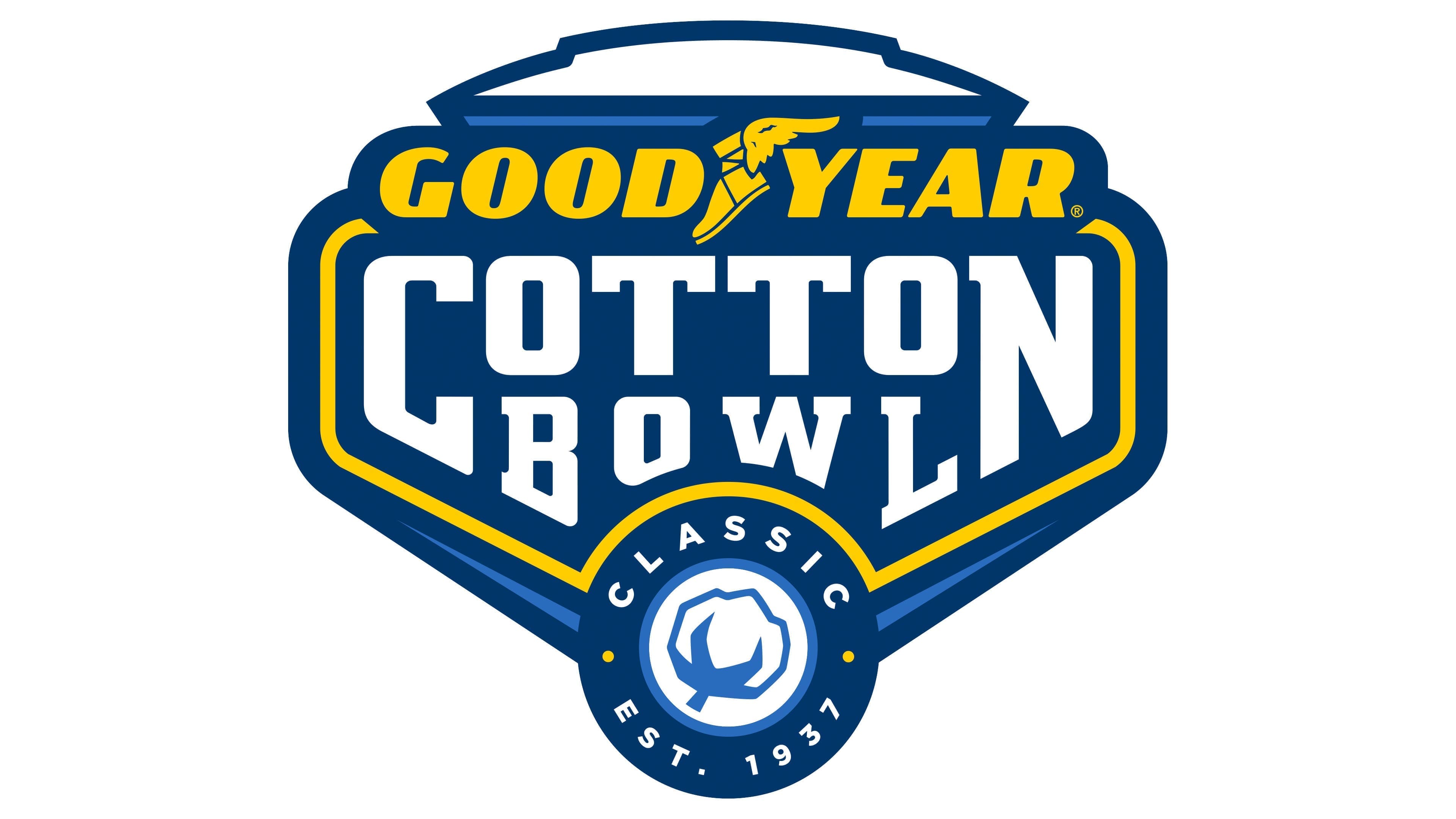
In November 2014, a long-term partnership with Goodyear was announced, beginning in January 2015, and the tournament was renamed the Goodyear Cotton Bowl Classic. The new visual identity was developed by Dallas-based agency Torch Creative. Work began in August 2014, initiated by the Cotton Bowl Athletic Association, to mark the start of a new era of sponsorship.
The logo’s shape is based on a shield design, with the top portion referencing a tire tread pattern and traditional Goodyear signage. At the top, the yellow inscription “GOODYEAR” incorporates the iconic winged-foot symbol into the lettering. The primary section of the shield features a dark blue background with large white letters spelling out “COTTON” and, below, the word “BOWL,” both centered and outlined in thin yellow.
The typography for “COTTON” and “BOWL” was custom-designed, inspired by Goodyear’s brand lettering but with modified proportions and internal spacing. The typeface features slab serifs and tight composition, giving the structure weight and stability.
At the bottom of the shield is a circular element with the inscription “CLASSIC EST. 1937” along its perimeter and a stylized white cotton boll in the center. This symbol visually links the modern logo to the tournament’s history.
The palette comprises dark blue, white, and yellow. Blue dominates, providing depth and reliability; yellow serves as an accent, reinforcing Goodyear’s corporate identity; and white appears in text and the cotton symbol, creating clear areas of contrast.
Overall, the logo emphasizes the event’s prestige and strong partnership with the new title sponsor.
Font and Colors
The visual focus is created by a substantial text block executed in a custom slab-serif style with straight strokes and slightly squared terminals. Letters have a dense, consistent structure and uniform height, giving the text stability and highlighting the tournament’s name. Compared with commercial typefaces, the closest matches are Verismo Bold and Addressotype Slab Solid. However, significant modifications were made: vertical strokes were thickened, inner proportions were adjusted, and stroke junction angles were refined.
The color scheme is built around dark blue as the foundational tone, contrasted by white fills and vivid yellow accents. Blue dominates the shield’s field and primary text, reinforcing the emblem’s authoritative, confident character, while yellow highlights the Goodyear brand section, thereby improving recognition. White distinguishes text elements and the cotton symbol, providing clean areas for visual clarity and heightening overall contrast.