


 Daewoo Logo PNG
Smooth, graceful lines make the Daewoo logo elegant and regal. The emblem suits cars defined by convenience and beauty. The sign’s elements convey the brand’s prestige and technical excellence.
Daewoo was founded in Seoul on March 22, 1967, by 27-year-old Kim Woo-jung as a small textile export company with $18,000 in capital. Its growth followed South Korea’s state-led industrialization. In 1975, Daewoo received a general trading company license, gaining access to export privileges and subsidized financing. During its first decade, Daewoo moved into heavy industry, shipbuilding, construction, electronics, and cars. In 1978, it bought Saehan Motors, later renamed Daewoo Motor in 1983.
In 1986, Daewoo formed a 50-50 joint venture with General Motors to use Western technology to build affordable cars for global markets. Hyundai and Samsung expanded in parallel, each following a different industrial path.
By the mid-1990s, Kim pushed the Vision 2000 plan to make Daewoo Motor one of the world’s top 10 automakers. In 1995, Daewoo bought a 60% stake in Poland’s FSO for $1.1 billion and built plants in Romania, Uzbekistan, Egypt, China, India, and Vietnam.
The expansion hid heavy debt and accounting fraud. After the Asian financial crisis of 1997-1998, Daewoo kept acquiring companies, while Hyundai and LG began restructuring. On November 1, 1999, Daewoo filed for bankruptcy with about $50 billion in debt. Most assets were sold off. Kim fled to Vietnam, returned in 2005, and was arrested. In 2006, he was sentenced to 10 years for fraud and embezzlement. General Motors bought Daewoo Motors in 2002, and it became GM Korea. Shipbuilding survived as Daewoo Shipbuilding & Marine Engineering. At the same time, the Daewoo name remained only as a licensed brand in some markets.
Meaning and History
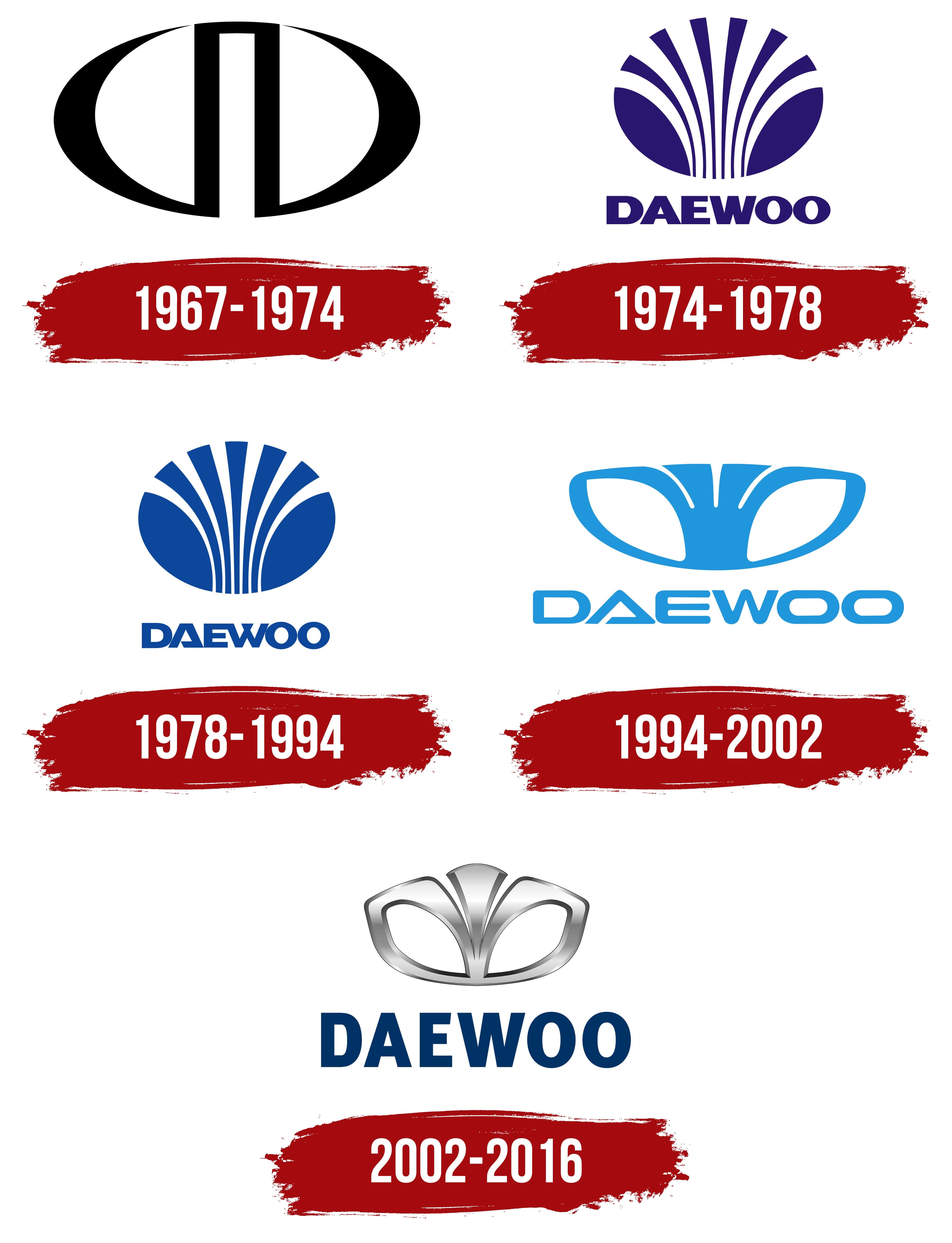
Daewoo Motor Co., Ltd. was part of the Daewoo Group in 1978, when the conglomerate acquired Saehan Motor. However, it became a legally independent unit only in 1983. Later, due to financial difficulties, General Motors acquired the division in 2001. Until 2011, some countries, such as Vietnam and South Korea, still used the original Daewoo emblem. Now, the company’s factories produce cars only for Asian consumers. The subsidiary, which produced commercial vehicles, was acquired by the Indian corporation Tata Motors.
At the same time, many Daewoo models were renamed. In 2004, General Motors announced it would supply them to Europe under the Chevrolet brand. They are sold under the same name in the Middle East, Thailand, and South Africa. In New Zealand and Australia, they carry the Holden label. In South Korea, Daewoo-branded cars were first renamed GM Korea (in 2011) and later Chevrolet (in 2015). In addition, some of the products are now manufactured under the Ravon brand (GM Uzbekistan). As a result, the original Daewoo Motor emblem is now rare. In total, five versions of the design are known.
What is Daewoo?
This well-known South Korean automaker, dominant in the global automotive industry before joining General Motors, is based in Seoul and produces a range of models, from luxury sedans to compact cars, focusing on cost-effective transportation options across various market segments. Competitive pricing in international markets was supported by vehicles combining Korean engineering with global design, made possible by an extensive manufacturing network spanning numerous countries.
1967 – 1974
The debut logo consists of two adjacent “D”s. The letters are aligned with the flat side and connected at the top. The convex half appears as a bracket or an arch turned to the side. The elements are black on a white background.
1974 – 1978
The designers changed the emblem’s style, shaping it as gushing stripes. They are painted in alternating colors: six purple lines and seven white lines. To their right and left are small ovals with pointed ends. Below is the brand name. The word “Daewoo” is written in sans-serif capital letters. The font is bold and printed.
1978 – 1994
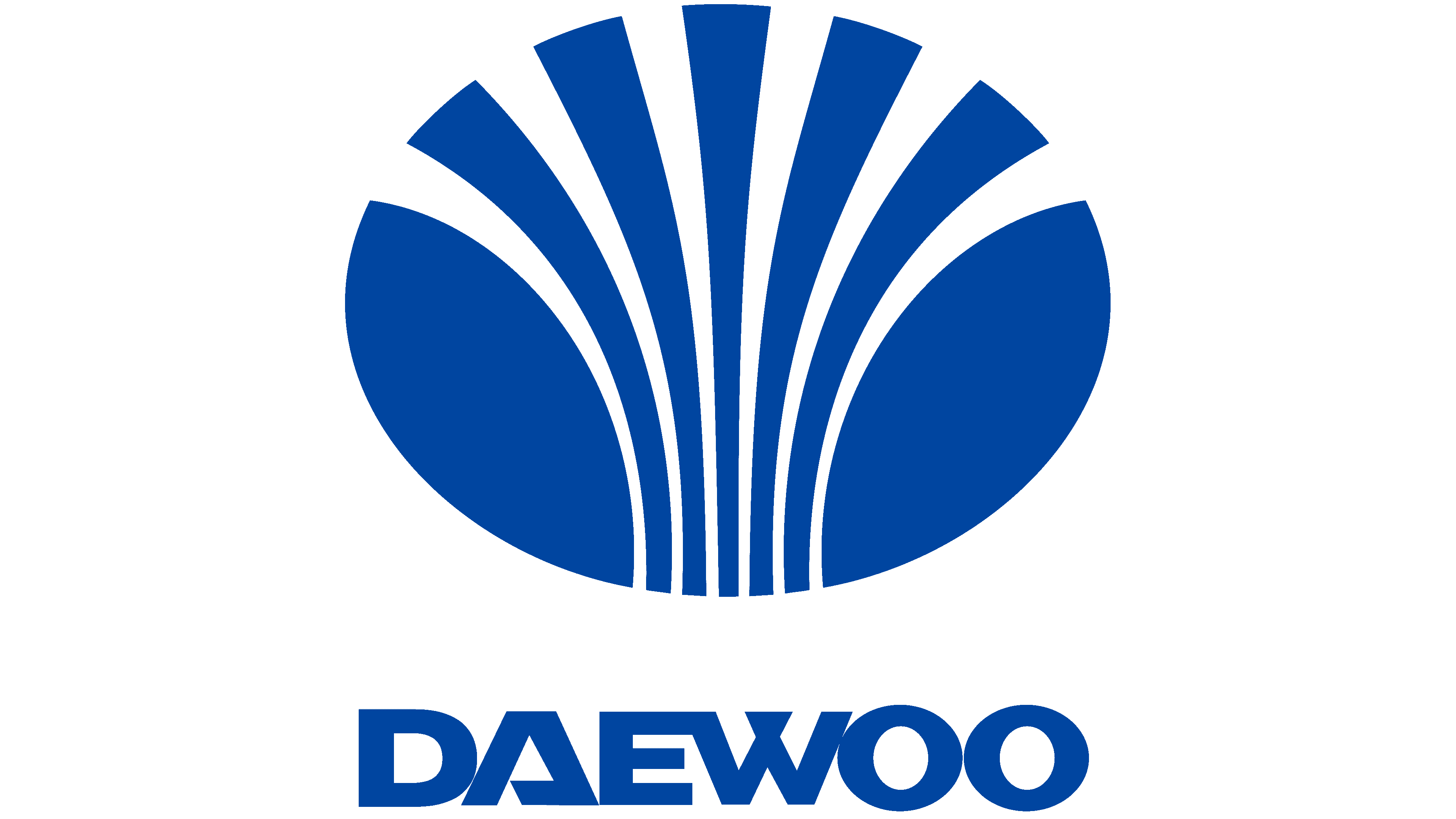
The developers reduced the number of stripes and changed the colors, depicting five blue lines and six white lines. The lateral ovals are enlarged. The inscription now uses a different font: thin and semi-connected, with the original beaten letters “A” (the third cuts off its crossbar) and “W” (its central part is made with a cross).
1994 – 2002
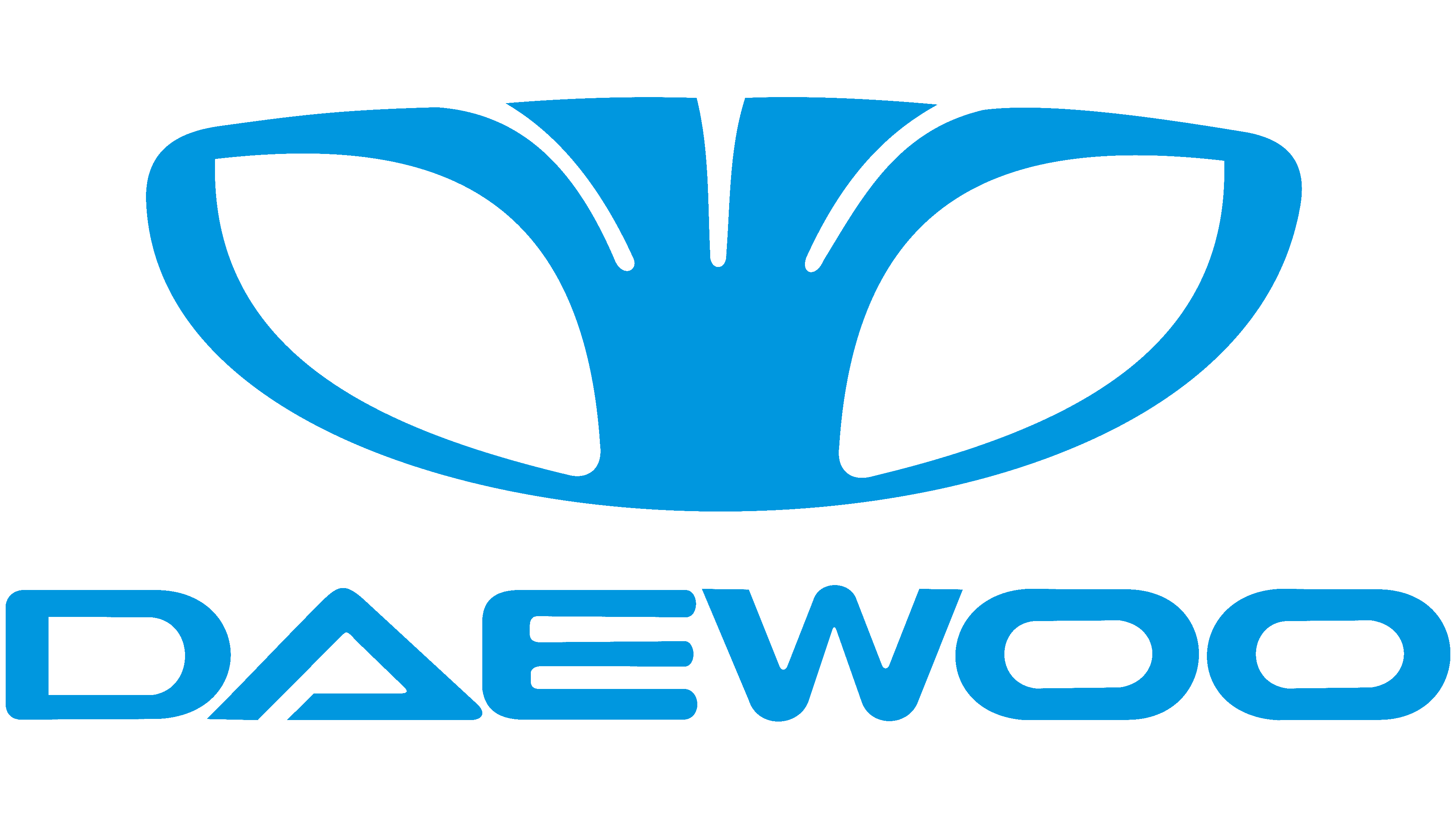
The emblem radically changed shape: it became a flattened oval with two short trapezoidal stripes. On the outside, the figure resembles a butterfly. The logo is blue, like the lettering below.
2002 – 2016
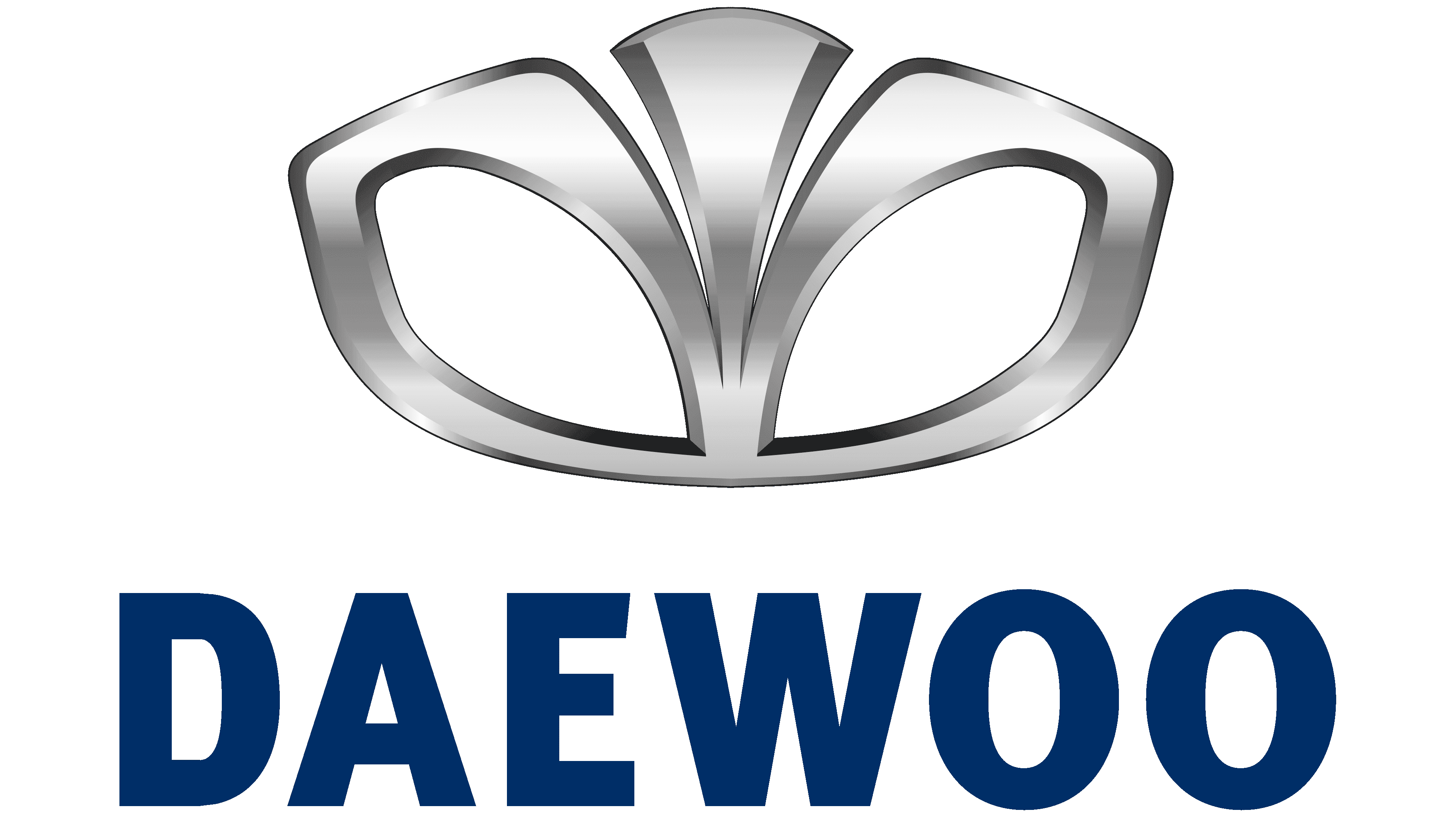
This is the latest version of the logo, which is still in use in some countries. Then, the car brand ceased to exist. This version shares something with the previous sign. The difference between them lies in the decorative style: here, it is three-dimensional and metallic, resembling a carnival mask with slits for the eyes. Below the icon is the company name in grotesque blue letters.
Font and Colors

Daewoo has always had an abstract logo. It was a mirrored structure with identical right and left sides.
Some versions used a rounded typeface with smooth lines. The first and last logos are acutely angled and straight, with even corners. The only thing they had in common was the lack of serifs. The signature palette consisted of black, purple, blue, and gray.
FAQ
What country is Daewoo from?
Daewoo is a well-known South Korean automobile company that began as National Motors. It changed names several times. Daewoo Group, a large South Korean conglomerate, bought and renamed it “Daewoo Motors.”
This South Korean brand produced affordable, reliable cars and became a key player in the global auto industry. It exported cars worldwide. Although General Motors later acquired the company, it remains an important part of South Korea’s industrial and automotive history.
What is the symbol of Daewoo?
The symbol is a stylized seashell. This emblem is significant in Asian philosophy, where the shell represents the beginning and end of everything. By adopting this symbol, the brand intended to convey completeness and continuity, aligning with the belief that all things are cyclical.
Through this symbolic representation, the South Korean brand sought to resonate with local consumers and international markets. The seashell logo testified to the company’s roots in Asian culture and captured a global audience with its universal message of new beginnings and continuous growth.
What does the Daewoo logo mean?
Often mistaken for a flower, the logo is a seashell. This symbol represents new beginnings, growth, and development, reflecting the brand’s focus on constant innovation.
The logo conveys abundance and economic power, reassuring stakeholders and consumers of the brand’s stability and prosperity. It reflects the brand’s promise to protect and support its customers through reliable, trustworthy products. These thoughtful design choices reinforce the brand’s identity, making it meaningful and resonant with consumers worldwide.
What is the logo for Daewoo?
Before becoming GM Korea, the company used a unique logo featuring a stylized shell. Often mistaken for a flower, this emblem has rich symbolism and a modern look.
The logo features a stylized shell symbol with a silver gradient, giving it an elegant, innovative look. The symbol consists of three elements: teardrop-shaped figures on the right and left and a triangular element in the center. These shapes create a balanced design that resembles a flower but represents a mollusk shell. The silver gradient adds depth to the logo, reflecting sophistication, quality, and technological advancement. Below the symbol, the brand name is displayed in bold blue letters, signifying trust, reliability, and professionalism.
What font is used in the Daewoo logo?
The logo uses a bold, low-contrast sans-serif font. This typography reinforces the brand’s personality and values.
The bold style makes the brand name stand out and stay memorable. Low contrast means minimal differences between thick and thin strokes, giving the image a modern and elegant look. The sans-serif style creates a clean, professional appearance suitable for an automotive company focused on innovation and trust. It has unique features such as modified letter spacing and a distinctive cutout in the top horizontal stroke of the “E.” These modifications make it distinctive and easy to recognize. The cutout in the letter “E” and the individual spacing between letters contribute to the logo’s distinctiveness.