


 Deutsche Telekom Logo PNG
The Deutsche Telekom logo is both imposing and simple. Its style suggests that the telecommunications service it represents holds a leading position, owns an extensive network, and covers a vast territory. The emblem’s monolithic nature underscores the company’s central role in connecting people through communication.
Deutsche Telekom traces its roots to Germany’s state telecom monopoly. Deutsche Bundespost ran telephone, postal, and telegraph services for decades. The system gave the country unified national coverage. Still, it also carried the slow pace and technical caution typical of state administration.
In 1989, Bundespost was split into three businesses: Deutsche Bundespost Telekom for telecommunications, Postdienst for postal services, and Postbank for financial services. The telecom unit inherited the national phone network just as German reunification put major pressure on infrastructure modernization in the eastern states.
In 1995, Deutsche Telekom AG became a joint-stock company. In November 1996, it listed its shares on the Frankfurt and New York stock exchanges. Germany promoted the IPO as a Volksaktie, or “people’s share,” bringing many private citizens into the stock market for the first time. In 1999 and 2000, the government sold further stakes, while T-Online grew into a major German internet provider and T-Mobile expanded across Europe.
The key global move came in 2001, when Deutsche Telekom bought VoiceStream Wireless for about $50 billion and turned it into T-Mobile USA. In Europe, it competed with British Telecom and Vodafone. At the same time, in the United States, T-Mobile trailed Verizon, AT&T, and Sprint for years. After John Legere took over in 2012, the “Un-carrier” campaign changed its position. In 2020, T-Mobile USA acquired Sprint for $26 billion, creating a stronger rival to Verizon and AT&T.
Meaning and History
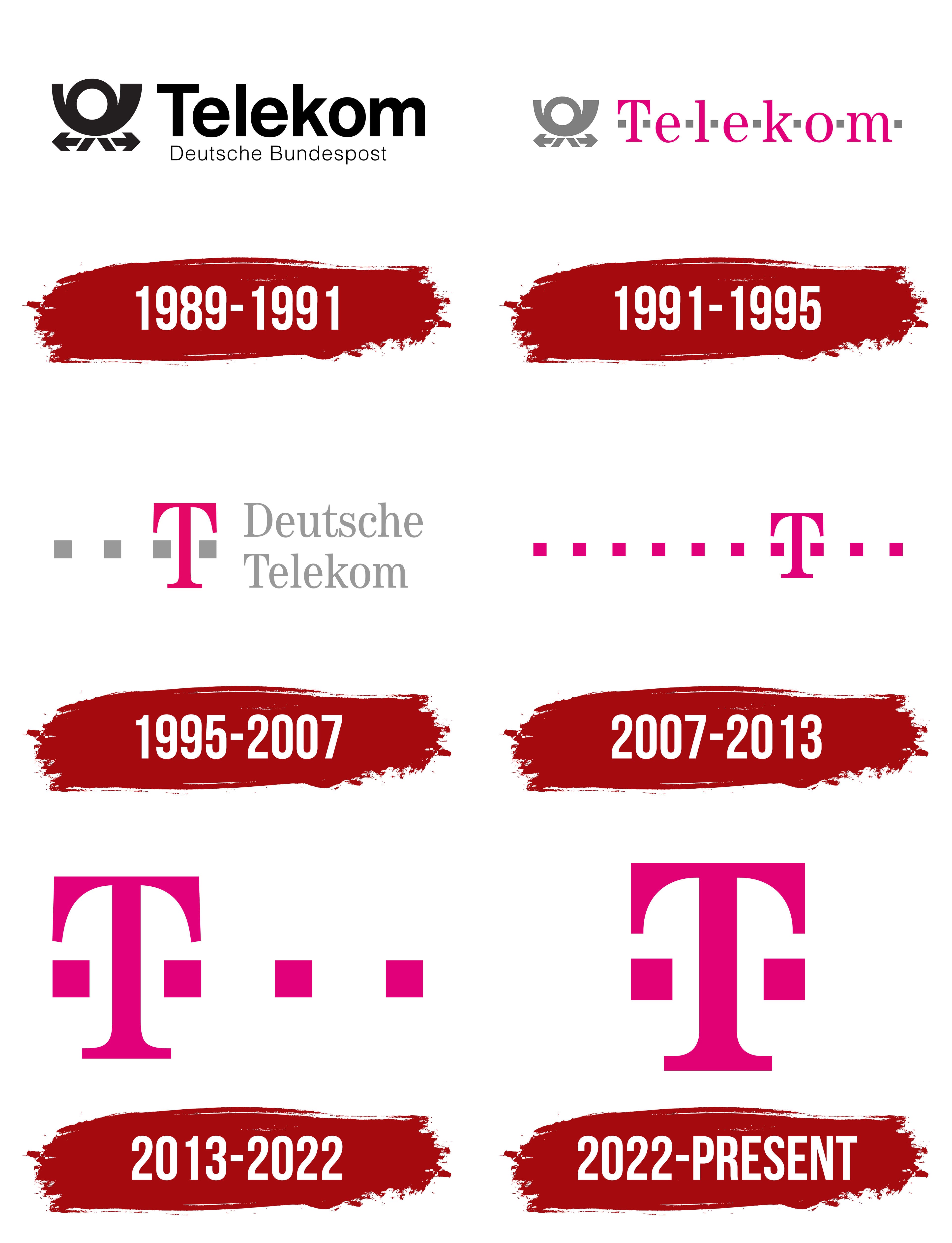
The brand has high visual recognition, which is not surprising given that millions of customers use Deutsche Telekom’s services throughout Germany. Over time, five variants of the logo were presented. Each new redesign made the company logo more modern and confident. However, the main message remained unchanged.
What is Deutsche Telekom?
It is one of the world’s largest telecommunications companies. The company also provides customers with mobile communications services and acts as an Internet service provider.
1989 – 1991
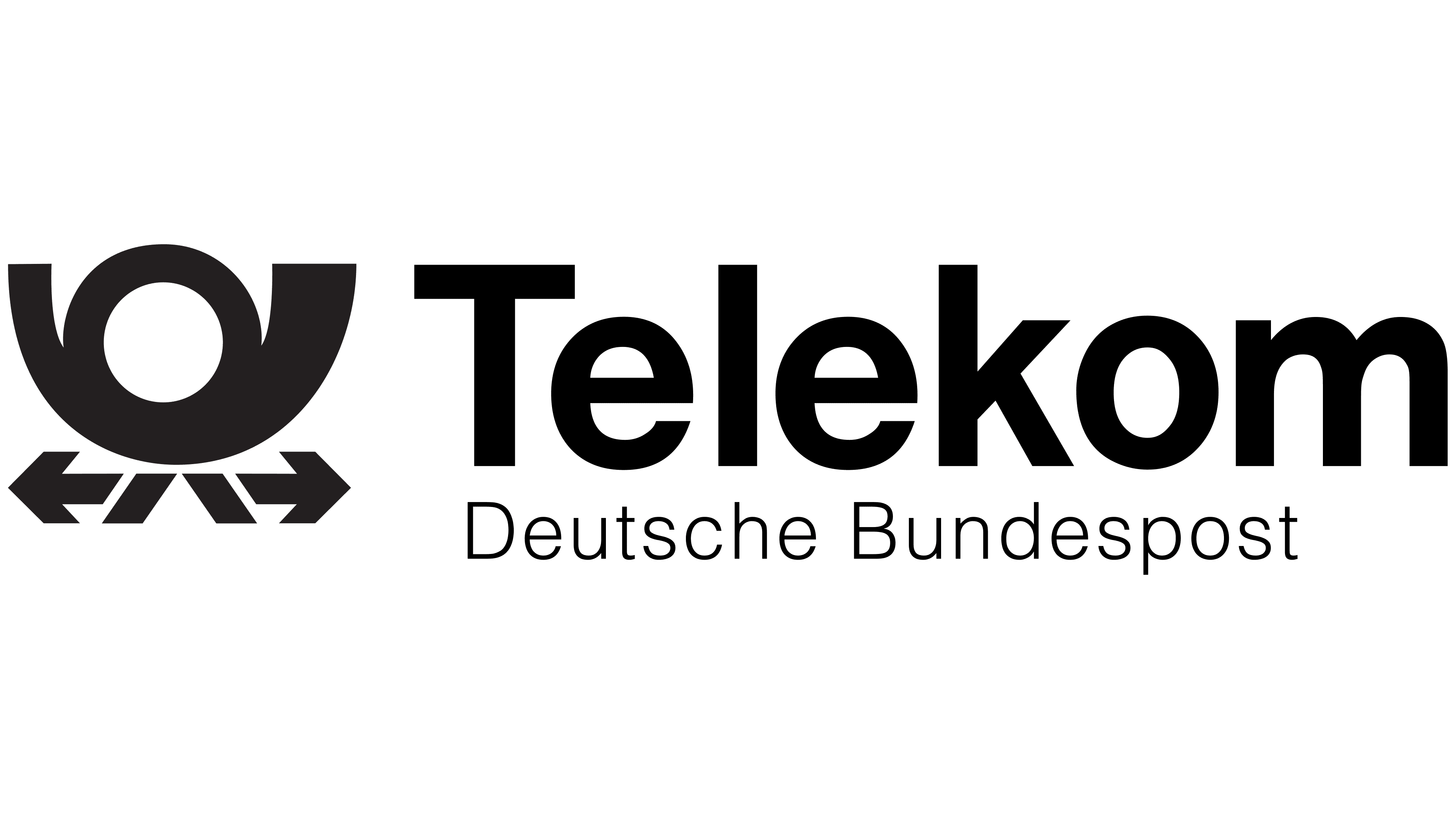
The original logo was presented almost immediately after the holding was created. It was based on a verbal inscription and a left-side emblem. The brand name was written in two lines. At the top was the word “Telekom.” It was set in a classic, simple grotesque sans-serif. All letters, except the initial, were lowercase. The lettering “Deutsche Bundespost” used the same typeface but in a much smaller size. Moreover, the lines were extremely thin, so not all clients immediately noticed the additional inscription.
The emblem was shaped as a stylized horn, with two legs and arrows pointing in different directions at its base. The image could also evoke associations with a snail.
Regarding the color palette, all elements are shown in black on a white background.
1991 – 1995
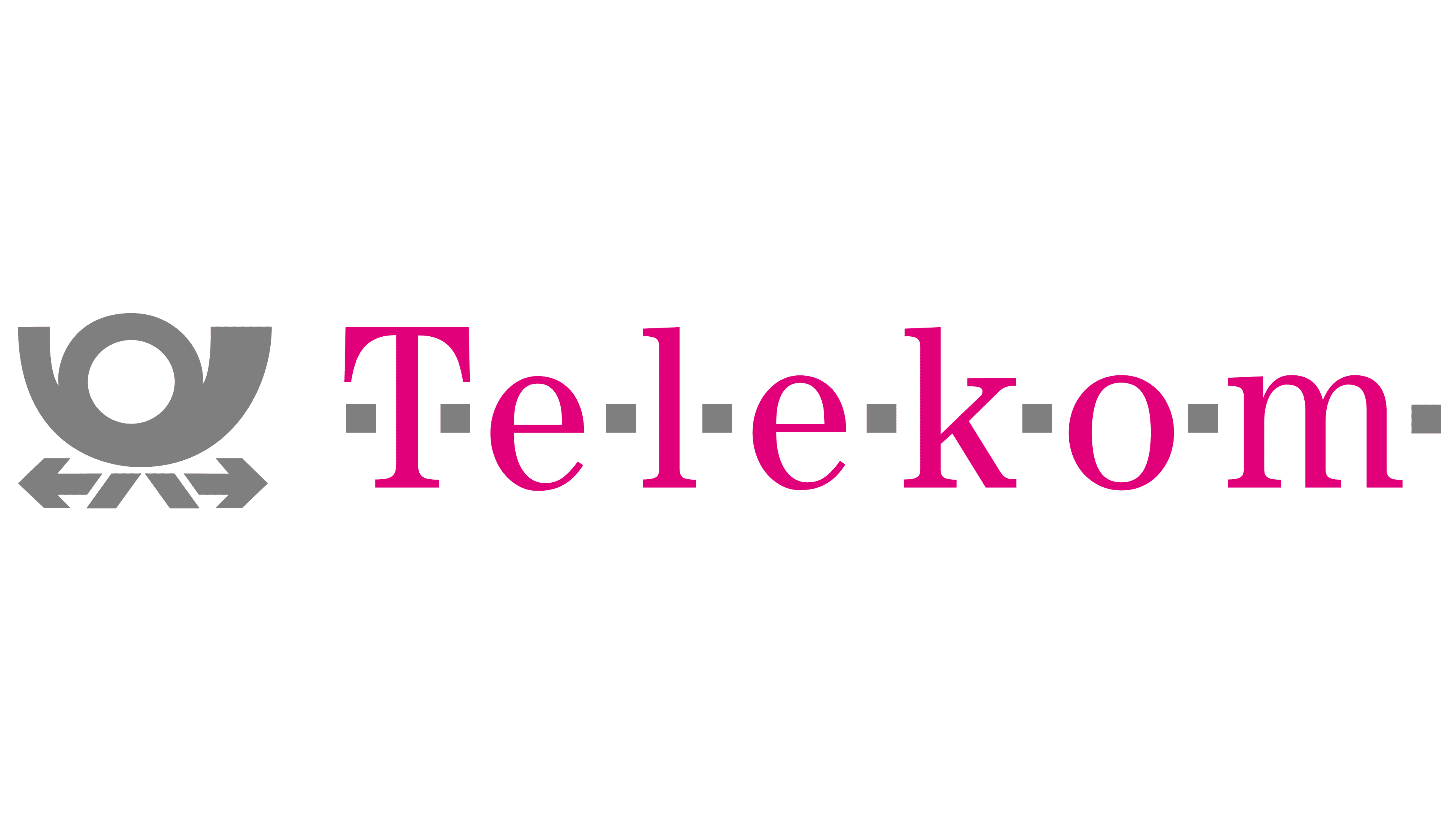
The first redesign mainly changed the lettering. The emblem was also moved to the left, and its color was changed to light gray. The brand name now consisted only of the word “Telekom.” All letters have been repainted pink. As for the font, the serifs add elegance. Gray horizontal lines also appeared on both sides of each letter. Many people associate this innovation with communication.
1995 – 2007
A controversial redesign that made the logo less clear to the target audience. The emblem was completely removed and replaced with a single large pink “T”. It was also surrounded by three gray horizontal lines on the left and one on the right. To the right of the emblem appeared the inscription “Deutsche Telekom.” The font was identical to the previous version.
2007 – 2013
The new redesign greatly simplified the logo. There was only one letter, “T,” and ten pink horizontal lines. Seven are on the left and three on the right. Despite the minimal number of elements, the Deutsche Telekom logo became cumbersome, and not every client understood the association between the lines and communication.
2013 – 2022
The previous version was simplified. It reduced the number of lines. Now there are only four. Three such features appear to the left of the letter “T” and to the right of the letter “T”. At the same time, the letter’s font remained unchanged.
2022 – today
The logo continued to simplify in 2022. Now, only two horizontal purple lines remain: one to the left and one to the right of the big “T.” As a result, the Deutsche Telekom logo looks more natural and harmonious, thanks to the balance on both sides. All elements are bright pink, which only adds to the image’s attractiveness.
Font and Colors

In the first versions of the logo, the emphasis was on the emblem, whereas in subsequent versions it shifted to the mysterious horizontal lines. As a result, little attention was paid to the inscriptions themselves. Overall, this is a classic bold serif font(in the first version, without serifs). The inscription looks modern, but it does not play a special role.
If a black-and-white color palette was chosen for the first version of the logo, after the first redesign, Deutsche Telekom preferred gray, white, and pink. This unusual contrast increases interest in the company’s activities. Bright pink and gloomy gray are unusual solutions for the telecommunications market.