


 DISH Network Logo PNG
The DISH Network logo is a satellite dish prototype. The emblem is arranged according to the associative principle. Indicates association, communication, signal transmission, and long-distance broadcasting via satellites.
Charlie Ergen came to the media from an unusual path. He studied accounting at the University of Tennessee, earned an MBA at Wake Forest, and built early capital by playing blackjack in Las Vegas. In 1980, Ergen founded EchoStar with Candy Ergen and Jim DeFranco. The company began with C-band satellite dishes, which the founders sold and installed across rural Colorado. By the mid-1980s, EchoStar had grown into a satellite equipment distributor. In 1987, Ergen applied to the FCC for a direct-broadcast satellite license. In 1992, EchoStar received the orbital slot at 119° west.
EchoStar I launched on December 28, 1995. On March 4, 1996, the company introduced DISH Network as a home satellite TV brand. DISH entered the market against DirecTV, owned by Hughes Electronics, with equipment priced around $199, including installation. By 1997, it had reached 1 million subscribers. In 1997, talks with Rupert Murdoch’s News Corp collapsed, followed by EchoStar’s $5 billion lawsuit and a later settlement.
In 1999, DISH became the first satellite provider to offer a DVR receiver. By 2008, it served more than 13 million households. On January 2, 2008, DISH Network Corporation spun off from EchoStar Corporation, while Ergen retained voting control of both companies. DISH bought Blockbuster in 2011 for $322 million, but the attempt to use it against Netflix failed.
In 2015, Sling TV launched as the first major U.S. live internet TV service without a satellite dish. In 2020, DISH acquired Boost Mobile from Sprint as part of the Sprint-T-Mobile merger. On December 31, 2023, DISH Network merged back into EchoStar Corporation through an all-stock deal.
Meaning and History
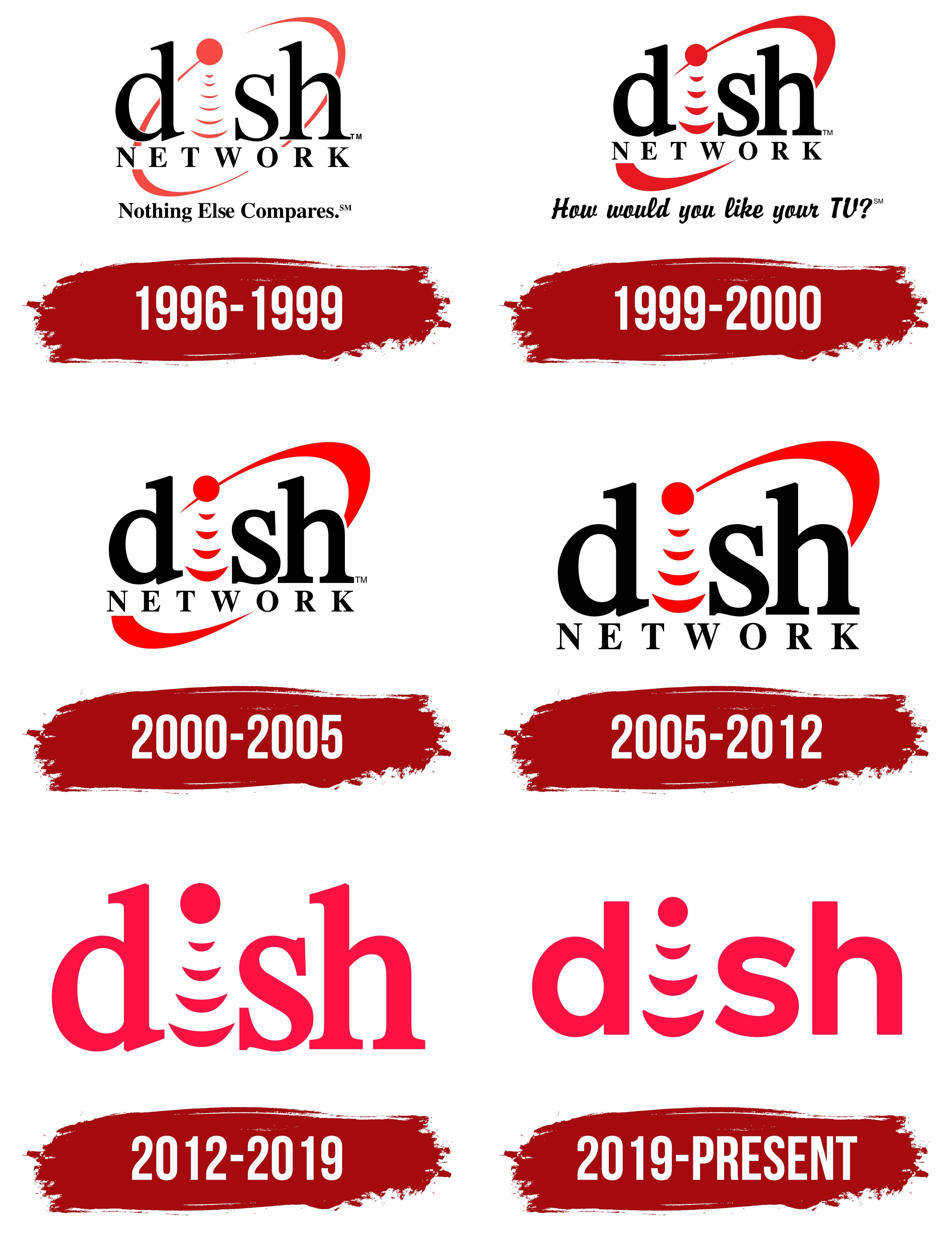
The company’s name is derived from the phrase “Digital Sky Highway”. Although DISH is an abbreviation, the logo spells it in lowercase. It has always been this way: in 1996, when EchoStar launched a satellite broadcasting service, designers created the first lowercase wordmark. Perhaps they needed an “i” with a dot to stylize it as a communications satellite transmitting a signal to Earth. The basic concept did not change until 2012. Then the company experimented by updating the color scheme and removing some elements. And in 2019, it went even further, choosing a new sans-serif font that has nothing to do with the usual serif.
What is DISH Network?
DISH Network is an American corporation providing satellite television and mobile communication services. Its history dates back to 1980, when the television equipment distributor Original EchoStar was created. The consumer brand DISH Network was introduced in 1996. In 2007, the company restructured, and the name began to be used not for a separate service but for the entire company.
1996 – 1999
The logo representing EchoStar Corporation’s satellite television service used “dish” in lowercase. The second letter consisted of six arched lines, arranged from bottom to top in descending order, and a large red circle symbolized the satellite. Behind the word was a ring – the orbit of the spacecraft’s rotation.
The second part of the brand name (“NETWORK”) was written in capital letters on the next line. Even below was the motto “Nothing Else Compares,” with a dot at the end. For it, the designers used the same black serif font as for the rest of the text. And all the graphic elements, including the satellite with its signals and orbital arc, were dark red.
1999 – 2000
With a slight redesign of the logo, the word “dish” has become more compact. Perhaps this effect came from narrowing the red ring in the background. The circle’s diameter, which marked the dot above the stylized letter “I,” also decreased, and the number of arched lines below it was reduced to four. The old motto was replaced by the phrase “How would you like your TV?” The designers made it handwritten, choosing a font with a slight slant and interconnected letters.
2000 – 2005
As the new millennium began, the telecommunications company simplified its emblem again. She removed the motto to emphasize her name, and the design has remained practically unchanged.
2005 – 2012
Another “cosmetic” update of the DISH Network logo took place in 2005. On August 16, a version of the badge was presented without the lower half of the red ring and with a shortened upper arc that no longer extended beyond the circle. The changes came as part of a rebranding under the inspiring slogan “Better TV for All.”
A little later, a variant appeared without the word “NETWORK.” And in 2010, an emblem with shiny purple-pink arcs came into use. The glossy effect was created by using a gradient and white spots.
2012 – 2019

In 2012, the company redesigned its logo to celebrate the launch of a new product called Hopper. The improved identity system was presented at a promotional event. After the redesign, it became less technological: the upper half of the orbital arc disappeared, and the word “NETWORK” disappeared. The remaining inscription with the stylized communications satellite was repainted red. The old bold serif type has survived.
2019 – today

The first major font change happened in 2019. The developers removed the serifs and rounded the in-letter space in “d,” giving the corporation name a completely new look. The number of arcuate lines replacing the bottom “i” was reduced to three.
There is also a variant with the slogan “Tuned In To You.” This phrase is at the bottom. It is written in white letters, along with “dish,” and placed inside a red circle.
Font and Colors
The DISH Network logo represents the satellite broadcast service and related products of the telecommunications company. The main graphic symbol looks like a circle with three arcs at the bottom. This is the classic symbol for the satellite and its signals, used since 1996 instead of the “i” in the word “dish.” As the emblem evolved, only three arcs disappeared (there were originally six), and the ring denotes the satellite’s orbit.

In past versions of the logo, the lettering closely resembled Times Bold. Still, in 2019, DISH Network broke tradition and ditched it for a bold geometric sans serif, reminiscent of Mostardesign’s Interval Sans Pro SemiBold. It also duplicates the Sling logo typeface. In this case, the wordmark’s main color is red, although earlier it was used only for graphic elements.